


How Much "Greencoin Solar" Can Your Rooftop Really Mine? Understanding Solar ROI
Let's be honest. When you hear the term "greencoin solar," you might think of a trendy cryptocurrency or a complex rewards scheme. But for homeowners and business leaders across the US and Europe, the most valuable "green coin" isn't digital—it's the real, tangible savings and return on investment (ROI) generated by a well-designed solar energy system. It's the money you don't send to the utility company, the protection you gain from volatile energy markets, and the contribution you make to a sustainable grid. So, the pressing question isn't about a fictional currency, but a practical one: How much value can solar power actually generate for you?
The Real Currency: Energy Savings & ROI
Forget speculative assets. The "greencoin" we're talking about is measured in kilowatt-hours (kWh), percentage returns, and years to payback. The fundamental equation is simple: a solar photovoltaic (PV) system converts sunlight into electricity, directly offsetting what you need to purchase from the grid. The value of each "coin" (or kWh) you generate is equivalent to your local electricity rate. With rates consistently rising—U.S. electricity saw an average 4.3% increase in 2023—the value of your self-generated power only grows over time.

Image Source: Unsplash - Representative image of a residential solar installation.
A typical residential solar system in sun-rich regions like Southern Europe or the American Southwest can cover 70-100% of a home's annual electricity needs. For a commercial operation, even a 40-60% offset can translate to tens of thousands in annual operational savings. The ROI is calculated by weighing the total system cost (after incentives) against the lifetime energy savings and increased property value.
Key Factors Influencing Your Solar Savings
Calculating your personal "greencoin" yield depends on several variables. Think of these as the mining parameters for your setup:
- Geographic Location & Solar Resource: Peak sun hours vary greatly. Arizona will naturally generate more than Northern Germany, but modern high-efficiency panels make solar viable across most latitudes.
- System Size & Design: This is based on your historical energy consumption and available roof or ground space. Oversizing can be beneficial if you plan to add an electric vehicle or a battery.
- Local Electricity Rates: The higher your current cost per kWh, the faster your payback period. This makes solar particularly compelling in high-cost regions like California, Germany, or the UK.
- Government Incentives & Net Metering: Policies are crucial. The US Investment Tax Credit (ITC), various European Union grants, and feed-in tariffs dramatically reduce net capital outlay.
- Technology Choice: Not all panels and inverters are created equal. Higher-efficiency components may have a higher upfront cost but produce more energy over a longer lifespan, boosting long-term yield.
Case Study: Real Numbers from a California Business
Let's move from theory to practice. A medium-sized warehouse distribution center in Fresno, California, was facing an average monthly electricity bill of $8,500, with rates projected to rise 5% annually. Their goal was to lock in energy costs and improve sustainability metrics.
The Solution & The "Greencoin" Yield:
- They installed a 500 kW rooftop solar PV system.
- The total project cost was $1.2 million.
- Utilizing the 30% federal ITC and a state-level rebate, the net investment fell to approximately $780,000.
The system generates an estimated 820,000 kWh annually. At their blended electricity rate of $0.18/kWh (and rising), this translates to annual savings of $147,600 in Year 1. The simple payback period is just over 5 years. Over the system's 25-year warranty period, assuming modest rate inflation, the cumulative savings are projected to exceed $4.5 million. That's a powerful stream of "greencoins" directly impacting their bottom line.
Beyond Savings: Energy Resilience & Sustainability
While financial ROI is the primary driver, the modern energy landscape adds two critical layers of value that systems like those from Highjoule are designed to capture:
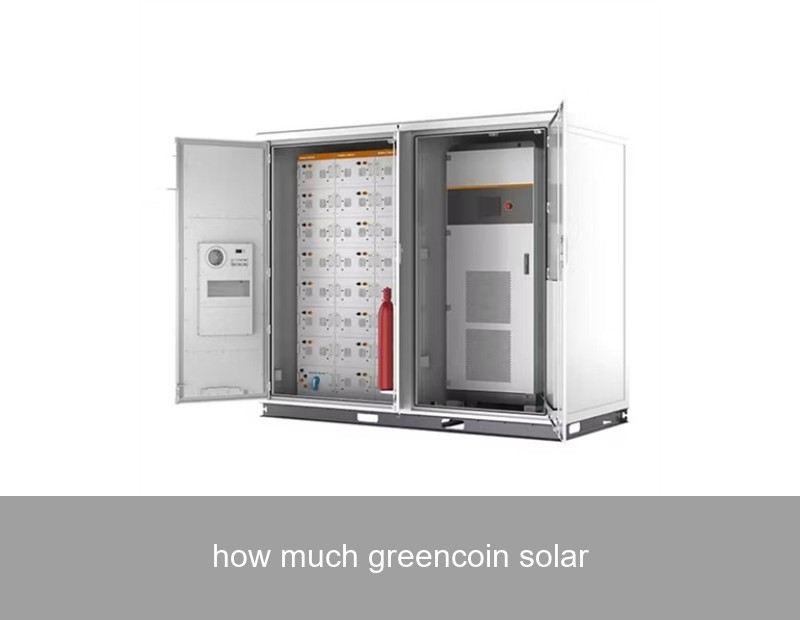
- Energy Resilience: A solar-only system shuts off during a grid outage for safety reasons. This is where battery energy storage systems (BESS) transform your setup. They store excess solar energy for use at night or during outages, turning your property into a personal microgrid. For businesses, this means avoiding downtime; for homeowners, it means security and comfort.
- Sustainability & ESG Goals: Each MWh of solar energy avoids approximately 0.5 - 0.8 metric tons of CO2, depending on the local grid mix. This is a direct, reportable contribution to corporate Environmental, Social, and Governance (ESG) targets and personal carbon reduction goals.

Image Source: Unsplash - Representative image of a battery energy storage system installation.
Highjoule: Your Partner in Maximizing Solar Value
This is where the conversation evolves from simply buying panels to investing in an intelligent, holistic energy system. At Highjoule, we understand that maximizing your "greencoin solar" yield isn't just about the PV modules; it's about integrating generation, storage, and smart management into a seamless solution.
Our approach focuses on long-term value optimization. For commercial and industrial clients, our H-IQ Energy Platform uses AI-driven analytics to not only manage your solar + storage assets but also to participate in grid services like demand response, unlocking additional revenue streams. For residential and microgrid applications, our Home Energy System integrates high-efficiency solar with our modular Paragon™ BESS, allowing users to maximize self-consumption, protect against outages, and dynamically adapt to time-of-use rates.
Our systems are designed with longevity and safety at their core, ensuring that the "coins" you mine today continue to flow reliably for decades. We provide end-to-end support, from initial feasibility analysis and financial modeling to installation, commissioning, and ongoing performance monitoring.
| Component | Feature | Impact on Your "Greencoin" Yield |
|---|---|---|
| High-Efficiency Solar Panels | Superior performance in varied light, longer degradation warranty | More kWh generated per square meter over system lifetime. |
| Paragon™ Battery Storage | Scalable, lithium-iron-phosphate (LFP) chemistry, smart cycling | Enables >80% self-consumption, provides backup power, allows for rate arbitrage. |
| H-IQ Energy Software | AI-based energy forecasting & grid service integration | Automatically optimizes for cost or carbon, can generate grid service revenue (C&I). |
Making the Investment: Next Steps
So, how much "greencoin solar" is your property capable of generating? The only way to get a precise, reliable figure is through a professional assessment. This analysis will model your site's solar potential, calculate system costs and incentives, and project your 25-year cash flow and savings.
The energy transition is accelerating, and incentives are at their peak. The most valuable "greencoin" might just be the one you don't earn because you waited. What specific energy challenge—whether it's a volatile monthly bill, a sustainability target, or a need for resilience—could a tailored solar-plus-storage solution solve for you today?
 Inquiry
 Online Chat