


How Much GSOL Enterprise Energy Storage Do You Really Need? A Strategic Guide
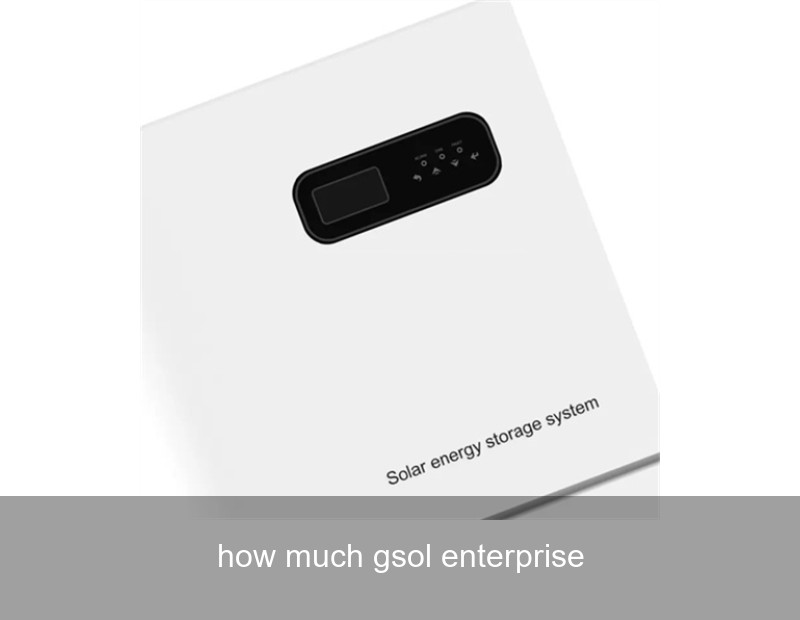
If you're managing energy for a factory, a commercial complex, or a microgrid, you've likely heard the term "GSOL" buzzing around. But when it comes to enterprise-scale solutions, the most pressing question isn't just "what is it?" but rather, how much GSOL enterprise capacity is required to truly future-proof your operations and achieve meaningful financial and sustainability goals? This isn't a one-size-fits-all answer. Determining the optimal scale is a strategic calculation, blending your load profile, economic objectives, and resilience requirements. Let's demystify the process.
At its core, GSOL—or Grid-Scale Optimized Lithium—refers to a class of advanced battery energy storage systems (BESS) designed for heavy-duty, commercial and industrial (C&I) applications. Unlike smaller residential units, an enterprise GSOL system is engineered for high-throughput cycling, sophisticated energy management, and seamless integration with existing infrastructure. The "how much" question is pivotal because undersizing leaves value on the table, while oversizing erodes your return on investment. It's about finding your unique energy sweet spot.
Key Factors Determining How Much GSOL Your Enterprise Needs
Think of sizing your energy storage like planning a logistics fleet. You need the right capacity and power to meet daily routes, handle peak season surges, and ensure backup for critical paths. Here’s the framework we use at Highjoule when consulting with enterprises.
1. Analyzing Your Energy Consumption Profile
The foundation is your load data. We examine 12-24 months of utility bills and interval data to identify:
- Peak Demand Charges: Often, 15-30% of a C&I electricity bill comes from short periods of peak power draw. A GSOL system can "peak shave," delivering power during those times to slash these charges.
- Load Shape & Consistency: Do you operate 24/7, or have pronounced day/night shifts? This determines daily cycling needs.
- Critical Loads: Which operations must never lose power? This defines your resilience requirement.
2. Defining Your Primary Use Cases (The Value Stack)
Your "why" dictates the "how much." Prioritizing use cases is essential:
| Use Case | Impact on Sizing | Typical Goal |
|---|---|---|
| Demand Charge Reduction | High power (kW) output for 1-4 hours. Often dictates the inverter/transformer size. | Cut peak demand by 20-40%. |
| Energy Arbitrage (Time-of-Use) | Longer discharge duration (2-6+ hours). Dictates energy capacity (kWh). | Buy/store cheap energy, use during expensive periods. |
| Backup Power & Resilience | Capacity sized to critical load profile over desired backup duration (e.g., 2-8 hours). | Ensure operational continuity during outages. |
| Renewable Integration (Solar/Wind) | Must match renewable generation curve to store excess and smooth delivery. | Maximize self-consumption of on-site renewables. |
3. Financial and Regulatory Drivers
Local incentives, like the U.S. Investment Tax Credit (ITC) for standalone storage or grid service programs (e.g., frequency response in the UK), can significantly improve project economics. The optimal GSOL enterprise size often aligns with the requirements to maximize these revenue streams or incentives. A detailed pro-forma financial model is non-negotiable.

Image Source: Unsplash - Sizing an enterprise system requires precise engineering analysis.
The Highjoule Difference: Engineering Your Enterprise Energy Blueprint
At Highjoule, we don't just sell batteries; we deliver strategic energy assets. Our approach to answering "how much GSOL enterprise storage" you need is rooted in a comprehensive Energy Blueprint Process. We start with our intelligent Highjoule HORIZON Platform, a simulation and monitoring suite that models your facility's energy flows against weather data, utility rates, and market signals. This isn't guesswork; it's predictive analytics.
Our flagship product for C&I applications, the Highjoule INTEGRA Series, is designed for this precise scalability. Built with GSOL chemistry, it offers:
- Modular Design: Start with a 250 kWh base unit and scale seamlessly to multi-megawatt-hour installations. This allows us to right-size your system and plan for cost-effective future expansion.
- Advanced Thermal Management: Ensures consistent performance and longevity, critical for enterprises that depend on daily, high-throughput cycling.
- Grid-Interactive Capabilities: Ready to participate in grid services where available, turning your storage system from a cost-saver into a potential revenue generator.
Our team of experts uses the Blueprint to balance your technical requirements with financial KPIs, presenting you with clear scenarios. For instance, we might show that a 750 kWh / 375 kW system maximizes your ROI in Year 4, while a 1.2 MWh system unlocks additional grid revenue in Year 6. The choice becomes a strategic business decision, not a technical mystery.
From Theory to Reality: A European Logistics Case Study
Let's ground this in a real-world example. Highjoule partnered with a major logistics hub in Rotterdam, Netherlands. The facility operated 24/5 with high refrigeration loads, leading to steep peak demand charges and concerns about grid reliability during winter peaks.
The Challenge: Reduce operational costs, integrate a planned rooftop solar array, and provide backup for critical cold storage.
Highjoule's Analysis: Our HORIZON Platform analyzed a year of load data, local DSO tariffs, and the solar generation profile. The simulation revealed that a system sized primarily for solar time-shift wouldn't adequately address peak charges, while a system sized only for peak shaving would underutilize the solar investment.
The Solution: A hybrid-sizing strategy. We deployed a 1.8 MWh Highjoule INTEGRA Series system configured for:
- Peak Shaving: Discharging during two predictable daily peaks.
- Solar Optimization: Storing midday solar excess for evening use.
- Contingency Backup: 4 hours of runtime for critical refrigeration units.
The Results (18 Months Post-Installation):
- 28% reduction in monthly demand charges.
- Increase in solar self-consumption from 55% to over 90%.
- Projected full ROI in 5.2 years, enhanced by the Dutch SDE++ subsidy for which the system qualified.
- The facility manager now has real-time visibility and control via the Highjoule HORIZON dashboard.
This case illustrates that the answer to "how much GSOL enterprise" is multidimensional. It was not the largest possible system, but the most intelligently configured one for their specific value stack. You can read more about European grid challenges from the European Network of Transmission System Operators (ENTSO-E).

Image Source: Unsplash - A Highjoule INTEGRA Series installation at a commercial facility.
Your Energy Independence Journey Starts Here
The journey to determining your ideal GSOL enterprise scale begins with a conversation and data. It's about moving from a reactive stance on energy costs to a proactive strategy for energy management. What single energy metric—be it peak demand, outage vulnerability, or renewable curtailment—keeps you up at night? How would transforming that metric impact your bottom line and sustainability report?
At Highjoule, we believe in empowering enterprises with clarity and choice. We invite you to start with our complimentary Energy Blueprint Assessment. Share your latest utility bill and a key operational goal, and our experts will provide a preliminary analysis of your potential savings and ideal system scale. Are you ready to define what "how much" means for your enterprise's future?
 Inquiry
 Online Chat