


How Much Does an HV Battery Unit Cost? A Clear Breakdown for Your Energy Project
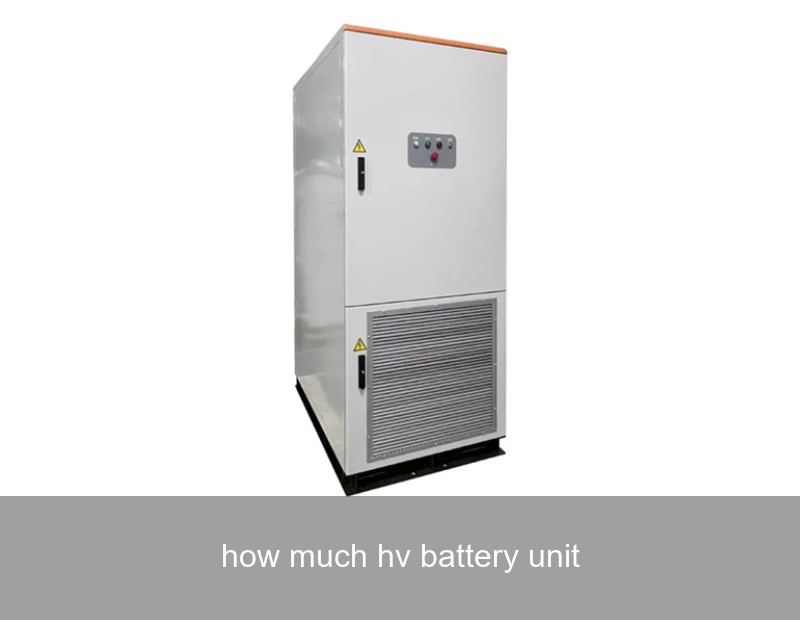
If you're exploring energy storage for your business, industrial facility, or community project, one of the first questions you likely have is: how much does an HV battery unit cost? It's a smart starting point, but the answer isn't as simple as a single price tag. Think of it like asking "how much does a house cost?"—the range is vast, depending on size, location, materials, and features. In the world of High Voltage (HV) battery energy storage systems (BESS), the final investment is shaped by capacity, technology, installation complexity, and the intelligent software that brings it to life. As a leader in advanced energy storage since 2005, Highjoule is here to demystify the costs and help you understand the true value proposition of a robust HV battery system.
What is an HV Battery Unit?
Let's clarify the term first. An HV (High Voltage) battery unit typically refers to a large-scale, containerized battery energy storage system designed for commercial, industrial (C&I), or utility-scale applications. Unlike residential battery systems that operate at lower voltages, HV systems are engineered to connect directly to medium-voltage grids or large-scale solar/wind farms, offering higher efficiency and power in a more compact footprint. These systems are the workhorses of the energy transition, enabling renewable integration, grid stabilization, and significant cost savings through peak shaving and backup power.
Key Factors Determining HV Battery Cost
The total installed cost of an HV battery unit is a composite of several critical components. Understanding these will help you make an apples-to-apples comparison between quotes.
- System Capacity & Power (kWh & kW): This is the most significant cost driver. Are you looking for a 500 kWh system for a factory's peak shaving or a 10 MWh+ system for a solar farm? Costs are often discussed in $/kWh for energy capacity and $/kW for power capacity.
- Battery Chemistry: Lithium-ion phosphate (LFP) is now the dominant chemistry for stationary storage due to its longer lifespan, superior safety profile, and declining costs. Other chemistries may have different upfront and long-term cost implications.
- Balance of System (BOS): This includes the power conversion system (PCS/inverters), thermal management, fire suppression, enclosures, and electrical components. A high-quality BOS ensures safety, efficiency, and longevity.
- Software & Intelligence: The "brain" of the system. Advanced energy management software (EMS) that can optimize for energy arbitrage, demand charge reduction, and grid services is crucial for maximizing return on investment (ROI).
- Installation & Integration: Site preparation, civil works, electrical interconnection, and commissioning. Complexity increases with grid connection requirements and local permitting regulations, which vary significantly across the US and Europe.
Breaking Down the Costs: A Closer Look
To give you a clearer picture, let's examine a typical cost structure for a mid-range commercial/industrial HV BESS project. The figures below are illustrative ranges based on current market trends in 2024 and can fluctuate based on the factors listed above.
| Cost Component | Description | Approximate Share of Total Cost |
|---|---|---|
| Battery Pack (Cells & Modules) | The core lithium-ion (LFP) cells and their assembly into modules. | 50-60% |
| Balance of Plant & Power Conversion | Inverters, transformers, HVAC, safety systems, and enclosure. | 20-30% |
| Software, Controls & Integration | Energy Management System (EMS), SCADA, and grid interconnection controls. | 5-10% |
| Installation & Commissioning | Civil works, electrical labor, grid fees, and system commissioning. | 10-20% |
According to analysis from the National Renewable Energy Laboratory (NREL), the average installed cost for utility-scale battery storage in the U.S. has been on a steady decline, falling significantly over the past decade. However, for a specific C&I project, you might be looking at a total installed cost ranging from $400 to $800 per kWh, with the final figure heavily dependent on system size and configuration. A smaller, complex installation will trend toward the higher end, while a streamlined, multi-megawatt project benefits from economies of scale.
Real-World Case Study: California Microgrid
Let's move from theory to practice. A compelling example comes from a manufacturing plant in California, facing high demand charges and frequent grid reliability warnings. Their goal was to reduce operational costs and ensure production continuity.
- Project: Integration of a 2 MWh / 1 MW HV battery unit with an existing 1.5 MW rooftop solar array.
- Solution: The plant deployed a containerized HV BESS, featuring LFP chemistry and advanced predictive EMS. The system was configured for solar self-consumption optimization and peak load shifting.
- Results: Within the first year of operation:
- Avoided 35% in monthly demand charges.
- Increased on-site renewable consumption by over 50%.
- Achieved an estimated payback period of under 6 years, factoring in California's SGIP incentive.

Image: A containerized HV battery unit at an industrial facility. (Source: Unsplash, representative image)
This case highlights that the question isn't just "how much does the HV battery unit cost?" but "what is the net cost after savings and revenue?" The right system pays for itself over time.
Beyond the Price Tag: Total Value of Ownership
Focusing solely on upfront capital expenditure (CapEx) can be misleading. The smarter approach is to evaluate the Total Cost of Ownership (TCO) and the long-term value stream. A slightly higher initial investment in a superior system can yield a much higher ROI through:
- Longer Lifespan & Warranty: A system rated for 6,000 cycles will outlast and outperform one rated for 4,000 cycles, delivering more value over its lifetime.
- Higher Round-Trip Efficiency: More of the energy you put in is available for use. A 95% efficient system vs. an 88% system means significantly less wasted energy over 10+ years.
- Advanced Software Capabilities: Can your system dynamically respond to real-time grid signals or wholesale market prices? This flexibility can unlock additional revenue, especially in markets like the UK or Texas's ERCOT. The International Energy Agency (IEA) emphasizes software as a key enabler for storage value.
Highjoule: Your Partner in Advanced Energy Storage
This is where Highjoule's nearly two decades of expertise becomes your strategic advantage. We don't just sell HV battery units; we deliver integrated, intelligent power solutions tailored to your specific economic and operational goals.
Our flagship product line, the H-Series HV BESS, is engineered for durability and intelligence. Built with top-tier LFP cells, our systems come with a robust 10-year performance warranty. What truly sets them apart is the JouleMind AI™ energy management platform. This proprietary software doesn't just monitor—it learns your load patterns, predicts weather and market conditions, and autonomously optimizes dispatch to maximize your financial return, whether your primary goal is demand charge reduction, renewable firming, or participation in grid service programs.
For a dairy cooperative in the Netherlands, Highjoule deployed a 1.2 MWh system that not only manages their volatile load from cooling facilities but also aggregates their flexibility to participate in the Dutch tertiary reserve market, creating a new revenue stream. This dual-use case was only possible through seamless hardware-software integration.

Image: Advanced monitoring and control are key to unlocking an HV battery's full value. (Source: Unsplash, representative image)
From initial consultancy and feasibility studies to system design, installation, and lifelong performance monitoring, Highjoule provides a single point of accountability. We navigate the complex regulatory landscapes in Europe and North America, ensuring your project is compliant, safe, and optimized for available incentives.
So, as you ponder how much an HV battery unit might cost for your specific application, we invite you to shift the conversation. What specific energy challenges are you aiming to solve—is it skyrocketing demand charges, the need for backup power, or a goal to achieve 100% renewable energy? Share your primary objective, and let's explore what the true value of a Highjoule solution could be for you.
 Inquiry
 Online Chat