


How Much Do Solar Panels Cost? A Clear Guide to Investing in Your Energy Future
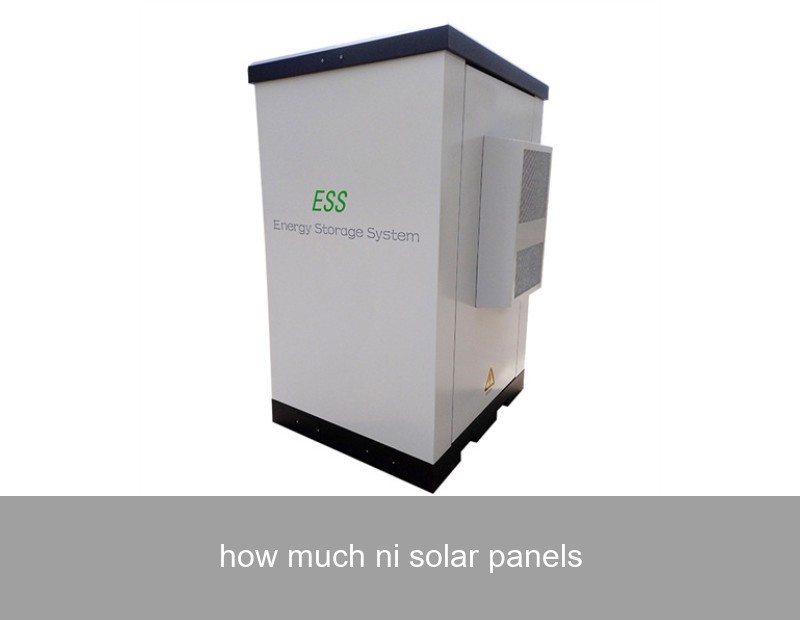
Table of Contents
- The Price Puzzle: More Than Just a Sticker Shock
- Breaking Down the Costs: Hardware, Labor, and The Hidden Factors
- A Real-World Case: The German Mittelstand Factory
- Maximizing Value: The Critical Role of Smart Energy Storage
- The Highjoule Solution: Intelligent Storage for a Smarter Investment
- Your Next Step: From Cost to Investment
If you've found yourself asking "how much do solar panels cost?", you're already on the right path. It's the essential first question for any homeowner or business leader considering renewable energy. But here's the reality we see at Highjoule: focusing solely on the upfront price of the panels is like buying a car based only on the tire cost. The true value—and the true cost—of solar energy lies in the complete system and its ability to deliver reliable, affordable power for decades. Let's unpack the real investment together.
The Price Puzzle: More Than Just a Sticker Shock
The initial quote for solar panels can vary wildly. In the U.S., the average residential system cost before incentives ranges from $15,000 to $25,000, while in Europe, figures might sit between €10,000 and €20,000 for a comparable setup. This variation isn't random. It's driven by a matrix of factors: the efficiency and brand of the panels (monocrystalline vs. polycrystalline), your roof's complexity, local labor rates, and the all-important balance-of-system components—especially the inverter and, increasingly, the battery storage system.
Think of it this way: the panels capture the sun, but what happens to that energy determines your savings. Without a way to use or store excess power, you're leaving potential and money on the table. This is where the conversation evolves from "panel cost" to "system value."
Breaking Down the Costs: Hardware, Labor, and The Hidden Factors
To understand the investment, we need to dissect it. A solar photovoltaic (PV) system is comprised of several key cost centers:
- Solar Panels (Modules): Typically 20-30% of the total cost. High-efficiency panels cost more but require less roof space.
- Inverter(s): 10-15% of the cost. This is the brain that converts DC solar power to usable AC power. Microinverters (per panel) cost more than string inverters but offer better performance in shaded conditions.
- Mounting Hardware & Electrical Components: About 10-15%. This is the unsung hero—the racking and wiring that keeps everything safe and secure.
- Labor & Installation: 15-25%. Expertise matters here. Proper installation ensures safety, performance, and longevity.
- Permits & Interconnection Fees: 5-10%. Varies significantly by region and utility company.
- Energy Storage (Battery): This is the game-changer. Adding storage, like a Highjoule system, represents a significant additional investment but fundamentally transforms your energy independence and ROI.
The Storage Premium: Why It's Worth It
Let's talk about that last point. A battery might add $8,000 to $15,000 to your system cost. Why consider it? Because it shifts the solar equation. Instead of sending excess power back to the grid for a low feed-in tariff, you store it for use at night or during peak rate periods. In markets like California or Germany with time-of-use rates or declining feed-in tariffs, this can dramatically improve payback time. The battery isn't just an add-on; it's the key to unlocking the full financial and practical potential of your solar array.
A Real-World Case: The German Mittelstand Factory
Let's move from theory to practice. Consider a real example from our work at Highjoule in southern Germany. A mid-sized manufacturing plant with high daytime energy consumption installed a 250 kW rooftop solar array. Initially, they faced a challenge: their production peaked in the morning, while solar generation peaked at midday. Over 30% of their solar energy was being exported to the grid at a low rate, while they still drew expensive power from the grid during early evening shifts.
The solution wasn't more panels; it was smarter technology. They integrated a Highjoule HES-200 commercial battery storage system. The results, monitored over one year, were compelling:
| Metric | Before Highjoule Storage | After Highjoule Storage |
|---|---|---|
| On-site solar consumption | 68% | 94% |
| Grid energy demand during peak hours | Reduced by 40% | Reduced by 85% |
| Monthly energy cost savings | €2,100 | €4,800 |
The battery paid for itself in under 5 years, and it now provides critical backup power for essential manufacturing lines. This case underscores a vital insight: the optimal solar investment is one tailored to your specific load profile, not just your roof size.

Image: Modern industrial solar installations, like this one, achieve maximum ROI when paired with intelligent storage. Credit: Unsplash.
Maximizing Value: The Critical Role of Smart Energy Storage
As the German case shows, the question "how much do solar panels cost?" is incomplete. The right question is: "What is the cost of achieving my energy goals?" For most, those goals are: lower bills, backup security, and sustainability.
A standalone solar system addresses only part of the first goal. To achieve all three, storage is non-negotiable. It turns your solar array into a personal microgrid. During a grid outage, while homes with only solar are left in the dark (due to mandatory anti-islanding shutoffs), a home with a Highjoule battery system can keep the lights on, the refrigerator running, and essential circuits powered.
Furthermore, with advanced energy management software—like the platform that powers every Highjoule system—your storage can be optimized for financial returns, learning utility rate schedules and automatically dispatching power when it's most valuable.
The Highjoule Solution: Intelligent Storage for a Smarter Investment
At Highjoule, we don't sell solar panels. We specialize in the advanced battery storage systems that make your solar investment work harder. Since 2005, we've focused on creating intelligent, safe, and durable energy storage solutions for residential, commercial, and microgrid applications.
Our product suite, like the Highjoule HES Series, is built with lithium iron phosphate (LFP) battery chemistry, renowned for its safety, longevity, and stability. Paired with our integrated inverter and sophisticated energy management system, a Highjoule unit becomes the command center for your renewable energy.
- For Homeowners: Our residential systems seamlessly integrate with new or existing solar, increasing self-consumption and providing peace-of-mind backup power.
- For Businesses: Our commercial-scale systems manage demand charges, provide peak shaving, and ensure operational continuity, delivering a clear and rapid return on investment.
By choosing a partner like Highjoule, you're not just buying a battery; you're investing in a system designed to optimize every kilowatt-hour your solar panels produce for the next 15+ years. This long-term performance is where the true cost savings are realized.

Image: A modern home battery storage unit, similar to Highjoule's residential solutions, enabling energy independence. Credit: Unsplash.
Understanding Incentives: They Change the Math
Both in the U.S. and Europe, financial incentives significantly reduce the net cost of a solar-plus-storage system. The U.S. federal Investment Tax Credit (ITC) currently covers 30% of the total installed cost of a solar and battery system if charged by solar. In Europe, countries like Italy, Austria, and others offer substantial tax deductions or rebates for storage. Always consult with a local expert for the most current programs, as these can be the final piece that makes your project not just feasible, but exceptionally advantageous.
Your Next Step: From Cost to Investment
So, how much do solar panels cost? As we've seen, the answer is complex but knowable. The final number will depend on your location, energy needs, and goals. But the more profound shift is to stop thinking in terms of "cost" and start planning for an "investment." An investment that pays dividends in lower utility bills, increased property value, and resilience against rising energy prices and grid instability.
To get a accurate picture for your specific situation, we recommend getting quotes from 2-3 certified installers who can model your home or business's energy profile. Ask them not just for the price of panels, but for a detailed analysis of a solar-plus-storage system's 25-year lifetime value.
What specific energy challenge—be it unpredictable bills, a desire for backup power, or a sustainability target—is driving you to consider solar today?
 Inquiry
 Online Chat