


Finding the Best Energy Storage Cabinet Battery for Your Power Needs
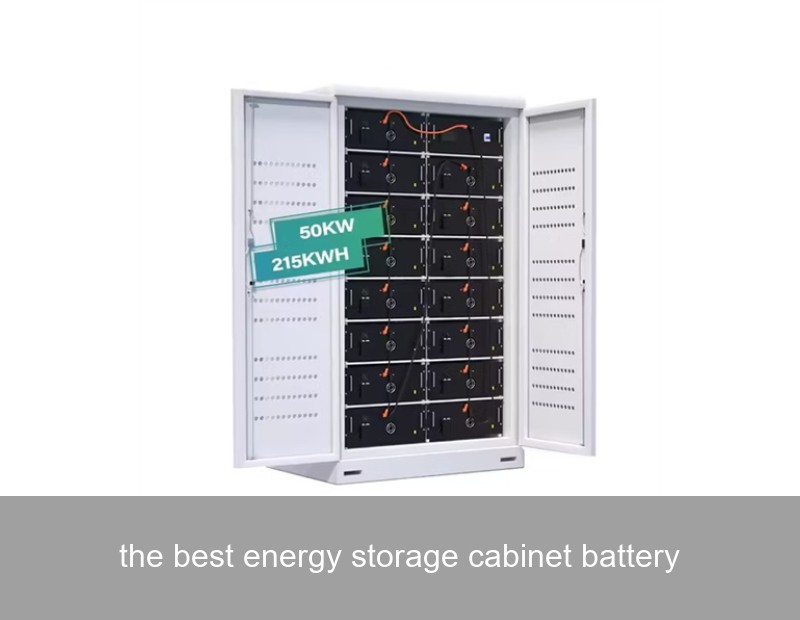
You've likely noticed it: the energy landscape is shifting beneath our feet. From homeowners seeking independence from volatile utility rates to factory managers grappling with peak demand charges, a common question is emerging. What is the most reliable, efficient, and intelligent way to store energy? The answer increasingly lies in a centralized, scalable solution: the best energy storage cabinet battery system. But with a market flooded with options, how do you discern which cabinet truly delivers on its promises of resilience, savings, and sustainability? Let's demystify the technology and explore what makes a cabinet system not just good, but the best fit for your application.
Table of Contents
The Phenomenon: Why Centralized Storage is Taking Over
Gone are the days when energy storage meant a cluster of standalone units. The modern approach, especially for commercial, industrial, and large residential applications, favors integrated cabinet systems. Think of it as the difference between a scattered team and a unified, coordinated unit. A premium energy storage cabinet battery consolidates battery modules, advanced power conversion systems (PCS), thermal management, and safety controls into a single, plug-and-play enclosure. This shift is driven by tangible needs: simplifying installation, reducing footprint, enhancing safety through centralized monitoring, and most importantly, scaling capacity seamlessly by adding more cabinets. It's the architectural backbone for a modern, flexible energy strategy.
Beyond the Spec Sheet: Key Metrics of the Best Energy Storage Cabinet Battery
Choosing the best energy storage cabinet battery isn't just about comparing kilowatt-hour (kWh) ratings. It's about understanding the system's intelligence, longevity, and total cost of ownership. Here are the critical dimensions to evaluate:
| Metric | What It Means | Why It Matters |
|---|---|---|
| Round-Trip Efficiency (RTE) | The percentage of energy put into storage that you can actually use. | A higher RTE (e.g., >95%) means less energy wasted as heat, maximizing your solar ROI and reducing costs. |
| Depth of Discharge (DoD) & Cycle Life | How much of the battery's capacity can be used daily and for how many cycles. | A cabinet designed for 90% DoD over 6,000+ cycles (like Lithium Iron Phosphate chemistry) offers a longer, more usable service life. |
| Integrated Energy Management System (EMS) | The "brain" that controls charging, discharging, and grid interaction. | An advanced EMS can automate peak shaving, schedule arbitrage, and ensure backup power, delivering the operational savings that justify the investment. |
| Thermal Management & Safety | How the system regulates temperature and prevents thermal runaway. | Liquid cooling systems often outperform air cooling in maintaining optimal temperature, ensuring safety, and prolonging battery life in demanding conditions. |
For a deeper dive into battery technologies and safety standards, the U.S. Department of Energy's Energy Storage Hub is an authoritative resource.
A Real-World Case: Industrial Savings in Bavaria
Let's move from theory to practice. Consider a mid-sized automotive parts manufacturer in Bavaria, Germany. Their challenge was classic: high peak demand charges from the utility, which can constitute up to 30-50% of a commercial electricity bill, and an intermittent grid connection affecting precision machinery.
In 2022, they deployed a 500 kWh / 750 kVA containerized solution comprising multiple high-performance energy storage cabinet battery units. The system's intelligent EMS was programmed to perform peak shaving: it automatically discharged the cabinets during the plant's short periods of highest power draw, smoothing the demand curve seen by the grid.
- Data Point: The system reduced their peak demand by 22% in the first year.
- Financial Impact: This translated to annual savings of over €48,000 on demand charges alone.
- Added Value: The system also provided seamless backup power for critical loads during two grid disturbances, preventing an estimated €120,000 in production line stoppages.
This case underscores that the best energy storage cabinet battery is one tuned to specific economic and operational signals, turning passive storage into an active financial asset.

A representative image of a modern industrial battery energy storage installation.
The Highjoule Approach: Engineering the Complete Storage Ecosystem
At Highjoule, with nearly two decades of experience since 2005, we've learned that delivering the best energy storage cabinet battery means looking beyond the hardware. It's about providing a holistic, intelligent power solution.
Our flagship product line, the H-Series Modular Energy Cabinet, embodies this philosophy. Each cabinet is a self-contained unit featuring our proprietary Lithium Iron Phosphate (LiFePO4) battery modules, a bi-directional hybrid inverter, and a state-of-the-art liquid cooling system. But the true differentiator is JouleMind™, our cloud-native AI-driven EMS.
- Adaptive Learning: JouleMind™ doesn't just follow rules; it learns your facility's load patterns, weather forecasts, and utility rate structures to optimize charge/discharge cycles for maximum economic return.
- Scalability: Need more capacity? Our cabinet-based architecture allows you to start with a single 100 kWh unit and scale to multi-megawatt installations by simply adding more cabinets in parallel.
- Grid Services Ready: For microgrids or large commercial sites, our systems are designed to participate in grid-balancing services like frequency regulation, opening an additional revenue stream in certain markets.
We provide end-to-end services—from initial feasibility analysis and system design to commissioning, remote monitoring, and lifecycle support—ensuring your storage investment performs optimally for its entire lifespan. Understanding grid integration is complex; organizations like the Smart Grid.gov consortium offer valuable context on these evolving dynamics.
Choosing the Right Cabinet: Your Decision Framework
So, how do you navigate your selection? Ask these pivotal questions:
- What is my primary objective? (e.g., Bill savings via peak shaving, backup power resilience, increasing solar self-consumption, or a combination?)
- What is my total cost of ownership analysis? Consider not just upfront cost, but efficiency losses, expected degradation, and maintenance needs over 10-15 years.
- How "smart" does the system need to be? Can its software adapt to changing utility tariffs and my evolving energy patterns?
- Does the provider offer long-term performance guarantees and professional support? The warranty and service agreement are as critical as the hardware specs.

Integrated solar and storage for residential and commercial applications.
Looking Ahead: The Role of Storage in a Decarbonized Grid
As renewables like wind and solar approach dominance in the generation mix (as noted by the International Energy Agency), the role of storage evolves from a nice-to-have to the essential glue of the grid. The best energy storage cabinet battery systems will be those that not only store energy but also communicate intelligently with other distributed assets—electric vehicle chargers, heat pumps, and the grid itself—forming responsive, resilient local energy networks.
Is your organization currently analyzing its energy consumption patterns to identify where a strategic storage investment could deliver the most immediate financial and operational resilience?
 Inquiry
 Online Chat