


How Much PV Anlage China is Installing, and What It Means for Global Energy Storage
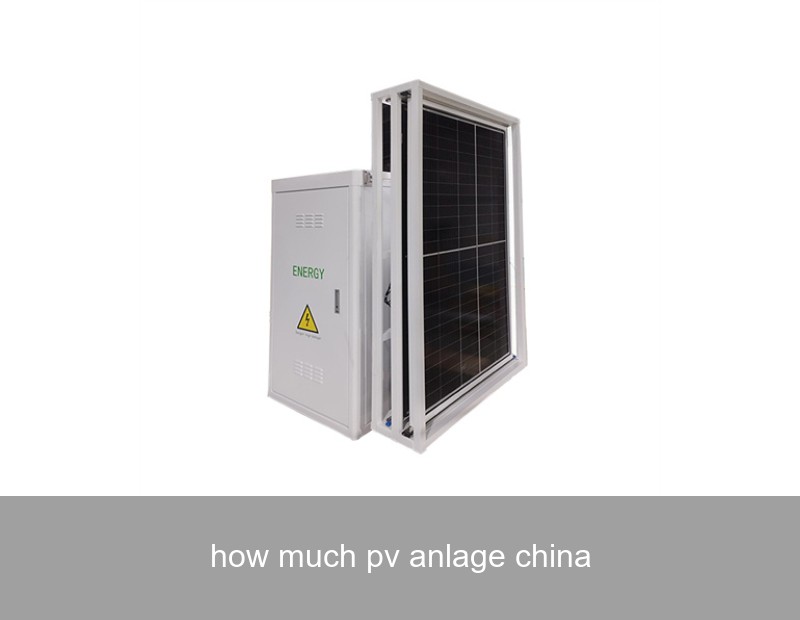
You've likely seen the headlines: China is installing solar panels at a pace that dwarfs the rest of the world combined. The term "PV Anlage" – German for photovoltaic system – is becoming synonymous with a global energy shift, and China is at its epicenter. But what does "how much PV Anlage China" is deploying truly mean for the international market, especially in Europe and the U.S.? Beyond the staggering gigawatt figures lies a critical challenge and opportunity: integrating this massive, intermittent power into stable grids. This is where advanced energy storage systems (ESS) become not just beneficial, but essential. As a global leader in this field, Highjoule's solutions are pivotal in turning raw solar potential into reliable, dispatchable power worldwide.
Table of Contents
- The Unprecedented Scale of China's Solar Deployment
- The Integration Challenge: From Curtailment to Grid Stability
- The Storage Solution: Enabling a Solar-Dominant Future
- Highjoule's Role: Intelligent Storage for Global Markets
- Case Study: Lessons from a German Industrial Park
- Future Outlook: What Does This Mean for Your Energy Strategy?
The Unprecedented Scale of China's Solar Deployment
Let's talk numbers. In 2023 alone, China added a staggering 216.9 gigawatts (GW) of solar PV capacity. To put that in perspective, that's more than the total installed solar capacity of the entire United States, and it was deployed in a single year. According to the National Energy Administration (NEA), China's cumulative solar capacity has now surpassed 600 GW. This isn't just growth; it's a quantum leap in manufacturing, logistics, and installation capabilities.
This scale has a dual impact globally. First, it has driven down the cost of solar panels everywhere, making solar projects more feasible. Second, it has set a new benchmark for the velocity of a renewable energy rollout. However, this rapid deployment brings a well-documented phenomenon: the "duck curve." As solar generation soars during midday, net demand plummets, creating a steep ramp-up requirement in the evening when the sun sets. Managing this curve is the next frontier.

Image Source: Unsplash - Representative image of a large-scale solar installation.
The Integration Challenge: From Curtailment to Grid Stability
So, what happens when you generate more solar power than the grid can consume at a given moment? You get curtailment. In some Chinese provinces with the highest solar penetration, curtailment rates have been a concern, meaning perfectly good renewable energy is wasted because the grid lacks the flexibility to absorb it. This isn't a uniquely Chinese problem; it's a preview of challenges for any region aggressively pursuing renewables.
The core issues are:
- Intermittency: Solar doesn't produce at night or during heavy cloud cover.
- Grid Congestion: Transmission lines may not have the capacity to move power from sunny, remote areas to dense urban centers.
- Frequency and Voltage Regulation: Traditional grids rely on the inertia of spinning turbines. Inverter-based resources like solar require new ways to maintain grid stability.
This is where the conversation shifts from mere generation to intelligent integration. The question is no longer just "how much PV," but "how well can we use it?"
The Storage Solution: Enabling a Solar-Dominant Future
Battery Energy Storage Systems (BESS) are the definitive answer to these integration challenges. They act as a buffer, charging when solar production is high and discharging when demand peaks or solar generation drops. The value of storage extends far beyond simple time-shifting:
| Storage Function | Benefit | Impact on Solar PV |
|---|---|---|
| Energy Arbitrage | Store cheap solar, discharge during expensive peak hours | Improves project economics and ROI |
| Frequency Regulation | Responds in milliseconds to grid frequency fluctuations | Enables higher penetration of solar without compromising grid stability |
| Capacity Firming | Smooths out solar output, making it more predictable and reliable | Allows solar to be treated as a more dependable capacity resource |
| Voltage Support | Injects or absorbs reactive power to maintain grid voltage | Protects grid infrastructure and reduces losses |
For commercial and industrial (C&I) entities, coupling solar with storage is a strategic move towards energy independence, protection from volatile energy prices, and a direct contribution to sustainability goals.
Highjoule's Role: Intelligent Storage for Global Markets
At Highjoule, we've been at the forefront of this energy transition since 2005. Observing trends like China's PV explosion informs our global product development. We understand that a one-size-fits-all solution doesn't work. Our portfolio is designed to meet the diverse needs of the European and U.S. markets, where grid dynamics and policy landscapes differ.
Our flagship product, the Highjoule Matrix™ BESS, is a modular, containerized solution built for C&I and utility-scale applications. Its key features directly address the challenges born from massive solar deployment:
- Advanced Battery Management System (BMS): Ensures safety, longevity, and optimal performance from our LiFePO4 battery cells, a chemistry chosen for its stability and cycle life.
- Grid-Forming Inverter Technology: This is crucial. Unlike traditional grid-following inverters, our system can "form" a grid, providing black-start capabilities and inherent stability in grids with high renewable penetration.
- AI-Powered Energy Management System (EMS): The brain of the operation. Our EMS doesn't just react; it forecasts weather, energy prices, and load patterns to optimize charge/discharge cycles for maximum economic and operational benefit.
For residential and smaller commercial applications, our Highjoule Home+ system provides seamless integration with rooftop solar, allowing homeowners to maximize self-consumption and maintain backup power. Whether for a factory in Bavaria or a microgrid in California, Highjoule provides the intelligence to make renewable energy reliable.

Image Source: Unsplash - Representative image of an industrial battery storage system.
Case Study: Lessons from a German Industrial Park
Let's move from theory to practice. Consider a real-world example from Germany, a country with its own ambitious Energiewende (energy transition). A large automotive manufacturing park in Lower Saxony faced rising energy costs and strict carbon reduction targets. They installed a 5 MW rooftop PV system but found themselves exporting excess power at low prices and still relying heavily on the grid during early morning and evening shifts.
Their solution was a 4 MWh Highjoule Matrix™ BESS integrated with their existing PV and building management system. Here’s what happened within the first year of operation:
- Self-Consumption of Solar Power Increased from 35% to over 80%: The battery stored midday excess for use during production peaks.
- Annual Energy Cost Savings of €280,000: Achieved through peak shaving and optimized arbitrage using our EMS's market price forecasting.
- Provision of Frequency Containment Reserve (FCR): The system automatically responds to grid frequency signals, generating an additional revenue stream of approximately €45,000 per year.
- Carbon Footprint Reduction: By maximizing clean solar usage and reducing peak grid draw (often served by fossil fuels), the site cut its scope 2 emissions by an estimated 1,200 tonnes of CO2 annually.
This case mirrors the integration challenge on a local scale. The lessons are clear: pairing solar with intelligent storage unlocks economic, operational, and environmental value. For more data on Germany's energy transition, you can refer to the Agora Energiewende think tank.
Future Outlook: What Does This Mean for Your Energy Strategy?
The trajectory set by China's PV expansion is a global signal. Solar costs will continue to fall, and deployment will accelerate in Europe and the U.S. The limiting factor will no longer be the cost of panels, but the cost and capability of integration. Forward-thinking businesses and utilities are now designing "solar-plus-storage" as a single, optimized asset.
Highjoule is partnering with developers and asset owners across these markets to future-proof their investments. Our systems are designed with interoperability in mind, ready to adapt to evolving grid codes and market mechanisms. As battery technology continues to advance, with research into areas like solid-state batteries, our platforms are engineered to incorporate these improvements, protecting your investment for the long term. You can explore global storage forecasts from the International Energy Agency (IEA).

Image Source: Unsplash - Representative image of energy system monitoring and control.
The narrative of "how much PV Anlage China" builds is ultimately a story about the future of global energy. It demonstrates what's possible and highlights what's needed next. As you evaluate your organization's or community's path to energy resilience and sustainability, the critical question becomes: Is your solar strategy equipped with the intelligence to store and manage its full potential?
 Inquiry
 Online Chat