


How Much SimpliPhi Power Do You Really Need? Demystifying Battery Sizing for Your Energy Independence
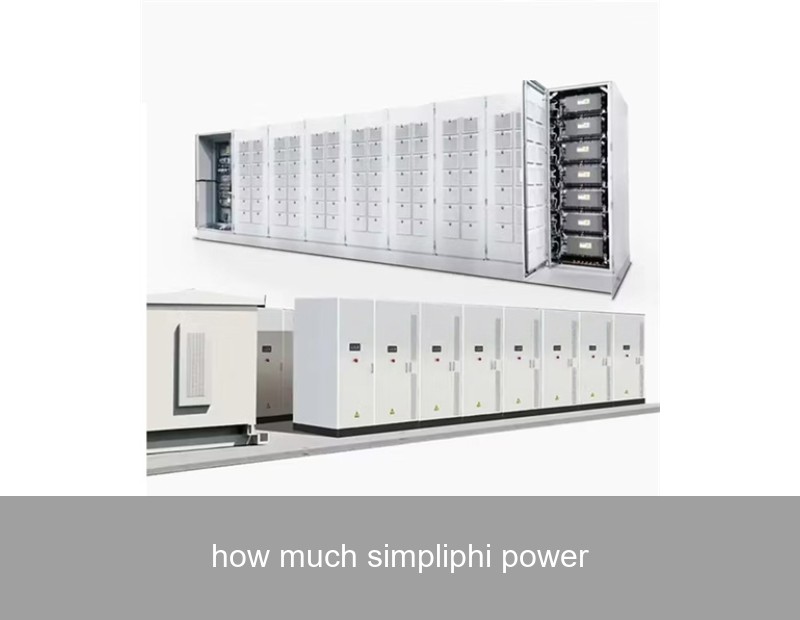
You've decided to take control of your energy future. Whether it's to shield your home from blackouts, maximize your solar investment, or simply reduce your carbon footprint, a reliable battery storage system is the key. In your search, you've likely come across the robust and safe lithium ferro phosphate (LFP) batteries from SimpliPhi Power. The critical question that emerges is: how much SimpliPhi power is right for your specific situation? Sizing your energy storage system is not a one-size-fits-all calculation; it's a balance between your energy needs, your goals, and your budget. Let's break down the factors that determine the answer and explore how companies like Highjoule translate this into a resilient power solution for you.
Table of Contents
- The Sizing Puzzle: It's More Than Just Kilowatt-Hours
- Key Factors That Answer "How Much Power?"
- A Real-World Case Study: From Theory to Practice
- The Highjoule Approach: Intelligent Sizing for Real Life
- Your Next Step Towards Energy Independence
The Sizing Puzzle: It's More Than Just Kilowatt-Hours
Many people focus solely on the battery's capacity, measured in kilowatt-hours (kWh). Think of this as the size of your fuel tank. A 10 kWh SimpliPhi battery bank stores more energy than a 5 kWh bank. However, capacity is only half the story. The other crucial metric is continuous power output, measured in kilowatts (kW). This is the rate at which the battery can deliver energy—imagine the width of the hose filling your car's tank. Can it simultaneously run your refrigerator (0.5 kW), lights (0.3 kW), well pump (1.5 kW), and an air conditioner (3.5 kW)? That peak load determines your required power output.
For instance, two homes might both use 20 kWh per day. Home A is a modern, all-electric home with an EV charger and heat pump. Home B is a gas-heated home with efficient appliances. While their daily energy (kWh) needs might be similar, Home A's instantaneous power (kW) demands will be far higher during charging or heating cycles. Under-sizing the power rating can lead to overloads and shutdowns when you need power the most.

Image: A modern home with solar and an EV. Such a setup has high simultaneous power demands, influencing battery sizing. Credit: Unsplash.
Key Factors That Answer "How Much Power?"
To move from a vague question to a precise answer for how much SimpliPhi power you need, we must analyze several data points. Use this as a checklist:
- Your Energy Audit (kWh): Review your utility bills to find your average daily kWh consumption. This sets the baseline for storage capacity.
- Your Critical Loads List (kW): What appliances must run during an outage? List them and their starting & running watts. The sum of running watts for appliances on simultaneously defines your needed continuous power output.
- Your Solar PV System Size: How much excess solar energy do you produce daily? Your battery should be sized to capture a meaningful portion of this surplus.
- Desired Backup Duration: Do you want to weather a 2-hour storm or achieve 24/7 off-grid independence? Duration (hours) multiplied by your critical load power (kW) equals the required capacity (kWh).
- Future-Proofing: Are you planning to buy an EV, switch to a heat pump, or expand your home? Factor in future energy needs.
As a global leader founded in 2005, Highjoule's design process meticulously weighs all these factors. Our HES (Highjoule Energy System) platform integrates high-performance LFP batteries, like those from SimpliPhi, with advanced inverter technology and AI-driven energy management. We don't just sell batteries; we provide a smart, efficient, and sustainable power solution tailored for commercial, industrial, residential, and microgrid applications. Our systems are designed to ensure the battery's power and capacity are perfectly matched to your unique load profile.
A Real-World Case Study: From Theory to Practice
Let's look at a concrete example from the U.S. market. A medium-sized dairy farm in Wisconsin wanted to reduce demand charges from the grid and ensure backup power for critical cooling and milking equipment. Their challenge was high, short-duration power draws from motors and chillers.
- Phenomenon: High utility demand charges spiking operational costs, coupled with grid instability risk.
- Data: Peak power demand: 85 kW. Critical load requirement during outage: 40 kW for 4 hours (160 kWh). Existing solar array: 50 kW.
- Case Implementation: Highjoule engineered a solution using a modular battery bank built with robust LFP cells, similar in performance and safety to SimpliPhi's technology. The system was sized for 200 kWh of storage with a 50 kW continuous power output. It was integrated with the farm's solar and configured for peak shaving and backup.
- Insight & Result: The system's high power rating handled the motor start surges seamlessly. Within the first year, the farm reduced its peak demand charges by over 30% and gained resilience against power outages that could have spoiled product and halted operations. The project demonstrated that understanding the difference between energy capacity and power delivery was crucial—the farm needed high power more than extreme capacity.
You can explore more on the importance of LFP chemistry for such demanding applications from authoritative sources like the U.S. Department of Energy's Solar Energy Technologies Office.
The Highjoule Approach: Intelligent Sizing for Real Life
At Highjoule, we believe the question "how much SimpliPhi power" is best answered by looking at your entire energy ecosystem. Our products and services are designed to take the guesswork out of the equation.
| Your Goal | Highjoule Solution Focus | Key Sizing Consideration |
|---|---|---|
| Whole-Home Backup | HES Residential Series with Load Management | Peak household power draw (kW) and desired autonomy (hours). |
| Maximize Solar Self-Consumption | HES + Smart Energy Gateway | Daily solar overproduction (kWh) and evening load profile. |
| Commercial Cost Savings (Demand Charge Reduction) | HES C&I Series with Predictive Analytics | Site-specific peak demand (kW) and utility rate structure. |
| Microgrid & Off-Grid Resilience | Scalable HES Microgrid Platform | 24/7 load profile, seasonal variation, and generator integration. |
Our technical experts use sophisticated modeling tools that go beyond simple spreadsheet calculations. We analyze your load data, simulate different outage scenarios, and model financial returns. For instance, pairing a correctly sized Highjoule system with the thermal stability and safety of LFP chemistry (the core of SimpliPhi's design) means you get a solution that is not only optimally sized but also built to last for thousands of cycles with minimal degradation. For independent verification of LFP battery longevity, resources like scientific literature on Lithium Iron Phosphate provide valuable insights.

Image: Expert analysis is key to proper system sizing. Credit: Unsplash.
Your Next Step Towards Energy Independence
So, how much SimpliPhi power—or more broadly, how much battery storage—do you need? The answer lies in a clear understanding of your energy habits, your resilience goals, and the intelligent integration of technology that can adapt to both. It's a journey from asking about kilowatt-hours to understanding your unique energy fingerprint.
As you contemplate your path to energy independence, what is the single biggest concern driving your search for a battery system: is it the fear of a prolonged blackout, the frustration of rising electricity costs, or the desire to make your renewable investment work harder for you?
Highjoule is here to help you find that precise answer. Contact our energy specialists today for a free, preliminary assessment. Share your latest utility bill and your backup priorities with us, and let's start the conversation about building a power solution that is perfectly sized for your life, your business, and our planet's future.
 Inquiry
 Online Chat