


Solar Platforms: How Much Do They Really Cost and Are They Worth It?
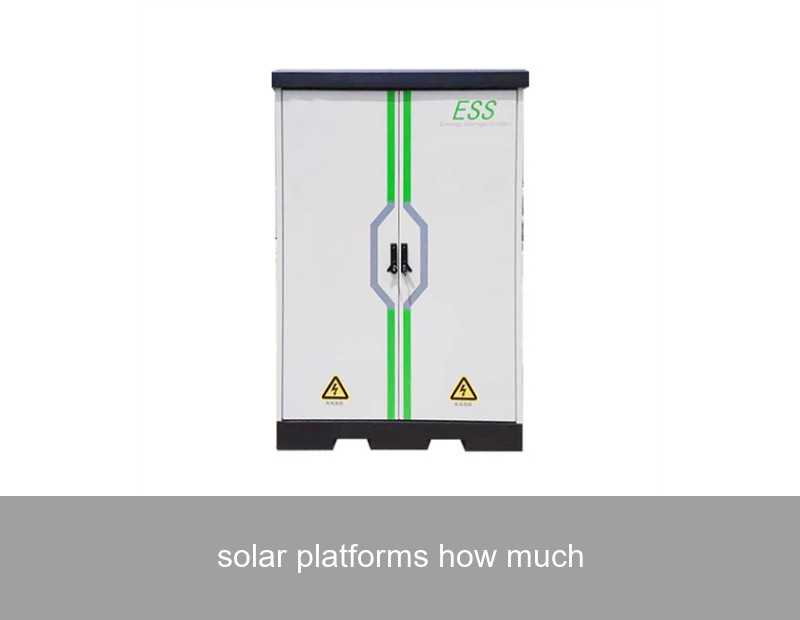
So, you're thinking about solar energy. You've seen the panels on your neighbor's roof, heard about lowering electricity bills, and maybe you've even gotten a quote or two. But then comes the big, looming question: solar platforms, how much? The initial price tag can be a shock, leaving many homeowners and business owners wondering if the investment will ever pay off. This hesitation is completely normal. The world of solar energy involves more than just panels; it's an integrated system, and understanding the true cost—and value—requires looking beyond the sticker price. Let's break down what you're really paying for and how modern energy storage transforms the equation.
Table of Contents
- The Price Puzzle: More Than Just Panels
- Breaking Down the Costs of a Solar Platform
- A Real-World Case Study: The German Bakery
- The Highjoule Solution: Intelligent Energy Management
- Calculating Your True Value: ROI and Independence
- What's Your Energy Independence Goal?
The Price Puzzle: More Than Just Panels
Asking "how much for solar?" is like asking "how much for a house?" The answer depends on countless factors. A solar platform—or photovoltaic (PV) system—is a complete energy solution. The panels themselves typically account for only about 20-25% of the total installed cost. The rest comes from "balance of system" components: inverters, mounting hardware, wiring, and critically, the labor for design, permitting, and installation. According to the U.S. Department of Energy, system size, your roof's condition, and local utility rates are the primary drivers of both cost and long-term savings.

This is where the conversation needs to evolve. Historically, solar was sold as a way to offset grid consumption. But the real financial and resilience power is unlocked when you can store the energy you produce. This shifts the question from "solar platforms, how much?" to "how much value can an intelligent energy platform deliver?"
Breaking Down the Costs of a Solar Platform
Let's look at a typical residential installation in the U.S. or Europe. For a 6 kW system (a common size for a single-family home), you might see a gross price range between $15,000 and $25,000 before incentives. But what does that include?
- Photovoltaic Panels: The most visible component. Efficiency and warranty vary by brand.
- Inverters: The brain of the solar system, converting DC power from panels to AC for your home. Microinverters or string inverters are the main options.
- Mounting & Racking: The hardware that securely attaches panels to your roof or ground.
- Permitting & Interconnection: Fees and paperwork required by your local authority and utility company.
- Installation Labor: Professional installation is critical for safety, performance, and warranty validity.
After federal tax credits (like the 30% ITC in the U.S.) or European subsidies, the net cost can drop significantly. However, this traditional setup has a limitation: when the sun sets, you're back to buying power from the grid at peak rates.
The Game Changer: Adding Battery Storage
This is the modern paradigm. A solar-plus-storage platform isn't just an expense; it's an upgrade to your property's energy infrastructure. Adding a battery storage system (BESS) increases the upfront cost but dramatically increases the value proposition. Think of it this way: solar panels are your energy generators, but batteries are your energy bank account. You can save your surplus energy for when you need it most—during evening peak hours, during a grid outage, or on cloudy days.
The cost of battery storage has fallen over 80% in the last decade, making it more accessible than ever. Integrating storage requires a more sophisticated inverter or a separate battery inverter, and of course, the battery modules themselves. Companies like Highjoule specialize in seamlessly integrating these components into a cohesive, intelligent system. Our Highjoule Hive™ energy storage systems are designed to work with any solar array, providing not just backup power, but intelligent energy arbitrage—automatically storing solar energy when it's cheap and using it when grid prices are high.
A Real-World Case Study: The German Bakery
Let's move beyond theory to a concrete example. Consider a medium-sized artisan bakery in Bavaria, Germany. Their challenge: high energy costs, especially for early morning oven pre-heating, and a commitment to sustainability.
- Phenomenon: Spiking energy bills and unreliable grid power affecting production.
- Data: They installed a 50 kW solar rooftop system coupled with a 100 kWh Highjoule Hive™ battery storage unit.
- Case Implementation: The system was designed to maximize self-consumption. Solar energy produced during the day powered daytime operations and charged the battery. The stored energy was then used to pre-heat ovens before dawn, avoiding expensive grid power.
- Insight & Result: Within the first year, the bakery achieved an 85% reduction in grid energy consumption during peak tariff periods. Their overall energy bill decreased by 60%. Furthermore, during two brief grid outages, the bakery continued operations uninterrupted, protecting thousands of euros in perishable goods and maintaining customer orders. The system's intelligent management software, Highjoule SynapseOS™, continuously optimizes the flow of energy based on production schedules and real-time electricity prices.

This case illustrates the shift from cost to value. The bakery's investment wasn't just in "solar panels"; it was in energy predictability, cost control, and business continuity.
The Highjoule Solution: Intelligent Energy Management
At Highjoule, we view a solar platform as the starting point for true energy independence. Since 2005, we've evolved from a component provider to a full-scale advanced energy storage system provider. Our answer to "solar platforms, how much?" is to first understand your energy profile, then design a system that maximizes your financial and operational return.
Our integrated offerings include:
| Product/Service | Key Benefit | Ideal For |
|---|---|---|
| Hive™ Residential ESS | Seamless backup power, bill management, and solar self-consumption optimization. | Homeowners seeking resilience and lower bills. |
| Hive™ Commercial & Industrial ESS | Demand charge reduction, peak shaving, and backup for critical loads. | Businesses, factories, agricultural operations. |
| SynapseOS™ Energy Management Software | AI-driven platform for monitoring, forecasting, and automated control of energy assets. | Any site with solar, storage, or complex energy needs. |
| Custom Microgrid Solutions | Design and integration of independent energy networks that can operate off-grid. | Remote communities, campuses, critical infrastructure. |
By focusing on the intelligence behind the hardware, we ensure your solar and storage investments work harder for you. The International Energy Agency (IEA) consistently highlights the enabling role of storage in the renewable transition, and our technology is built to be at the forefront of this shift.
Calculating Your True Value: ROI and Independence
So, let's return to the initial question with a new lens. Instead of just "solar platforms, how much?" ask:
- How much can I save on my monthly energy bill with solar + storage?
- What is the financial value of avoiding a 4-hour power outage for my home or business?
- How will locking in a lower, predictable energy cost affect my long-term budget or business plan?
- What government incentives (tax credits, rebates, feed-in tariffs) are available in my region to offset the initial cost?
The payback period for a solar-plus-storage system in markets like California, Germany, or Italy can often be between 6-10 years, with the system continuing to produce free, clean energy for 15-25 years thereafter. You're not just buying equipment; you're pre-paying for decades of electricity at a known, stable cost—a powerful hedge against rising utility rates.
What's Your Energy Independence Goal?
The journey begins with understanding your own energy data. We encourage you to look at your last 12 months of utility bills. Identify your baseline consumption, your peak demand, and what a single outage would cost you. With that information in hand, the conversation changes from an abstract "how much" to a concrete "what's possible."
Is your primary driver financial savings, environmental impact, or unwavering resilience? Perhaps it's all three. The modern solar platform, especially when paired with intelligent storage like Highjoule's systems, is uniquely capable of delivering on all these fronts. So, what energy challenge are you looking to solve first?
 Inquiry
 Online Chat