


How Much Solar Panels for House? Your Guide to Sizing a Home Solar System
So, you're thinking about powering your home with the sun. It's an exciting move towards energy independence, lower bills, and a smaller carbon footprint. But one of the very first questions that pops up is: "How much solar panels for house do I actually need?" If you're picturing a simple formula, hold on. The answer isn't a one-size-fits-all number like "20 panels." It's a personalized calculation that depends on your home, your lifestyle, and your energy goals. Think of it not just as buying panels, but as designing your own miniature, clean power plant. This guide will walk you through everything, from the basic math to the smart technology that makes it all work seamlessly.
Key Factors That Determine How Many Solar Panels You Need
Let's break down the five core pieces of the puzzle. Getting a handle on these will give you a clear picture long before you get a quote.
1. Your Home's Energy Consumption (kWh)
This is your starting point. How much fuel does your house currently use? You'll find this on your electricity bill listed as kilowatt-hours (kWh) consumed over a month or a year. For an accurate solar panel estimate, look at your total annual usage. A typical U.S. home uses about 10,632 kWh per year, while an average EU household might use between 2,500 to 5,000 kWh, depending on size and efficiency. The higher your consumption, the more panels you'll need to offset it.
2. Your Sunlight Exposure (Peak Sun Hours)
Not all sunshine is created equal. A "peak sun hour" is defined as one hour of sunlight that delivers 1,000 watts of photovoltaic power per square meter. Your location dictates this crucial number. A sunny home in Arizona might average 6.5 peak sun hours daily, while a house in Seattle might get 3.5. The same solar panel will produce significantly more energy in Arizona. You can find maps and tools from the National Renewable Energy Laboratory (NREL) to estimate your local average.

Image: Roof orientation and shading are critical in calculating effective sunlight exposure.
3. Solar Panel Efficiency and Wattage
Solar panel technology has advanced rapidly. Today's premium panels are more efficient, meaning they convert a higher percentage of sunlight into electricity. Panel power is rated in watts (W). Common residential panels range from 350W to over 450W per panel. Here’s a quick comparison:
| Panel Type | Typical Efficiency | Power per Panel (Watts) | Space Efficiency |
|---|---|---|---|
| Standard Monocrystalline | 18-20% | 350-400W | Good |
| High-Efficiency Monocrystalline | 21-23% | 400-450W+ | Excellent |
Higher efficiency panels generate more power in less space, which is ideal for roofs with size constraints.
4. Available Roof Space and Layout
This is the physical constraint. You need enough unshaded, structurally sound roof area facing the right direction (typically south in the Northern Hemisphere). A 400W panel is roughly 21 square feet. You can do the rough math: if you have 300 sq. ft. of suitable south-facing roof, you can fit about 14 panels. Obstructions like chimneys, vents, and shading from trees or other buildings must be factored in by a professional designer.
5. Your Future Energy Plans (Think EVs and Batteries!)
This is where forward-thinking pays off. Are you planning to buy an electric vehicle (adding ~4,000-6,000 kWh/year)? Considering adding air conditioning or a heat pump? Your energy needs will grow. Furthermore, to maximize self-consumption and gain backup power, integrating a battery storage system is a game-changer. It allows you to store excess solar energy produced during the day for use at night, reducing reliance on the grid. Sizing your system with future consumption and storage in mind is a hallmark of a truly resilient home energy setup.
A Practical Step-by-Step Calculation
Let's connect the dots with a simplified formula:
- Find your annual kWh need: E.g., 9,000 kWh.
- Find your daily peak sun hours: E.g., 4.5 hours (location-dependent).
- Calculate the system size (in kW) needed: (Annual kWh) / (365 days * peak sun hours) = Required kW.
9,000 / (365 * 4.5) = 9,000 / 1642.5 ≈ 5.48 kW system. - Determine number of panels: (System size in kW * 1000) / Panel Wattage.
For 400W panels: (5.48 * 1000) / 400 = 5,480 / 400 = 13.7 panels (round up to 14-15).
Remember, this is a basic estimate. Real-world factors like temperature, inverter efficiency, and shading will affect final output.
Case Study: A Real-Life Example from Munich, Germany
Let's look at the Müller family in Munich (average 4.2 peak sun hours). Their annual consumption was 4,800 kWh. They drove an electric vehicle, adding roughly 2,500 kWh/year, and wanted backup power for essential loads during occasional grid outages.
- Total Annual Energy Goal: 4,800 kWh (home) + 2,500 kWh (EV) = 7,300 kWh.
- System Size Calculation: 7,300 / (365 * 4.2) = 7,300 / 1,533 ≈ 4.76 kW.
- Initial Panel Plan: Using 420W panels: (4.76 * 1000) / 420 ≈ 11.3 panels.
However, their installer recommended a key upgrade: oversizing the solar array slightly and pairing it with a Highjoule HES-10 home energy storage system. Why? The 5.2 kW solar system (using 13 of the 420W panels) would produce more daytime energy, charging both the home and the battery. The 10 kWh battery bank stores excess energy to power the home and charge the EV in the evening, dramatically increasing their self-consumption from ~30% to over 80%. The result: they now cover nearly 95% of their total annual energy needs with solar, are protected from outages, and have a predictable energy cost for the next 25+ years.
Beyond the Panels: The Crucial Role of a Complete System
Solar panels are just the visible part of the ecosystem. The inverter converts their DC power to usable AC power for your home. And as the Müller family's case shows, the battery storage system is the brain and backbone of modern energy independence. It turns a solar system that only works when the sun shines into a 24/7 personal power hub.
How Highjoule's Smart Solutions Optimize Your Solar Investment
This is where expertise and integrated technology make all the difference. At Highjoule, with nearly two decades of experience, we understand that the question "how much solar panels for house" is just the beginning. Our approach focuses on delivering a holistic, intelligent energy solution.
Our HES Series Home Energy Storage systems are designed to seamlessly integrate with new or existing solar arrays. They feature advanced lithium iron phosphate (LiFePO4) batteries known for safety and long life, coupled with a hybrid inverter that manages energy flow between solar, battery, home, and grid with incredible efficiency. Our proprietary energy management software learns your consumption patterns and automatically optimizes when to store solar energy, when to use it, and when to draw from the grid, ensuring you get the maximum financial and practical benefit from every panel on your roof.
For homeowners, this means you can confidently size a system knowing that the energy you produce won't be wasted. It also provides peace of mind with reliable backup power, keeping your lights on and your essentials running during a grid failure. For commercial and microgrid applications, our scalable solutions provide stability and significant cost savings.

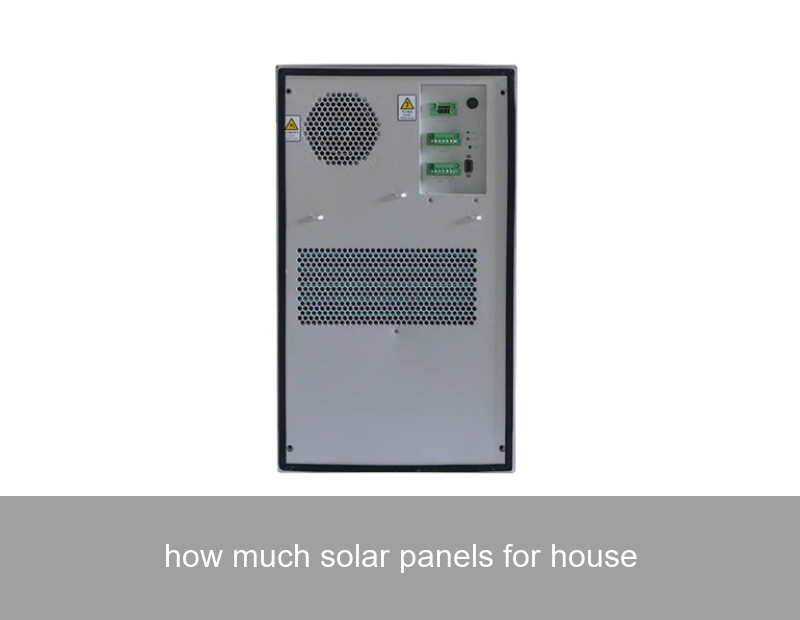
Image: A modern home battery system, like those from Highjoule, is key to maximizing solar use.
Your Next Step Towards Energy Independence
You now have the knowledge to understand what goes into sizing a solar system. But the most accurate answer will come from a personalized assessment that considers your unique roof, electricity data, and aspirations. So, instead of just asking "how many panels?", perhaps the more powerful question to ask yourself is: "What level of energy resilience and control do I want for my home, and how can a smart, integrated system from a trusted provider like Highjoule help me achieve it?" What's the first energy goal you'd like to tackle with your own solar and storage system?
 Inquiry
 Online Chat