


How Much Can You Save with Solar Sharing? A Deep Dive into Community and Allume's SolShare
You've seen the solar panels popping up on rooftops everywhere. You like the idea of clean energy and lower bills, but what if your roof isn't suitable? Or you live in an apartment? This is a common dilemma, and it's where innovative solutions like solar sharing and specific technologies like Allume's SolShare come into play. But the burning question for any homeowner, tenant, or building manager is: how much can you actually save? Let's unpack the potential of shared solar, examine real-world data, and see how it integrates with modern energy systems.
Table of Contents
- What is Solar Sharing & How Does Allume's SolShare Work?
- The Cost Savings Breakdown: "How Much" in Real Numbers
- Beyond the Bill: The Grid Resilience and Sustainability Angle
- A Real-World Case Study: Multi-Tenant Housing in Europe
- Maximizing Value: Integrating Solar Sharing with Advanced Storage
- Is Solar Sharing Right for Your Building?
What is Solar Sharing & How Does Allume's SolShare Work?
Traditional rooftop solar is a one-to-one system: one roof, one inverter, one household. Solar sharing, or community solar, flips this model. It allows multiple energy users to benefit from a single solar array. This can be a ground-mounted community garden or, more relevant for urban settings, a single large array on a multi-unit residential or commercial building.
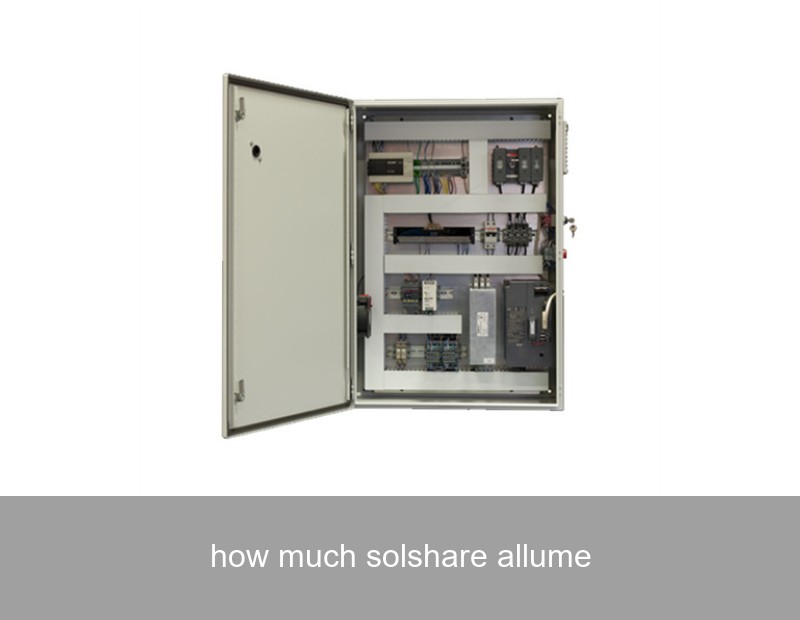
Allume's SolShare technology is a pioneering hardware solution designed specifically for this latter scenario. It's essentially the world's first behind-the-meter solar sharing system for apartments. Here’s the simple genius of it:
- One Solar Array: A single solar PV system is installed on the apartment building's roof.
- The SolShare Unit: This device sits in the building's electrical room and dynamically distributes the generated solar power.
- Dynamic Allocation: Instead of sending power to one unit, SolShare intelligently routes solar energy to multiple individual tenant meters in real-time, based on who is using electricity at that moment.
This means if Tenant A is at work, their "share" of the solar power automatically flows to Tenant B who is working from home. It maximizes self-consumption of the solar energy on-site, reducing what's fed back to the grid and, most importantly, slashing individual electricity bills for all participants.

Image: Solar panels on a modern apartment building rooftop, a prime candidate for solar sharing technology. (Photo: Unsplash)
The Cost Savings Breakdown: "How Much" in Real Numbers
So, let's get to the core question: how much can SolShare and similar models save? The answer isn't a single percentage, as it depends on local energy prices, solar resource, system size, and consumption patterns. However, we can build a clear financial picture.
Typically, residents in a building with SolShare can see a reduction of 20-40% on their individual electricity bills. This is not the savings on the *whole* bill, but on the portion of energy consumption that can be offset by the shared solar system. For a tenant spending $150/month on electricity, that's a saving of $30-$60 monthly, or $360-$720 annually.
The building owner or developer also wins. The system increases the property's value, makes it more attractive to eco-conscious tenants (potentially reducing vacancy rates), and can provide a new revenue stream or offset common area electricity costs.
| Factor | Impact on Savings | Note |
|---|---|---|
| Local Electricity Rate | Higher rates = Higher savings | Savings are more significant in regions like Germany or California vs. areas with very cheap grid power. |
| Solar Irradiation | More sun = More generation = More savings | System output is key. Southern Europe offers higher potential than Northern Europe. |
| Tenant Consumption Profile | Daytime consumption aligns best with solar production | Work-from-home tenants or buildings with high daytime base load see optimal offset. |
| System Size & Cost | Larger systems offset more, but have higher upfront cost | Requires careful sizing based on available roof space and aggregate tenant demand. |
Beyond the Bill: The Grid Resilience and Sustainability Angle
The benefits extend far beyond personal finance. By promoting local energy consumption, solar sharing reduces strain on the distribution grid during peak hours. It's a decentralized, efficient model that supports grid stability—a major concern for utilities in both Europe and the US as electrification increases.
Environmentally, it democratizes access to renewables. According to the National Renewable Energy Laboratory (NREL), nearly 50% of U.S. households and businesses cannot host rooftop solar due to renting, shading, or roof constraints. Technologies like SolShare directly address this "solar equity" gap, enabling a much broader segment of the population to participate in the energy transition.
A Real-World Case Study: Multi-Tenant Housing in Europe
Let's look at a concrete example. A 2019 pilot project in Bristol, UK, involved a block of 18 social housing apartments. A 19.8 kWp solar array was installed on the roof, connected to a SolShare unit to distribute power to 6 of the flats.
- Result: Over a 12-month period, the system achieved an average 25% reduction in grid-derived electricity for each participating household.
- Annual Savings: Each household saved approximately £180-£220 per year (approx. $230-$280 at the time).
- Tenant Feedback: Residents reported increased awareness of their energy use and appreciation for the lower, more predictable bills, a crucial factor for low-income households.
This case highlights that savings are tangible and meaningful, particularly when scaled across many units. The project also demonstrated flawless technical operation, with the SolShare unit autonomously managing the dynamic allocation without any tenant intervention.
Maximizing Value: Integrating Solar Sharing with Advanced Storage
While solar sharing optimizes consumption during the day, a significant portion of energy demand occurs in the evening when the sun isn't shining. This is where pairing a shared solar system with a battery energy storage system (BESS) creates a truly transformative energy solution.
Imagine the shared solar array charging a central battery during the day. In the evening peak, that stored energy can be dispatched to tenants, further reducing their reliance on the expensive grid. This turns a multi-tenant building into its own resilient microgrid.
This is precisely where Highjoule excels. As a global leader in advanced储能系统 since 2005, Highjoule provides intelligent, scalable storage solutions that are the perfect complement to solar sharing setups. For a commercial or multi-residential building, a Highjoule C&I储能系统 can:
- Increase Solar Self-Consumption: Store excess midday solar for use at night, potentially doubling the bill savings from the solar array alone.
- Provide Backup Power: Offer critical power to common areas or even individual units during grid outages, a major value-add for property managers.
- Enable Grid Services: In some markets, aggregated storage can provide services to the utility, generating additional revenue to offset system costs.

Image: A modern battery energy storage system (BESS), like those from Highjoule, which can store shared solar energy for use anytime. (Photo: Unsplash)
By integrating Highjoule's smart storage with a SolShare-based solar system, building owners can move from simply reducing bills to actively managing and optimizing their entire energy ecosystem, achieving true energy independence and sustainability.
Is Solar Sharing Right for Your Building?
The potential of solar sharing is immense, but its success hinges on the right conditions. It's an ideal solution for:
- Multi-Unit Residential Buildings (Apartments, Condos)
- Social and Affordable Housing Developments
- Commercial Strips or Industrial Parks with Multiple Tenants
- University Campuses or Military Bases
Key considerations include local regulations on energy sharing, the physical condition and orientation of the roof, the willingness of tenants or owners to engage, and of course, the financial model (who pays, who saves).
As we've seen, the question "how much can SolShare save?" has a promising answer, often in the range of 20-40% on electricity costs for tenants. But the more strategic question is: How much value could you unlock by combining solar sharing with intelligent energy storage to create a future-proof, resilient, and cost-effective power solution for your entire community?
What's the first step you would take to assess the solar sharing potential for your property or community?
 Inquiry
 Online Chat