


How Much Southern Energy Can We Really Harness and Store?
If you live in the sun-drenched regions of the American South or Southern Europe, you feel it every day—an immense, radiant power pouring down from the sky. It’s more than just warmth; it’s a vast, untapped reservoir of clean electricity. This leads us to a critical question for our energy future: how much southern energy, specifically from solar resources, can we realistically capture, and more importantly, make reliably available even when the sun sets? The answer isn't just in the number of panels we install, but in the sophisticated technology that holds that power for when we need it most.
The Data Doesn't Lie: Quantifying Solar Irradiance
Let's talk numbers. Solar irradiance, measured in kilowatt-hours per square meter per day (kWh/m²/day), is the fundamental metric. According to data from the National Renewable Energy Laboratory (NREL), regions like the U.S. Southwest and Southern Europe boast some of the highest averages globally.
- Phoenix, Arizona, USA: Averages about 6-7 kWh/m²/day annually.
- Seville, Spain: Averages approximately 5.5-6 kWh/m²/day.
- Northern Germany (for contrast): Averages around 3 kWh/m²/day.
This means a single square meter of land in the American South can generate nearly twice the annual solar energy of the same area in cloudier northern climates. The raw potential is staggering. But this is where the conversation often stops—at generation. The real challenge, and opportunity, begins after the electrons are produced.

Image Source: Unsplash - A visual representation of high solar potential in southern regions.
From Potential to Problem: The Intermittency Challenge
Here's the phenomenon every grid operator in sunny regions knows all too well: the "duck curve." As solar production soars midday, demand is relatively low. Then, as the sun sets and people return home, demand peaks precisely when solar generation plummets. This creates a steep ramp-up requirement for traditional fossil-fuel plants, causing grid instability and price spikes.
So, we're back to our core question: how much southern energy is truly usable if it's not available on demand? The raw gigawatt-hours of potential are meaningless without a way to time-shift them. This mismatch between generation and consumption patterns is the single biggest barrier to maximizing the value of southern solar resources.
The Storage Solution: Capturing and Time-Shifting Sunshine
This is where Battery Energy Storage Systems (BESS) become the indispensable hero. Think of BESS not just as a battery, but as a "time machine" for energy. It allows us to capture the surplus midday sun and deliver it during the evening peak or during cloudy periods.
The key metrics for storage are capacity (MWh – how much energy it can hold) and power (MW – how fast it can discharge). To understand the scale needed, we must look at both daily cycling and backup power needs. A robust system doesn't just smooth the duck curve; it provides critical backup during grid outages, which are becoming more frequent due to extreme weather.
Case Study: A Texas Manufacturing Plant's Transformation
Let's ground this in a real-world example. A mid-sized automotive parts manufacturer in San Antonio, Texas, faced crippling demand charges and frequent grid instability. Their peak energy demand occurred in the late afternoon, just as their on-site solar production was waning.
Their solution involved a hybrid system:
- A 2.5 MW solar PV array.
- A 1.5 MW / 3 MWh Highjoule HI-Stack Commercial battery storage system.
The results, over one year, were transformative:
| Metric | Before System | After System | Change |
|---|---|---|---|
| Peak Demand from Grid | 2.1 MW | 1.0 MW | -52% |
| Annual Demand Charges | $180,000 | $86,000 | ~$94,000 saved |
| Grid Energy Consumption | 4.2 GWh | 2.8 GWh | -33% |
| Self-Consumption of Solar | 65% | 98% | +33% |
This case perfectly illustrates the answer to "how much southern energy" can be used: Nearly all of it. The Highjoule BESS increased the usability of their solar investment from 65% to 98%, turning wasted potential into direct savings and resilience. The plant now operates through brief grid disturbances without a hiccup, protecting millions in potential production losses.
Highjoule's Role: Smart, Sustainable Power Solutions
At Highjoule, founded in 2005, we've spent nearly two decades perfecting the technology that unlocks this potential. Our systems are designed specifically for the high-throughput, high-reliability needs of commercial, industrial, and microgrid applications in sunny climates.
Our HI-Stack series, featured in the Texas case, is built with advanced lithium-iron-phosphate (LFP) chemistry, known for its safety, long cycle life, and thermal stability—crucial in hot southern environments. What sets our solutions apart is the Highjoule Smart Controller, an AI-driven energy management system. It doesn't just store and release energy; it predicts energy usage patterns, weather, and grid conditions to make millisecond decisions that maximize financial return and reliability.
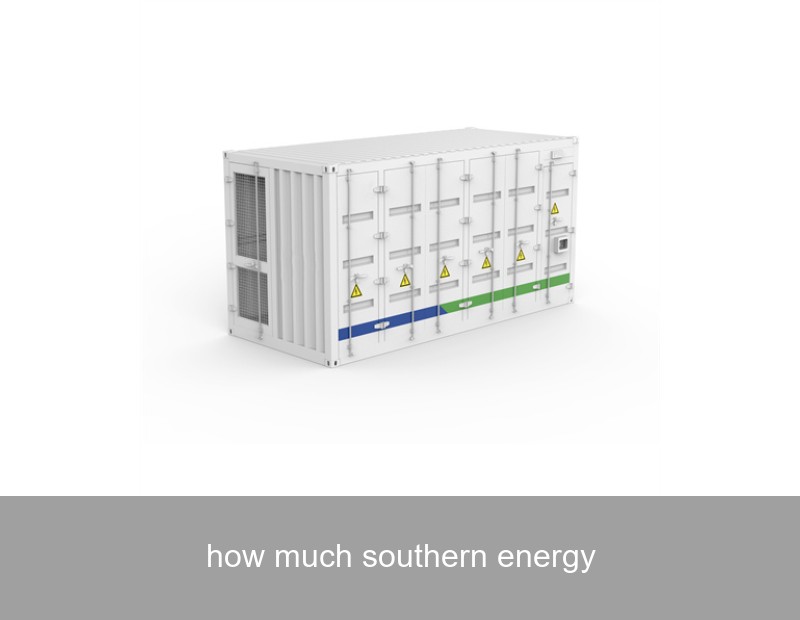
For larger-scale needs, such as utility support or industrial microgrids, our HI-Block containerized solutions provide multi-megawatt storage in a pre-integrated, rapidly deployable format. We don't just sell hardware; we provide a complete, intelligent power resilience platform.

Image Source: Unsplash - Representative image of a modern battery storage system control interface.
The Future of the Southern Energy Grid
The integration of widespread storage is fundamentally reshaping energy economics in sun-rich regions. A report by Wood Mackenzie notes that the U.S. storage market is set to grow exponentially, driven largely by states like Texas, California, and Florida. The goal is no longer just to generate clean energy, but to create a dispatchable clean energy resource that can compete with, and eventually replace, traditional peaker plants.
This evolution turns the question from "how much southern energy can we generate?" to "how much southern energy can we intelligently integrate into a resilient, sustainable, and cost-effective grid?" The answer grows more promising every day as storage costs decline and software intelligence advances.
So, what's the first step your business or community should take to move from simply having solar potential to fully owning your 24/7 clean power destiny?
 Inquiry
 Online Chat