


How Much Power Can a Sun2000 20K-MBO Inverter Really Deliver? A Data-Driven Analysis
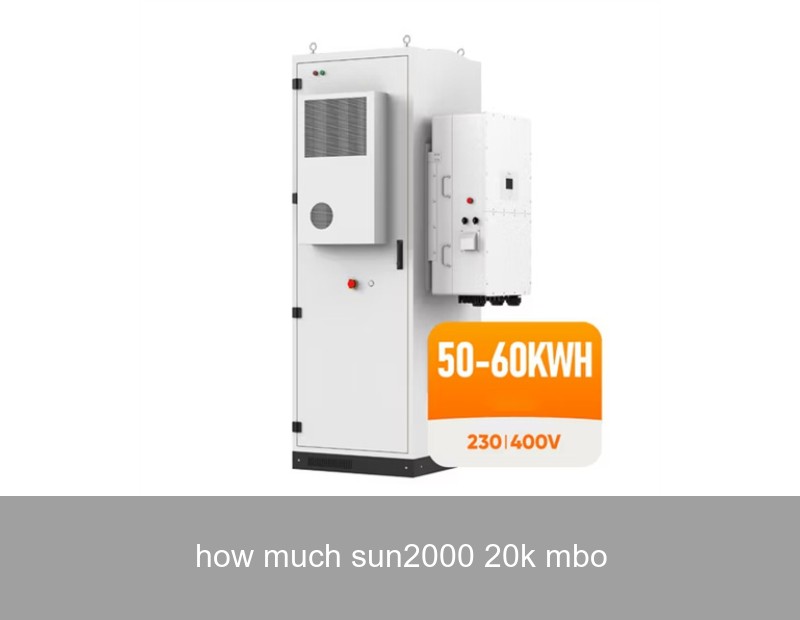
If you're planning a commercial or large residential solar installation, you've likely asked: "How much power can a system built around a Sun2000 20K-MBO inverter actually produce?" It’s a brilliant question because the answer isn't just a number on a datasheet. The true output hinges on a fascinating interplay between your location's climate, your panel selection, system design, and crucially, how well your energy storage integrates. As a product technology expert at Highjoule, I spend my days demystifying these questions to help businesses and homeowners unlock maximum value from their renewable investments.
The Phenomenon: The Quest for True Solar Output
Many assume that pairing a 20kW inverter with 20kW of panels yields a predictable, constant output. The reality is more dynamic. Solar generation is a dance with the sun, influenced by irradiance, temperature, shading, and system losses. The inverter, like the Huawei Sun2000-20KTL-MBO, is the conductor of this orchestra—it converts the DC power from your panels into usable AC power. Its "20K" nameplate rating (20,000 watts) is its maximum output capacity under specific conditions. But the input from your panels can be higher, allowing it to clip during peak sun hours to capture more morning and evening energy—a smart trade-off for greater overall yield. So, "how much" it delivers daily or annually is a calculation that extends far beyond the inverter itself.
The Data: Decoding the Sun2000 20K-MBO Spec Sheet
Let's break down the key specifications that influence real-world performance:
- Max. Output Power: 20 kW (This is your AC ceiling).
- Max. DC Input Power: Often recommended at ~22-24 kW for optimal sizing, allowing the inverter to handle peak panel production without excessive clipping.
- MPPT Range & Efficiency: With multiple Maximum Power Point Trackers (MPPTs), this inverter excels at handling arrays on different roof planes or with partial shading, maximizing harvest from each string. Its peak efficiency exceeds 98.5%, meaning minimal energy is lost in conversion.
To estimate production, we use tools like NREL's PVWatts Calculator. For a 22kW DC system using a 20K-MBO inverter in Southern California (a prime market), we might see:
| Month | Estimated AC Energy (kWh) |
|---|---|
| January | 2,450 |
| July | 3,620 |
| Annual Total | ~36,000 kWh |
In sunnier parts of Europe, like Spain, the annual yield could be similar, while in Germany, it might be closer to 28,000-32,000 kWh due to lower irradiance. This variance highlights why geographic context is king.

Image Source: Unsplash (Professional photography of commercial solar arrays)
Case Study: A German Dairy Farm's Real-World Results
Let's move from theory to practice. A dairy farm in Bavaria, Germany, partnered with Highjoule to achieve energy independence. Their goal was to power milking operations, cooling, and farm facilities.
- System Core: Huawei Sun2000-20KTL-MBO inverter.
- Panel Array: 21.6 kWp of high-efficiency monocrystalline panels.
- The Critical Addition: A Highjoule HES-30 integrated battery storage system (30 kWh capacity).
- Smart Management: Highjoule's Energy Management System (EMS) for intelligent dispatch.
The results after one year? The solar system alone generated approximately 31,500 kWh. However, the Highjoule battery and EMS enabled 85% self-consumption of that solar energy, up from an estimated 35% without storage. By storing midday surpluses for use during high-tariff evening hours, the farm reduced its grid electricity purchases by over 70%. The inverter's reliable performance was foundational, but the intelligent storage and management truly unlocked the financial and operational resilience. You can explore more real-world data from the U.S. Department of Energy's Solar Office.
The Insight: It's Not Just the Inverter, It's the Ecosystem
The inverter is a superb component, but it's not a standalone solution. Modern energy independence requires a holistic system: generation (solar panels), conversion (inverter), storage (battery), and intelligence (software). This is where companies like Highjoule create transformative value. Founded in 2005, we've evolved from providing components to delivering complete, smart energy ecosystems. Our expertise lies in seamlessly integrating top-tier hardware like the Sun2000 with our own advanced battery systems and AI-driven software platforms.
The Highjoule Advantage: Beyond the Inverter
When you choose Highjoule, you're not just buying an inverter-compatible system; you're investing in a optimized, future-proof energy asset. Our solutions for commercial, industrial, and residential applications ensure every kilowatt-hour from your Sun2000 20K-MBO is captured, stored, and used strategically.
- Highjoule HES Series Battery Systems: Our scalable lithium-ion batteries (from 10 kWh to multi-MWh) are engineered for safety, longevity (10,000+ cycles), and seamless communication with leading inverters, ensuring stable DC coupling or flexible AC coupling setups.
- Intelligent Energy Management System (EMS): This is the brain. Our EMS uses weather forecasting, load profiling, and tariff data to autonomously decide when to store solar energy, power your loads, or sell back to the grid, maximizing your return.
- Microgrid-Ready Design: For businesses prioritizing resilience, our systems can island from the grid during outages, keeping critical operations running using stored solar energy.

Image Source: Unsplash (Example of a clean, modern home battery installation)
Consider this: a Sun2000 inverter maximizes harvest, but without storage, a significant portion of that midday energy might be exported at low rates. Pairing it with a Highjoule system transforms that exported energy into on-demand power, a concept thoroughly supported by grid studies from entities like the Fraunhofer Institute for Solar Energy Systems.
Your Next Step: From Calculation to Reality
So, back to your initial question: "How much can a Sun2000 20K-MBO deliver?" With the right design and partners, it can deliver far more than just AC watts—it can deliver energy security, significant cost savings, and a substantial step toward sustainability. The precise kWh figure for your property depends on your roof, your sun, and your consumption patterns.
What specific energy challenge—be it rising utility costs, demand charge management, or backup power needs—is driving your interest in a 20kW solar solution today?
 Inquiry
 Online Chat