


Industrial UPS Battery Backup: The Unsung Hero of Modern Manufacturing
a fully automated automotive assembly line is humming along, robots welding with precision, conveyors moving seamlessly. Suddenly, the lights flicker. A voltage dip, lasting less than a second, hits the grid. Without a robust industrial UPS battery backup system, the entire line could halt. The result? Six-figure losses from downtime, scrapped materials, and missed deadlines—all in the blink of an eye. In today's hyper-connected, just-in-time industrial landscape, clean, continuous power isn't a luxury; it's the very lifeblood of productivity and profitability. This article delves into why modern industry demands a new approach to backup power and how advanced battery energy storage systems (BESS) are providing the answer.
Table of Contents
- The Silent Threat: More Than Just Blackouts
- The Data: Quantifying the Cost of Unreliable Power
- Case Study: A German Automotive Supplier's Solution
- Industrial UPS Reimagined: BESS vs. Traditional Solutions
- Highjoule's Role: Intelligent Power Resilience for Industry
- Future-Proofing Your Power Strategy
The Silent Threat: More Than Just Blackouts
When most facility managers think of power problems, they imagine complete outages. However, the more frequent and insidious threats are power quality issues: sags, swells, harmonics, and frequency variations. These are often caused by grid instability, nearby heavy machinery switching on, or even renewable energy intermittency. An ordinary standby generator is too slow to react to these micro-events. What you need is an industrial UPS battery backup that acts as a buffer, providing instantaneous power to bridge these gaps and condition the electricity feeding your sensitive CNC machines, PLCs, and data centers.
The Data: Quantifying the Cost of Unreliable Power
The numbers are staggering. According to a report by the U.S. Department of Energy, power outages and interruptions cost the U.S. economy an estimated $150 billion annually, with the industrial sector bearing a significant portion. A study by the Ponemon Institute found that the average cost of a single data center outage has risen to over $740,000. For a continuous process plant, like chemical or pharmaceutical manufacturing, even a brief shutdown can mean days of lost production as systems are restarted and recalibrated. This financial risk makes a reliable backup system not an expense, but a critical capital protection asset.
Case Study: A German Automotive Supplier's Resilience Transformation
Let's look at a real-world example. A Tier-1 automotive supplier in Bavaria, Germany, producing high-precision electric vehicle components, faced recurring micro-outages from the local grid, averaging 8-10 events per year. Each event caused a 45-minute production stoppage for their cleanroom manufacturing line. Their existing diesel genset took 12-15 seconds to engage, which was insufficient.
The Solution: The company partnered with Highjoule to deploy a containerized, lithium-ion Battery Energy Storage System (BESS) integrated with a high-efficiency UPS. The system was designed for a 500 kW / 1 MWh capacity.
The Results (After 18 Months):
- Zero Production Stoppages: 14 grid disturbances were seamlessly bridged by the BESS with zero interruption.
- Cost Savings: Avoided an estimated €580,000 in lost production and scrap material.
- Energy Arbitrage: The system was programmed to charge during low-tariff night hours and discharge during peak afternoon hours, reducing demand charges and saving an additional €65,000 annually.
- CO2 Reduction: By minimizing diesel generator runtime, the facility cut its backup-related emissions by over 80%.
This case exemplifies the dual role of a modern industrial UPS battery backup: it's both a guardian of uptime and a tool for energy cost optimization.

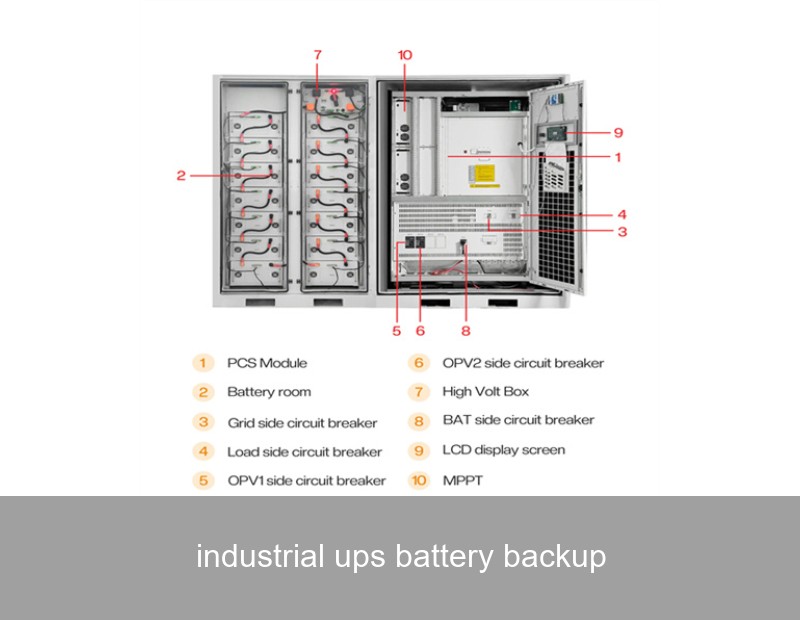
Modern industrial BESS solutions, like those from Highjoule, are designed for seamless integration into demanding factory environments.
Industrial UPS Reimagined: BESS vs. Traditional Solutions
How does a battery-based system differ from legacy approaches? The comparison is revealing.
| Feature | Traditional Lead-Acid UPS + Diesel Genset | Advanced Lithium BESS (e.g., Highjoule) |
|---|---|---|
| Response Time | UPS: Instantaneous; Genset: 10-30 seconds | Fully instantaneous (sub-20ms) |
| Runtime | Limited by battery bank size; requires fuel for long outages | Scalable energy capacity; can be sized for critical hours of backup |
| Additional Value | Primarily backup only | Peak shaving, demand charge management, renewable integration |
| Lifetime & Maintenance | Frequent battery replacement, fuel maintenance, emissions testing | Long cycle life, minimal maintenance, no emissions during use |
| Footprint & Flexibility | Large, fixed infrastructure | Modular, scalable, can be containerized for easy deployment |
Highjoule's Role: Intelligent Power Resilience for Industry
Since 2005, Highjoule has been at the forefront of this shift. We understand that an industrial UPS battery backup is a core component of operational intelligence. Our H-Series Industrial BESS is engineered specifically for harsh industrial environments. It combines high-density, UL 9540-certified lithium-ion battery racks with our proprietary EnergyOS™ control platform. This isn't just a battery; it's an intelligent energy asset.
What does this mean for your facility? The system continuously monitors your load and grid conditions. In the event of a disturbance, it provides seamless backup. During normal operation, it automatically switches to cost-optimization mode, discharging strategically to cut peak demand charges—a major line item for factories. Furthermore, for facilities with on-site solar, our BESS stores excess solar generation, maximizing self-consumption and shielding you further from grid volatility. We provide end-to-end service, from initial consultancy and system design to installation, grid integration, and 24/7 remote monitoring.

Integrating on-site renewables with a robust BESS creates a true microgrid, enhancing sustainability and independence.
Future-Proofing Your Power Strategy
The energy landscape is changing rapidly. Electrification, carbon reduction targets, and volatile energy markets are pressing concerns for every plant manager. A forward-thinking power resilience strategy must address these trends. The U.S. National Renewable Energy Laboratory (NREL) highlights the critical role of storage in enhancing grid and community resilience. By investing in a versatile BESS today, you're not just buying backup power; you're building an adaptable energy infrastructure that can participate in future grid services, accommodate more electric vehicle charging, and ensure compliance with tightening environmental regulations.
An Open Question to Consider
As you look at your facility's energy roadmap, can you afford to view your industrial UPS battery backup as a standalone insurance policy? Or will you leverage it as a strategic, revenue-protecting, and cost-saving asset that actively contributes to your bottom line and sustainability goals every single day, not just during emergencies? What would a 30% reduction in your peak demand charges do for your operational budget this year?
 Inquiry
 Online Chat