


How Much Do Jauch Batteries Cost? A Deep Dive into Value and Performance
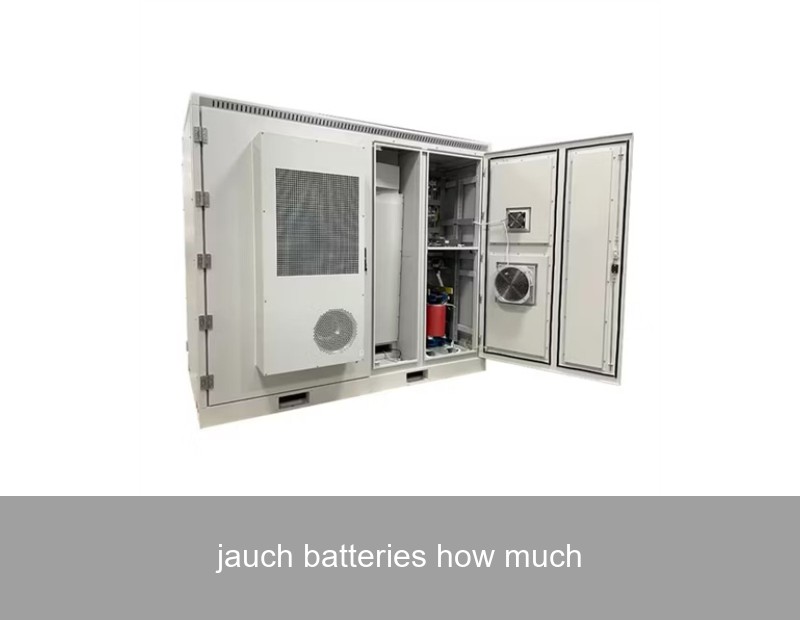
If you're researching energy storage for a critical application, you've likely come across the question: "Jauch batteries how much?" It's a valid starting point, but as with any sophisticated technology, the answer is rarely a simple number. In the world of renewable energy, medical devices, security systems, and industrial IoT, Jauch batteries are known for their reliability. However, understanding their total cost of ownership and exploring the broader landscape of energy storage solutions is crucial for making an informed investment. Let's unpack the factors behind the price and explore what true value means in today's advanced energy storage market.
What Are Jauch Batteries and Where Are They Used?
Jauch is a well-established German battery manufacturer, particularly recognized for its high-quality lithium-ion and lithium polymer cells and battery packs. They are a key component supplier, often providing the "heart" of a system rather than complete, ready-to-install energy storage solutions. You'll typically find Jauch batteries integrated into:
- Uninterruptible Power Supplies (UPS): Protecting servers and critical infrastructure.
- Medical Technology: Powering portable devices and emergency systems where failure is not an option.
- Security & Alarm Systems: Ensuring 24/7 operation even during grid outages.
- Consumer Electronics: In tools, e-bikes, and specialized equipment.
Their reputation is built on precision engineering and consistency, which is reflected in their pricing, often positioned at a premium compared to standard consumer-grade cells.
The Real Cost Breakdown: More Than Just the Price Tag
Asking "how much" for a battery is like asking "how much for a car." The range is vast. A single Jauch lithium polymer cell might cost anywhere from $10 to $50+, depending on capacity and chemistry. A custom battery pack for a specific medical device could run into the hundreds of dollars. But the initial purchase price is just the tip of the iceberg.
The true cost encompasses:
- Initial Purchase Price: The invoice cost of the cells or battery pack.
- Integration & Engineering: Costs for designing the battery management system (BMS), housing, and integrating it into your product or system.
- Lifetime & Cycle Life: How many charge/discharge cycles can it endure before capacity degrades? A cheaper battery that needs replacing twice as often is more expensive in the long run.
- Efficiency: Energy lost as heat during charging and discharging. Higher efficiency means lower electricity bills and faster ROI.
- Warranty & Support: The length and terms of the warranty are a direct reflection of the manufacturer's confidence and add to the product's value.

Image: Understanding total cost requires looking beyond the cell to integration and testing. (Source: Unsplash)
Key Factors Influencing the Price of Jauch Batteries
Several technical specifications directly impact the "how much" for a Jauch or any premium battery:
| Factor | Impact on Cost | Question to Ask |
|---|---|---|
| Chemistry (NMC, LFP, LiPo) | LFP (Lithium Iron Phosphate) often has a higher upfront cost but a much longer cycle life than NMC. | Is longevity or high energy density more important for my use case? |
| Capacity (Ah or kWh) | Cost increases roughly linearly with capacity. Doubling the storage typically doubles the cell cost. | What is my actual daily energy need to avoid over-sizing? |
| Voltage & Configuration | Custom series/parallel configurations for specific voltage needs add engineering and BMS complexity. | Does my system require a standard or custom voltage? |
| Certifications (UL, IEC, UN38.3) | Mandatory for commercial/industrial use, these rigorous tests add significant cost but ensure safety. | What certifications are required for my market and application? | Order Volume | Unit cost for a prototype batch is vastly higher than for a mass-production order of 10,000 units. | What is the scale of my project? |
A Real-World Case Study: Cost vs. Value in Action
Let's move from theory to practice. Consider a mid-sized winery in California's Napa Valley. They wanted to reduce peak demand charges and ensure backup power for critical refrigeration. Their initial research looked at standard lithium-ion options.
Phenomenon: High afternoon energy demand from cooling systems coincided with peak utility rates, leading to exorbitant monthly bills. Grid instability also posed a spoilage risk.
Data: Their peak demand was 200kW, with a daily backup need of 100kWh. A standard system quote came in at around $120,000 with a 10-year expected lifespan and 80% depth of discharge.
Case & Insight: They opted for a solution using Highjoule's H-Stack Industrial battery energy storage system (BESS), which utilizes Lithium Iron Phosphate (LFP) chemistry. The upfront investment was approximately $140,000—higher than the initial quote. However, the Highjoule system offered a 15-year warranty, 95% round-trip efficiency (vs. 88% on the standard quote), and could handle 100% depth of discharge without significant degradation. The intelligent energy management software also optimized discharge to shave peak demand more precisely. Within 4 years, the higher efficiency and superior peak-shaving capabilities delivered a full return on investment (ROI), and the longer lifespan meant years of additional, nearly free energy storage. The true cost per kWh stored over the system's life was dramatically lower.

Image: Commercial energy storage, like at this winery, requires calculating long-term operational savings. (Source: Unsplash)
The Highjoule Alternative: Smart Energy Storage Solutions
While component batteries like those from Jauch are essential for OEMs, end-users—whether homeowners, businesses, or microgrid operators—need complete, warrantied, and intelligent systems. This is where Highjoule positions its expertise. As a global leader in advanced储能系统 since 2005, we don't just sell battery cells; we deliver integrated power solutions.
For someone asking "Jauch batteries how much?" but actually needing reliable power, Highjoule provides a clearer path:
- Highjoule H-Cube Residential: A sleek, all-in-one storage system that pairs seamlessly with solar. Homeowners get a guaranteed performance, with intuitive app control, without worrying about individual cell specifications.
- Highjoule H-Stack Commercial & Industrial (C&I): Scalable from 100kWh to multi-MWh, these modular systems are engineered for maximum ROI through peak shaving, demand response, and backup power. They feature our proprietary Adaptive BMS for safety and longevity.
- Highjoule Microgrid Solutions: Complete, turnkey systems that integrate generation, storage, and load management for energy independence in remote locations or resilient campuses.
Our value proposition shifts the question from "how much does this component cost?" to "how much value can this energy solution create?" We handle the complex integration, ensuring safety, compliance, and optimal performance so our customers can focus on their core activities.
How to Make the Right Decision for Your Project
So, how do you navigate this complex landscape? Start by defining your needs with precision:
- Application: Is this for product integration (OEM) or an end-user energy storage system?
- Performance Requirements: Define needed capacity, power output, cycle life, and efficiency.
- Total Budget: Consider CapEx (purchase) and OpEx (operating costs, electricity savings) over a 10-15 year period.
- Vendor Evaluation: Look for proven track records, comprehensive warranties, and local service support.
For deeper insights into battery technology trends, authoritative resources like the U.S. DOE Battery Testing Manual or the IEA's Energy Storage Report offer valuable context.
Ultimately, the most important question isn't "Jauch batteries how much?" but rather, "What is the most reliable and cost-effective way to meet my specific energy resilience and savings goals?" Whether you are an engineer selecting components or a business owner seeking energy independence, the answer lies in a holistic view of performance, partnership, and long-term value. What specific energy challenge are you looking to solve, and what has been your biggest hurdle in evaluating the true cost of a solution?
 Inquiry
 Online Chat