


How Much Does an LFP PV Speicher (Battery) Really Cost? A Complete Breakdown
If you're a homeowner in Europe or the US looking at solar panels, one question inevitably pops up: "Should I add a battery?" And more specifically, "How much does a good LFP PV Speicher cost?" It's a smart question. With electricity prices fluctuating and the desire for energy independence growing, investing in a Lithium Iron Phosphate (LFP) battery for your photovoltaic (PV) system is a major consideration. The simple answer is: a complete system for a typical home can range from $8,000 to $15,000+ installed. But the real answer is far more nuanced. The price tag is just the entry point—the true value lies in understanding the technology, the long-term savings, and the peace of mind it brings. Let's demystify the costs together.
The LFP Advantage: Why It's the Go-To for Home Storage
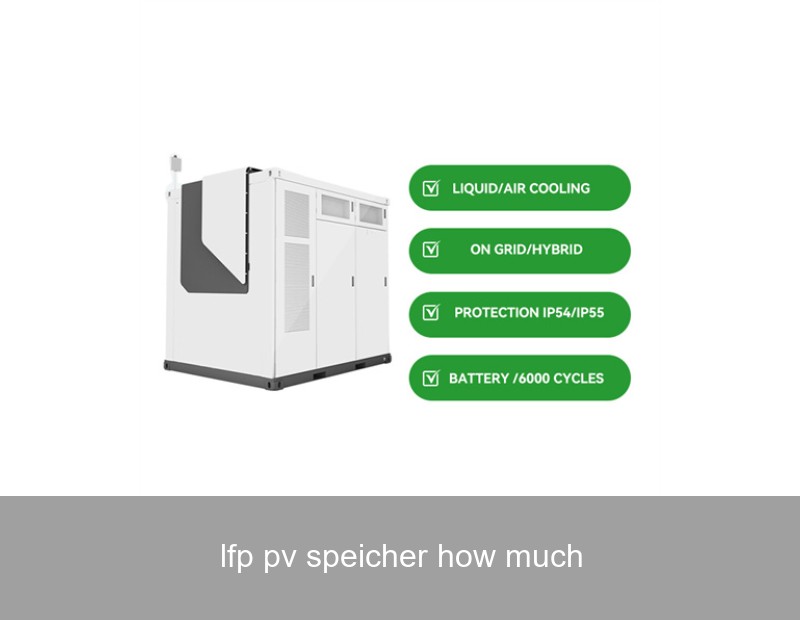
First, why is LFP the buzzword in residential energy storage? LFP stands for Lithium Iron Phosphate, a specific type of lithium-ion battery chemistry. It has become the dominant choice for home PV Speicher systems, and for good reason. Unlike older chemistries, LFP batteries offer exceptional thermal and chemical stability, making them inherently safer with a much lower risk of fire. They also boast a long lifespan, typically rated for 6,000 to 10,000 cycles, meaning they can be charged and discharged daily for well over 15 years. While their energy density might be slightly lower than some alternatives, for a stationary home battery, safety, longevity, and value-for-money are the winning trifecta.

Think of it this way: you wouldn't want the most energy-dense but less stable battery chemistry sitting in your garage. You want the reliable, long-lasting workhorse—that's LFP.
The Real Cost Breakdown: More Than Just the Battery Price
When asking "how much," you're rarely just buying a battery box. You're investing in a complete system integration. Here’s what contributes to the final cost:
- The Battery Module(s): This is the core cost, usually priced per kilowatt-hour (kWh) of usable capacity. In 2024, you can expect roughly $400 to $800 per kWh for quality LFP modules. A 10 kWh usable capacity unit, a common size, might have a module cost between $4,000 and $8,000.
- The Battery Management System (BMS): The brain of the operation. A sophisticated BMS, like those used in Highjoule systems, is crucial for safety, performance, and longevity. It's integrated into the overall product cost.
- The Hybrid Inverter or DC-Coupling Solution: This device manages power flow between your solar panels, battery, and home grid. If you're adding storage to an existing PV system, you might need a compatible hybrid inverter. Costs range from $1,500 to $4,000.
- Balance of System (BoS): Cabling, electrical components, safety disconnects, and mounting hardware.
- Installation & Labor: This varies widely by region, installer, and system complexity. Typically, labor can add $1,500 to $3,000 to the project.
- Permits & Grid Connection Fees: Local authorities may require permits, and your utility might have specific interconnection requirements.
| Cost Component | Estimated Range (USD) | Notes |
|---|---|---|
| LFP Battery (10 kWh usable) | $4,000 - $8,000 | Core component; price varies by brand, warranty, and features. |
| Hybrid Inverter | $1,500 - $4,000 | May not be needed for DC-coupled or all-in-one systems. |
| Installation & Labor | $1,500 - $3,000 | Highly dependent on location and system complexity. |
| Total Installed Cost (Est.) | $8,000 - $15,000+ | Before incentives or tax credits. |
From Theory to Practice: A German Household Case Study
Let's look at real data. The Fraunhofer ISE Energy Charts consistently show that solar power generation peaks at midday, while household consumption often peaks in morning and evening. This mismatch is the core value proposition for a battery.
Consider a family in Bavaria, Germany, with a 8 kWp solar array and an annual consumption of 4,500 kWh. Before installing a LFP PV Speicher, their self-consumption rate (using their own solar power directly) was around 30%. They installed a 9.6 kWh Highjoule Harmony Home system. The result? Their self-consumption rate jumped to over 80%. They now buy minimal electricity from the grid, primarily in deep winter. Based on a German electricity price of €0.35/kWh (approx. $0.38), they are avoiding over €1,200 ($1,300) in grid electricity costs annually. With the system's 12-year warranty and projected lifespan of 20+ years, the payback period falls well within the warranty period, after which they enjoy nearly free electricity for years.
Highjoule's Smart LFP Solutions: Engineered for Value & Safety
At Highjoule, with nearly two decades of experience, we've engineered our LFP-based systems to maximize your investment from day one. Our Harmony Home Series isn't just a battery; it's an integrated energy management platform. We address the core cost factors by offering scalable, modular designs. Start with a base capacity and expand later if your needs change—this prevents overbuying initially. Our all-in-one units include the high-efficiency inverter and advanced, self-monitoring BMS, simplifying installation and reducing BoS costs.

More importantly, our systems are built for the long haul. Using automotive-grade LFP cells and a proprietary thermal management system, we ensure cycle life that meets or exceeds spec sheets in real-world conditions. For our commercial and industrial clients, our GridMAX series provides the same LFP reliability at utility scale, enabling peak shaving and backup power for critical operations. The question isn't just "how much does the battery cost," but "how much value does a thoughtfully engineered system deliver over its lifetime?"
Maximizing Your ROI: Key Factors That Influence "How Much" You Save
Your return on investment (ROI) depends on several local factors:
- Your Local Electricity Rates & Net Metering Policy: Higher grid prices and less favorable net metering (where you sell excess solar back to the grid) make batteries more valuable. In many parts of the US and Europe, feed-in tariffs are dropping, making self-consumption king.
- Solar Production Profile & Consumption Habits: A home that is occupied during the day may benefit less than one where everyone is out until evening. Smart energy management, like scheduling high-load appliances, can boost savings.
- Available Incentives: This is huge. The US federal Investment Tax Credit (ITC) currently covers 30% of the installed cost of a solar-plus-storage system. Many European countries, like Italy and Austria, also offer substantial grants or tax deductions. Always consult a local expert on the latest schemes. The DSIRE database is a great resource for North American incentives.
- System Configuration: DC-coupled systems (where solar charges the battery directly) can be more efficient than AC-coupled for new installations, impacting long-term energy harvest.
Your Next Step: Finding Your Perfect Match
So, how much for your LFP PV Speicher? The journey to a precise number starts with understanding your unique energy fingerprint. We recommend you gather your last 12 months of electricity bills to understand your consumption patterns. Then, have a qualified installer assess your site, existing solar (if any), and discuss your goals: Is it backup power during outages, maximizing self-sufficiency, or locking in energy costs?
Given the complexity and long-term nature of this investment, what specific energy goal is most important for your household to achieve in the next 5 years?
 Inquiry
 Online Chat