


Understanding Longi Solar Panels Price in Sweden for a Smarter Investment
If you're a homeowner or business in Sweden considering solar power, you've likely come across Longi solar panels. Renowned globally for their high efficiency and reliability, they are a compelling choice for harnessing the Swedish sun. But when you start searching for "Longi solar panels in Sweden price," you quickly realize the quoted figure is just the beginning. The true value—and the final cost of your energy independence—is a more nuanced equation, influenced by Sweden's unique climate, energy market, and the crucial integration of storage. Let's illuminate the full picture.
The Swedish Solar Surge: More Than Just Midnight Sun
Sweden's relationship with solar energy is fascinating. While the famous midnight sun graces the north, the southern and central regions, where most of the population lives, receive a moderate amount of sunlight—comparable to parts of Germany, a solar leader. The driving forces here aren't just peak sun hours; they are soaring electricity prices, strong environmental consciousness, and supportive policies like the tax deduction for solar electricity production (solcellselsbonus). This creates a market where the quality and longevity of your components, like choosing high-efficiency Longi panels, matter immensely for maximizing every kilowatt-hour of available light.

Image: A typical Swedish home integrating solar panels. Source: Unsplash
Decoding the Price of Longi Solar Panels in Sweden
As of 2024, the price for Longi solar panels in the Swedish market typically ranges from 2.5 to 4 SEK per watt peak (Wp) for the modules themselves, depending on the specific series (e.g., Hi-MO series) and order volume. For a standard 5 kWp residential system, that translates to roughly 12,500 - 20,000 SEK for the panels. However, this is merely the hardware cost of the panels.
The total installed system price, which includes inverters, mounting structures, cabling, and labor, usually falls between 15,000 and 25,000 SEK per kWp installed. Therefore, a complete 5 kWp system with Longi panels might have a gross investment between 75,000 and 125,000 SEK. The solcellselsbonus, which is paid per kWh fed into the grid over 15 years, significantly offsets this initial cost.
Key Factors Influencing the Final Quote:
- Panel Model: Longi's Hi-MO X series, with its advanced bifacial or N-type technology, commands a premium over the standard Hi-MO 5 series due to higher efficiency and better low-light performance.
- System Complexity: Roof type (tiled vs. metal), angle, accessibility, and any necessary electrical upgrades.
- Installation Partner: Reputable, certified installers with proven track records may charge more but ensure optimal performance and warranty validity.
- Economies of Scale: Larger commercial installations see a significantly lower cost per kWp.
The Real Cost: Beyond the Price Tag per Panel
Focusing solely on the Longi solar panels price in Sweden can lead to a suboptimal investment. The real metric is the Levelized Cost of Energy (LCOE)—the average net present cost of electricity generation over the system's lifetime. High-efficiency panels like Longi's reduce LCOE by generating more power from the same roof area, especially important during Sweden's shorter winter days. But there's a pivotal, often overlooked, component: what happens to the energy you produce?
Without storage, excess daytime solar energy is sold to the grid at a price lower than the retail rate you buy it back at in the evening. This arbitrage loss diminishes your savings.
A Stockholm Case Study: From Quote to Kilowatt-hour
Consider the Andersson family in Västerås. In early 2023, they installed a 8.2 kWp system using Longi Hi-MO 5 panels (410W each). The total installed cost was approximately 185,000 SEK. In its first year, the system produced 7,800 kWh. About 35% of this was directly consumed, offsetting their daytime electricity costs. The remaining 65% was exported to the grid.
While the solcellselsbonus provided a return on exported power, their self-consumption rate was the true savings driver. They realized that to increase this rate and gain true energy independence, they needed to store their surplus. This is a common "aha moment" for Swedish solar adopters and leads us to the most critical part of the value chain.
Maximizing Your Investment: The Critical Role of Storage
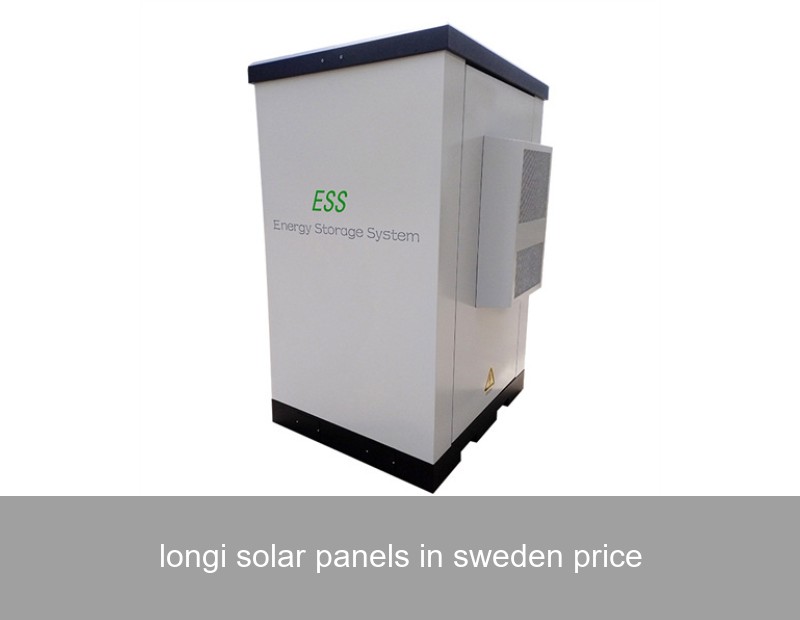
This is where the story evolves from generating cheap power to managing your own smart energy ecosystem. A solar panel system is a one-way producer; a Battery Energy Storage System (BESS) turns your home into a resilient, self-optimizing microgrid.
By adding storage, you can:
- Boost Self-Consumption: Store excess daytime solar for use at night, potentially increasing self-use from ~30-40% to over 70%.
- Provide Backup Power: Keep essential loads running during grid outages—a valuable feature even in reliable grids.
- Optimize Economics: Charge the battery with solar or cheap off-peak grid electricity and discharge during expensive peak hours.
This integration is not trivial. It requires an intelligent system that seamlessly manages energy flow between panels, battery, home loads, and the grid.
Highjoule: Your Partner for a Complete Swedish Energy Solution
At Highjoule, we understand that the journey doesn't end with selecting premium Longi solar panels in Sweden. The price of panels is a starting point for a broader conversation about energy resilience and efficiency. Since 2005, we have evolved into a global leader by providing integrated, intelligent storage solutions that make high-quality generation like Longi truly pay off.
For the Swedish market, we offer our Highjoule HES (Home Energy System), a modular and scalable battery storage solution. The HES is designed to work harmoniously with any high-efficiency solar array, including Longi. Its AI-driven energy management software doesn't just store power; it learns your consumption patterns, weather forecasts, and electricity tariff schedules to autonomously make decisions that maximize your financial savings and comfort.

Image: A modern home battery storage unit, similar to Highjoule's systems. Source: Unsplash
Imagine the Andersson family retrofitting their system with a Highjoule HES. Their 70%+ self-consumption would shield them from volatile spot prices. During a winter grid disturbance, their heat and lights stay on. Our systems are designed for the Scandinavian environment, with robust performance and remote monitoring via a user-friendly app.
Why Pair Longi with Highjoule?
| Component | Role | Highjoule's Value Addition |
|---|---|---|
| Longi Solar Panels | High-efficiency energy generation | Provides the high-quality, reliable DC power that our systems are optimized to manage and store. |
| Highjoule HES | Intelligent energy storage & management | Unlocks the full value of your solar investment by maximizing self-use, providing backup, and enabling smart grid interaction. |
| Integrated System | Complete home energy ecosystem | Delivers peace of mind, true energy independence, and optimized lifetime savings that far exceed the sum of its parts. |
Navigating Your Solar Journey in Sweden
So, when you research Longi solar panels price in Sweden, remember you are investing in an energy solution, not just panels. The most strategic approach is to plan your solar-plus-storage system holistically from the outset. This ensures all components are perfectly sized and compatible, often leading to a lower total integrated cost than retrofitting later.
We encourage you to request quotes that include both high-efficiency panels and a capable storage system like the Highjoule HES. Compare not just the upfront cost, but the projected 20-year savings, increased self-sufficiency, and resilience. Ask installers about their experience with integrated systems and the intelligence of the energy management platform.
What specific energy goals are you hoping to achieve with your solar investment—is it purely financial return, complete backup security, or reducing your carbon footprint to its absolute minimum?
 Inquiry
 Online Chat