


How to Make Solar Energy Economical: A Practical Guide for Homeowners and Businesses
For decades, the dream of harnessing the sun's abundant power has been tempered by a single, persistent question: "Is it worth the cost?" While the environmental benefits are clear, making solar energy economical—truly cost-effective over the long term—has been the final hurdle for widespread adoption. The good news? That hurdle is being cleared right now. This isn't just about cheaper panels; it's about a smarter, more integrated system that turns sunlight into reliable, affordable electricity day and night. Let's explore the modern equation for solar economics.
Table of Contents
- The Phenomenon: The Price-Value Gap in Solar
- The Data: Where the Savings Really Come From
- The Case Study: A German Bakery's Recipe for Success
- The Key Insight: It's About the System, Not Just the Panels
- The Highjoule Approach: Intelligent Storage for Maximum Economy
- Looking Forward: Your Energy Independence
The Phenomenon: The Price-Value Gap in Solar
You've likely seen the headlines: "Solar Panel Prices Have Fallen Over 80% in the Last Decade." It's true. The hardware for capturing solar energy is more affordable than ever. Yet, for many homeowners and business operators, the financial calculation still feels uncertain. Why? Because traditional solar setups often create a surplus of energy when you don't need it (in the middle of the day) and leave you dependent on the grid when you do (in the evening). This mismatch means you're not maximizing the value of every kilowatt-hour your panels produce. The true goal isn't just to generate solar power; it's to have economical solar power available precisely when your home or facility demands it.
The Data: Where the Savings Really Come From
Economics is driven by data. Let's break down the numbers. According to the International Renewable Energy Agency (IRENA), the global weighted-average levelized cost of electricity (LCOE) from utility-scale solar photovoltaics plunged 88% between 2010 and 2021. But for an end-user, the story is more nuanced. Savings are realized through three main channels:
- Reduced Grid Imports: Using your own solar power directly avoids buying expensive peak-hour electricity from your utility.
- Optimized Self-Consumption: The higher the percentage of your solar generation you use directly, the better your return on investment. This is where storage is key.
- Resilience Value: The ability to power critical loads during grid outages prevents business disruption or home inconvenience, a value that's increasingly important.
| Scenario | Solar Only | Solar + Advanced Storage (like Highjoule) |
|---|---|---|
| Self-Consumption Rate | 30-40% | 70-85%+ |
| Bill Reduction | 60-70% | 90-100%+ |
| Grid Independence During Outage | No | Yes |

Image: A modern energy setup maximizing solar use. Source: Unsplash
The Case Study: A German Bakery's Recipe for Success
Let's look at a real-world example from Bavaria, Germany. Bäckerei Schmidt (a mid-sized family bakery) faced steep energy costs, with ovens, refrigeration, and lighting operating from pre-dawn to evening. Their rooftop solar installation (50 kW) covered their daytime base load but left them buying expensive grid power during morning and evening peaks. They were only using about 35% of their solar generation directly.
In 2022, they integrated a Highjoule HI Series commercial battery storage system (120 kWh capacity). The results, monitored over one year, were compelling:
- Self-Consumption Jump: Increased from 35% to 82%.
- Energy Cost Savings: Total electricity costs reduced by an additional 68% on top of solar savings alone.
- Peak Shaving: The system's intelligent software learned the bakery's load patterns and discharged the battery during the highest tariff periods (6-8 AM and 5-8 PM), virtually eliminating demand charges.
- ROI Timeline: The combined solar + storage system is projected to pay for itself in under 7 years, thanks in part to Germany's supportive renewable energy framework.
"For us, it was a simple business decision," said owner Klaus Schmidt. "The Highjoule system didn't just store energy; it managed it intelligently, turning our solar panels from a partial solution into the backbone of our energy supply. We've baked our energy costs, quite literally."
The Key Insight: It's About the System, Not Just the Panels
The bakery's story underscores the pivotal insight: to make solar energy economical, you must shift your thinking from solar generation to integrated energy management. The solar panels are the source, but the brain of the operation is the energy storage and management system. An advanced battery system does more than just hold a charge; it:
- Time-shifts energy: Stores cheap, midday solar power for expensive, evening use.
- Optimizes dynamically: Uses weather forecasting and usage learning to predict solar yield and load needs.
- Provides grid services: In some markets, systems can even generate modest revenue by supporting grid stability.
- Ensures resilience: Keeps lights on during outages, a critical factor for businesses and families alike.
The Highjoule Approach: Intelligent Storage for Maximum Economy
This is where Highjoule's expertise, honed since 2005, becomes crucial. We don't just sell batteries; we provide intelligent, integrated storage solutions designed to make your solar investment economical from day one.
Our Residential HOMe Series features compact, high-density lithium iron phosphate (LiFePO4) batteries known for safety and longevity. Paired with our adaptive energy management platform, it seamlessly integrates with your existing or new solar array, learning your household patterns to maximize self-consumption and shield you from peak rates.
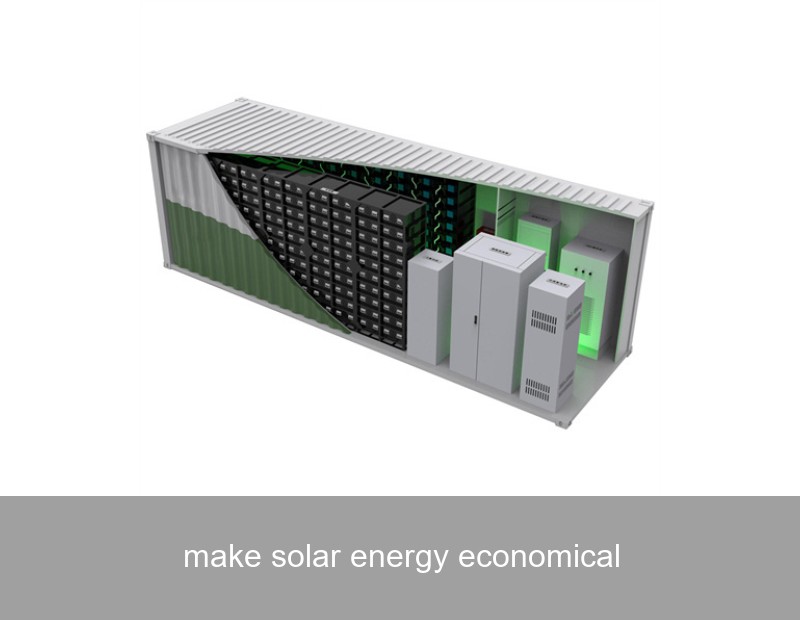
For commercial and industrial clients, our HI Series modular storage systems are scalable from 100 kWh to multi-megawatt hours. They come with sophisticated monitoring and control software that can manage complex load profiles, perform peak shaving, and even participate in demand response programs, turning your energy storage into an active financial asset.
Highjoule's systems are built on a foundation of safety, durability, and smart software—the three pillars required to ensure the long-term economics of your solar+storage project.

Image: A clean, modern battery storage installation. Source: Unsplash
Looking Forward: Your Energy Independence
The journey to make solar energy economical is no longer a waiting game. The technology is proven, the costs are viable, and the value extends beyond simple bill savings to encompass predictability, control, and resilience. Whether you're a homeowner tired of volatile utility rates or a business owner looking to lock in long-term operational costs, the combination of solar and intelligent storage presents a compelling answer.
So, the question isn't really "Can solar be economical?" The data and case studies confirm it can. The more pertinent question for you is: "What does my energy usage pattern look like, and how much of that could be transformed into predictable, clean, and self-controlled power with the right system?"
 Inquiry
 Online Chat