


Multiway Solar: How Much Can It Save and Transform Your Energy System?
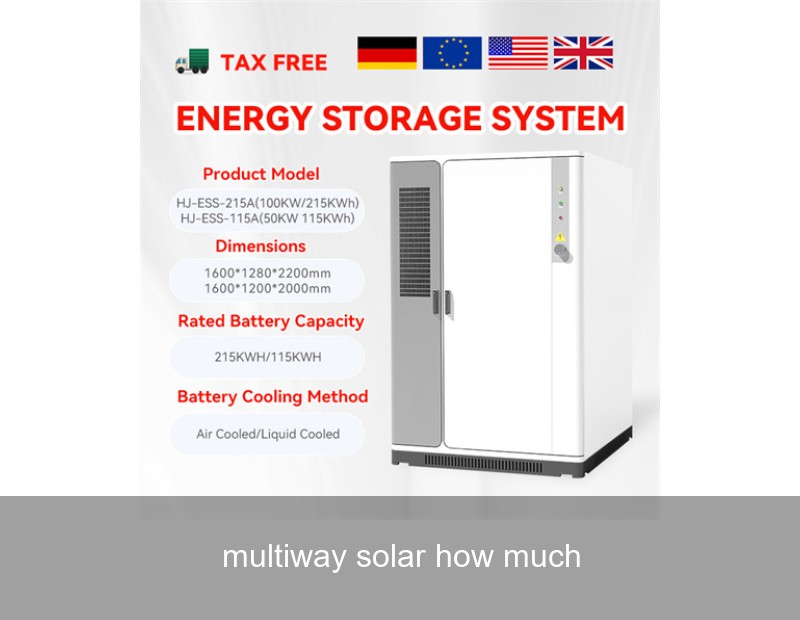
You've likely heard the buzz: solar panels are a great investment. But what if you could push that investment further? What if the sunlight hitting your roof could power not just your lights during the day, but also your evening TV, your overnight charging, and even your car? That's the promise of "multiway solar" – a system designed not just to generate, but to intelligently manage, store, and direct solar energy. So, the pressing question becomes: Multiway solar, how much benefit does it truly deliver, and is it worth the upfront cost? Let's break down the numbers, the technology, and the real-world impact to give you a clear picture.
Table of Contents
- The Phenomenon: From One-Way Street to Multi-Lane Energy Highway
- The Data: Quantifying the "How Much" in Savings and Security
- The Case Study: A European Business Cuts Bills and Carbon
- The Insight: It's About Intelligent Control, Not Just Panels & Batteries
- Highjoule's Role: Engineering Your Multiway Solar Ecosystem
- Your Next Step: From Curiosity to Clarity
The Phenomenon: From One-Way Street to Multi-Lane Energy Highway
Traditional solar setups are often a one-way street. Panels produce DC electricity, an inverter converts it to AC for your home, and any excess is sent back to the grid (often for a modest feed-in tariff). When the sun sets, you're back to buying 100% of your power from the utility. This model leaves a lot of potential on the table.
Multiway solar transforms this linear flow into a dynamic, multi-lane system. Think of it as your personal, intelligent energy ecosystem:
- Way 1: Solar energy powers your home/business in real-time.
- Way 2: Excess energy charges a battery storage system instead of being exported immediately.
- Way 3: Stored energy powers your property during peak evening hours or at night, avoiding high grid rates.
- Way 4: Sophisticated energy management can direct solar power to specific high-load appliances or electric vehicle chargers.
- Way 5: During a grid outage, the system can island itself, providing critical backup power from the battery.
This multi-directional flow is the core of modern energy resilience and independence. But to understand its true value, we need to look at the numbers.
The Data: Quantifying the "How Much" in Savings and Security
So, how much can you actually save? The answer depends on your location, energy consumption, utility rates, and system size. However, industry data provides compelling averages. According to the U.S. Department of Energy, adding storage to solar can increase a homeowner's energy self-consumption from 20-40% to 50-80% or more. This directly slashes the amount of expensive grid electricity you need to purchase.
Let's frame it with a simplified table for a typical household in California or Germany:
| Scenario | Solar Self-Consumption | Estimated Bill Reduction* | Grid Independence During Sun Hours |
|---|---|---|---|
| Solar Only (No Battery) | ~30-40% | 40-60% | High |
| Solar + Basic Battery | ~60-70% | 70-85% | Very High |
| Advanced Multiway Solar (with AI-driven management) | 80-95%+ | 80-95%+ | Near Total (with backup) |
*Reduction on electricity cost portion of bill. Actual savings vary. Figures are illustrative based on market analysis.
The key takeaway? The leap from "solar only" to "solar with storage" is significant, but the leap to an intelligently managed multiway solar system unlocks the final tier of value, optimizing every kilowatt-hour produced.

Image Source: Unsplash (Representative image of a modern solar-powered home and EV)
The Case Study: A European Business Cuts Bills and Carbon
Let's move from theory to a tangible example. A medium-sized dairy processing plant in the Netherlands faced volatile energy costs and stringent sustainability targets. Their daytime operations were energy-intensive, but much of their solar production (from a legacy array) was being exported at low noon-time rates, while they bought expensive power later.
They partnered with Highjoule to implement a turnkey multiway solar upgrade. The solution included:
- Expansion of their existing PV array.
- Installation of a Highjoule Matrix™ Commercial Battery Energy Storage System (BESS) with 500 kWh capacity.
- Integration of Highjoule's Apex Energy Management System (EMS) to intelligently control energy flow between solar, battery, factory loads, and the grid.
The results after one year were compelling:
- Energy Cost Reduction: Overall electricity costs decreased by 68%.
- Self-Consumption: The share of solar energy used directly on-site jumped from 35% to 89%.
- Peak Shaving: The system automatically reduced grid demand during the most expensive peak periods, saving thousands in demand charges.
- Carbon Footprint: Scope 2 emissions (from purchased electricity) were reduced by over 70 tonnes of CO2 equivalent annually.
The plant manager noted, "It's not just about the panels anymore. The Highjoule Apex EMS makes the decisions, storing power when it's cheap and abundant, and using it when we need it most. It transformed our solar array from a simple generator into the brain of our energy operation."
The Insight: It's About Intelligent Control, Not Just Panels & Batteries
The case study reveals the critical insight: the heart of a high-performance multiway solar system is not the hardware alone—it's the intelligence that orchestrates it. You could have the best panels and a large battery, but without sophisticated software to predict generation, learn consumption patterns, and respond to grid signals, you're leaving savings and resilience on the table.
This is where the distinction between a basic solar-plus-storage kit and a fully integrated multiway solar ecosystem becomes clear. The latter uses software like Highjoule's Apex EMS to perform:
- Predictive Optimization: Using weather forecasts to plan charging/discharging cycles.
- Time-of-Use (TOU) Arbitrage: Automatically charging the battery when grid rates are low (even at night) to discharge when rates are high.
- Peak Shaving: Protecting businesses from punitive demand charges by capping grid draw.
- Seamless Backup: Providing sub-second transition to backup power during outages, a critical feature for both homes and businesses.
This level of control is what ultimately answers "how much" value you can extract. It maximizes your financial return on investment (ROI) and provides peace of mind that is hard to quantify.
Highjoule's Role: Engineering Your Multiway Solar Ecosystem
Since 2005, Highjoule has been at the forefront of this intelligent energy shift. We don't just sell components; we engineer integrated solutions that make multiway solar a practical reality. Our expertise spans the entire chain, ensuring each part works in perfect harmony.
For residential clients, our Highjoule H-Series Home Energy Systems offer scalable battery storage (like the H-Core 10kWh module) paired with our intuitive Home Hub controller. It seamlessly integrates with your existing or new solar, managing energy flows to maximize self-use, provide whole-home or critical-load backup, and prepare for EV charging.
For commercial and industrial (C&I) applications, our Matrix™ BESS is a containerized or modular, utility-grade solution. Coupled with the industrial-strength Apex EMS, it allows factories, farms, and office complexes to actively manage their energy profile, participate in grid services, and build a robust microgrid. For developers, our Microgrid Solutions Division provides the design and engineering expertise to create independent, renewable-powered communities or industrial parks.

Image Source: Unsplash (Representative image of a commercial battery storage system control room)
Addressing the Core Question: How Much Does It Cost?
Circling back to the fundamental question, the investment for a multiway solar system is higher than solar alone, but the payoff is fundamentally different. You are investing in long-term energy price stability and operational resilience. While exact quotes require a site assessment, the total system cost is influenced by storage capacity, software capabilities, and integration complexity. The compelling ROI comes from stacking value streams: reduced energy bills, avoided demand charges, potential revenue from grid services, increased property value, and invaluable backup power. Financing options and incentives, like the U.S. Residential Clean Energy Credit or various European grants, can significantly improve the economics.
Your Next Step: From Curiosity to Clarity
The journey to understanding multiway solar, how much it can save you, and what it can do for your energy independence starts with a detailed analysis of your unique situation. Generic calculators can give a ballpark, but true clarity comes from a personalized assessment that considers your past energy bills, your physical site, your local utility's rate structure, and your specific goals.
What would a 70% reduction in your electricity costs mean for your household budget or your business's bottom line this year? How would your operations change if you knew you could weather a grid outage without disruption?
We invite you to start that conversation. Highjoule's experts are ready to provide a tailored analysis and show you how an intelligently managed multiway solar ecosystem can transform your energy landscape.
 Inquiry
 Online Chat