


Understanding MySol Solar Battery Capacity: Your Key to Energy Independence
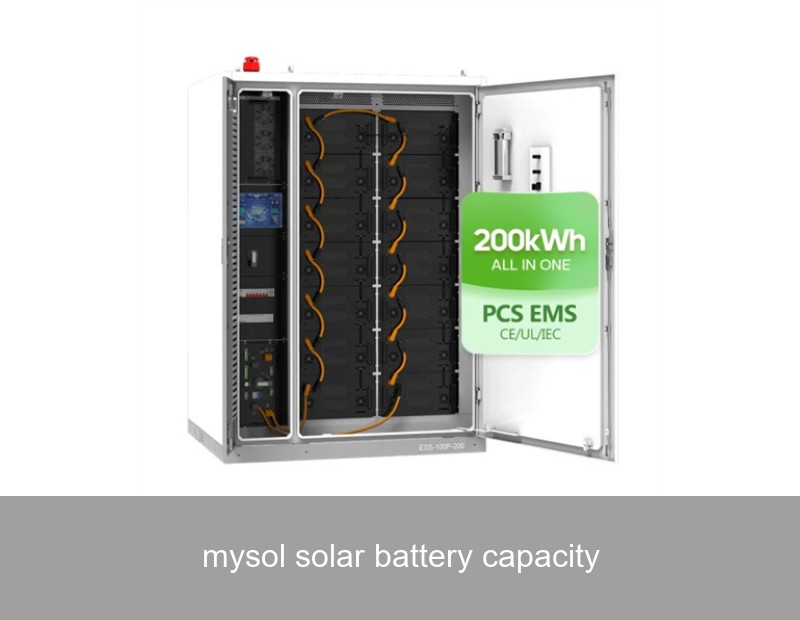
Have you ever watched your solar panels generate a surplus of clean energy on a sunny afternoon, only to see it flow back to the grid, knowing you'll have to buy it back at night? This common phenomenon is the very challenge that solar battery capacity aims to solve. For homeowners and businesses investing in solar, the true power of their system isn't fully unlocked until they can store that self-generated electricity. This is where understanding your MySol solar battery capacity becomes crucial. It's not just a number on a spec sheet; it's the measure of your energy resilience, your savings potential, and your step towards true energy autonomy. In this guide, we'll demystify battery capacity, explore what it means for your solar investment, and show you how choosing the right storage solution can transform your relationship with energy.
What Exactly is Solar Battery Capacity?
Let's break it down simply. A battery's capacity tells you how much electricity it can store, typically measured in kilowatt-hours (kWh). Think of it like a water tank: the capacity is the total volume of water (or energy) the tank can hold. A MySol solar battery with a 10 kWh capacity can, in theory, deliver 10 kilowatts of power for one hour, 5 kilowatts for two hours, and so on.
However, there are two key concepts you need to know:
- Usable Capacity: This is the most important figure. Batteries are never fully discharged to preserve their lifespan. If a battery has a 13.5 kWh total capacity but a 12 kWh usable capacity, that 12 kWh is the energy you can actually use.
- Power Rating (kW): Often confused with capacity, this is how much power the battery can deliver at one time. A battery with a 5 kW power rating and 10 kWh capacity can run a 5 kW appliance for 2 hours. Need to start a well pump or an AC unit? You need sufficient power rating.
For a system like the MySol solar battery, understanding the interplay between usable capacity and power rating is essential for sizing a system that meets both your daily energy needs and peak power demands.
The Key Metrics at a Glance
| Term | Unit | What It Means | Analogy |
|---|---|---|---|
| Capacity | kWh | Total amount of energy stored. | Size of a fuel tank. |
| Usable Capacity | kWh | Energy you can actually use. | Usable fuel in the tank. |
| Power Rating | kW | Rate at which energy can be delivered. | Size of the fuel line to the engine. |
Why Your Battery's Capacity is More Than Just a Number
Choosing the correct capacity isn't an academic exercise; it directly impacts your wallet and your comfort. An undersized battery will leave you drawing expensive power from the grid every evening. An oversized one means you've over-invested in storage you won't fully utilize.
So, what does the right solar battery capacity enable?
- Maximized Self-Consumption: Store excess solar generation from the day to use at night, drastically reducing your reliance on the utility grid. The U.S. Department of Energy highlights this as a core benefit of pairing solar with storage.
- Backup Power Resilience: During a grid outage, your battery's usable capacity determines how long you can keep essential loads (lights, fridge, medical equipment) running. It's your personal microgrid.
- Financial Optimization: In regions with Time-of-Use (TOU) rates or demand charges, you can use stored energy during peak price periods, leading to significant bill savings.

Image Source: Unsplash (Representative image of a home solar and storage system)
A Real-World Case: From Capacity to Real Savings in California
Let's look at a concrete example from our work at Highjoule. We partnered with a medium-sized family home in Sacramento, California—a market with high electricity rates, favorable solar incentives, and a risk of public safety power shutoffs.
The Challenge: The home had a 7.5 kW solar array but was still sending over 60% of its daytime production to the grid, only to purchase expensive power in the evening (peak TOU rates exceeded $0.45/kWh). They also sought reliable backup for essential circuits during outages.
The Solution: Highjoule's team conducted a detailed energy audit. We analyzed their 24-hour load profile, peak sun hours, and backup requirements. We recommended and installed a system centered on our Highjoule H2 Series modular battery, configured with a 13.5 kWh usable capacity and a 7.6 kW continuous power output. This capacity was sized to cover their average nightly consumption and critical loads for over 24 hours.
The Data-Driven Outcome (12-month period):
- Grid Independence: Self-consumption of solar energy rose from ~40% to 92%.
- Financial Savings: Annual electricity bill reduced by $2,300, despite the higher evening rates.
- Resilience: The system provided seamless backup during two planned utility outages, totaling 18 hours.
This case, typical in many European and U.S. markets, shows that correctly sized capacity, paired with intelligent energy management, turns a solar array from a partial solution into a comprehensive energy asset.
Choosing the Right Capacity for Your Home
How do you determine the ideal MySol solar battery capacity for your needs? Follow this logical ladder:
- Analyze Your Consumption: Review your utility bill. Identify your average daily kWh usage, but more importantly, your usage pattern. How much energy do you use after sunset?
- Define Your Goals: Is your primary goal bill savings, backup power, or both? For backup, list the essential appliances you need to run and their wattage.
- Consider Your Solar Production: How much excess solar energy does your system typically produce? Your battery should be sized to capture a significant portion of this surplus.
- Think Modularity: Your needs may change. A system like Highjoule's H2 Series allows you to start with a base capacity and add more modules later, providing future-proof flexibility that a fixed solar battery capacity system cannot.
Looking Beyond Capacity: The Highjoule Advantage
While capacity is a fundamental spec, the intelligence and durability of the battery system are what ensure you realize its full value over 15+ years. This is where Highjoule's nearly two decades of expertise comes into play. Our solutions, such as the Highjoule H2 Series for residential and Highjoule GridStack for commercial applications, are designed with a holistic view.
We integrate high-quality lithium iron phosphate (LFP) battery chemistry—known for its safety and long cycle life—with an intelligent energy management system (EMS). This EMS doesn't just fill and empty the battery; it learns your patterns, weather forecasts, and utility rate schedules to optimize every kilowatt-hour. It prioritizes solar self-consumption, can participate in certain grid services programs (where available), and ensures your system operates at peak efficiency. According to a report by the National Renewable Energy Laboratory (NREL), advanced controls and software are critical to maximizing the value stream of storage.

Image Source: Unsplash (Representative image of a modern battery storage unit)
For homeowners considering a MySol solar battery or any storage solution, we advise looking at the entire ecosystem: capacity, power, chemistry, software, and the provider's track record for support and warranty fulfillment.
Ready to Define Your Energy Future?
Understanding your needed solar battery capacity is the first strategic step toward energy independence. But the next step is a conversation. What unique energy patterns, local incentives, and personal resilience goals will shape the perfect storage solution for your home? We invite you to share your biggest energy challenge with us. Is it unpredictable bills, concern over grid stability, or simply the desire to make the most of your solar investment?
 Inquiry
 Online Chat