


N-Type Solar Panels Price in Sweden: A 2024 Investment Guide for Smarter Energy
If you're researching solar energy for your home in Sweden, you've likely encountered the term "N-type solar panels." Touted as the newer, more efficient technology, they naturally lead to a key question: what is the real-world n type solar panels price in Sweden, and is the premium worth it for the Swedish climate? Beyond just the cost per panel, a truly smart energy investment involves understanding how these high-efficiency panels pair with intelligent storage to combat dark winters and maximize summer sun. Let's break down the costs, technology, and system synergy to help you make an informed decision.
Understanding N-Type Solar Panels: The Premium Choice
First, a quick primer. Most traditional solar panels use P-type silicon cells. N-type technology, while not brand new, is becoming the premium standard due to its fundamental advantages. The key difference lies in the base silicon material used, which gives N-type panels several benefits:
- Higher Efficiency: N-type cells typically convert more sunlight into electricity, especially in low-light conditions—a significant factor for Swedish mornings, evenings, and overcast days.
- Lower Degradation: They are less prone to a performance decline called Light-Induced Degradation (LID). This means they maintain their higher output for longer, often with warranties guaranteeing 90%+ performance after 25 years.
- Better Temperature Coefficient: All panels lose efficiency as they get hot. N-type panels lose less, making them marginally more effective during rare Swedish heatwaves and generally more stable.
So, while the upfront n type solar panels price in Sweden is higher, you're paying for a product that will generate more electricity over its lifetime, especially in sub-optimal light.
N-Type Solar Panel Price Breakdown in Sweden
Let's talk numbers. Prices are dynamic, but as of 2024, you can expect the following ranges for the panel components themselves. Remember, this is before installation, inverter, mounting, or the crucial storage system.
| Panel Type / Power Range | Average Price per Panel (SEK) | Average Price per Watt (SEK/Wp) | Notes |
|---|---|---|---|
| N-Type (430W - 500W) | 1,800 - 2,500 SEK | 4.0 - 5.2 SEK/Wp | Premium tier, from brands like LONGi, Jinko, Trina. |
| Standard P-Type (400W - 470W) | 1,400 - 1,900 SEK | 3.3 - 4.2 SEK/Wp | Common market standard, good performance. |
Image: Modern solar panels in a Nordic setting. Source: Unsplash

Why the range? The final n type solar panels price in Sweden depends on brand, exact model efficiency, purchase volume (whole system vs. few panels), and supplier. For a typical residential system of 10 kWp (which is common in Sweden to offset high winter electricity use), the panel cost alone could be 40,000 - 52,000 SEK for N-type versus 33,000 - 42,000 SEK for P-type.
However, the Swedish Energy Agency (Energimyndigheten) emphasizes that total system performance is key. A more efficient system with N-type panels might require fewer panels to meet your energy needs, potentially saving on roof space and balance-of-system costs.
Case Study: A Stockholm Household's Energy Transformation
Let's look at a real-world scenario. The Andersson family in a Stockholm villa installed a 12 kWp solar array in early 2023.
- Choice: They opted for N-type panels (24x 500W panels) over a similarly priced P-type system with more panels.
- Annual Production: Their first-year monitored production was 10,200 kWh. A comparable P-type system was estimated by their installer to produce around 9,500 kWh annually due to slightly lower efficiency and higher degradation in the first year.
- Financial Impact: With an average electricity price of 1.80 SEK/kWh (including spot price and fees), the extra 700 kWh generated by the N-type system translates to an additional 1,260 SEK in annual revenue/savings. Over 25 years, even with degradation, this difference compounds significantly, closing the initial price gap.
"For us, it wasn't just about the panel price," says Mr. Andersson. "It was about getting the most energy from our limited south-facing roof. The higher winter output was a decisive factor."
Beyond Panels: The Crucial Role of the Complete System
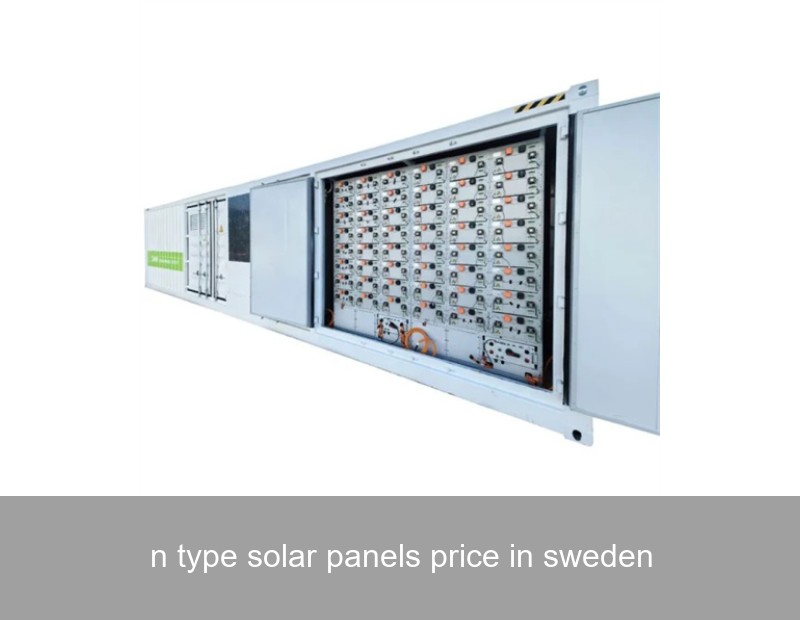
Focusing solely on the n type solar panels price in Sweden is a common mistake. The panels are only one part of the energy equation. An inverter converts the DC power to AC for your home, and this is where smart systems truly shine. But the most critical component for maximizing self-consumption in Sweden—where summer production is abundant and winter scarce—is the battery energy storage system (BESS).
Without storage, excess summer energy is sold to the grid at a low price, only for you to buy back expensive power during dark winter months. A battery flips this script, allowing you to store your daytime production for use in the evening, increasing energy independence from the grid.
The Highjoule Solution: Smart Storage Maximizes Your Solar Investment
This is where Highjoule's expertise becomes vital. As a global leader in advanced energy storage since 2005, we understand that a solar investment is only as good as the system that manages it. Pairing your high-efficiency N-type panels with a Highjoule storage system is the key to unlocking their full financial potential.
Our HES (Home Energy System) is designed for markets like Sweden and the EU. It's more than just a battery; it's an intelligent energy manager:
- High-Cycle Life & Winter-Ready: Using stable LFP (Lithium Iron Phosphate) chemistry, our batteries endure thousands of charge cycles and perform reliably in a wide temperature range, crucial for Swedish seasons.
- Advanced Self-Consumption Software: The system intelligently decides when to store solar energy, power your home, or (if beneficial) feed into the grid, optimizing for your specific tariff and consumption patterns.
- Backup Power Functionality: Optional configuration provides peace of mind during grid outages—a valuable feature.
- Scalability: Start with a capacity that fits your budget and easily expand later as your needs grow, perhaps with an electric vehicle.
Image: A modern home battery storage unit. Source: Unsplash

When evaluating the total system cost, consider the n type solar panels price in Sweden as an investment in generation quality, and a Highjoule storage system as the investment in utilization quality. Together, they form a resilient, high-return energy asset.
Future Outlook & Making Your Decision
The trend is clear. According to the International Energy Agency (IEA), N-type technologies are rapidly gaining market share globally due to their performance benefits. As production scales, the price premium is expected to shrink, but their value proposition in Nordic climates remains strong today.
So, how should you approach your decision?
- Calculate Your Needs: Use tools from Svensk Solenergi or consult an installer to model production differences between P-type and N-type for your specific location and roof.
- Think System, Not Panels: Request quotes for complete systems: N-type + storage vs. P-type + storage. The overall economics often favor the more efficient panel when paired with a battery.
- Prioritize Storage: For most Swedish households, allocating budget to a capable storage system like Highjoule's HES often delivers a faster return on investment than solely opting for the most expensive panels.
Given the long-term nature of a solar investment (25+ years), what specific energy consumption pattern in your home are you most eager to solve—reducing peak evening costs, achieving backup security, or maximizing your contribution to a fossil-free future?
 Inquiry
 Online Chat