


Understanding the UTL TOPCon Solar Panel 590 Watt Price and Its Value for Your Energy System
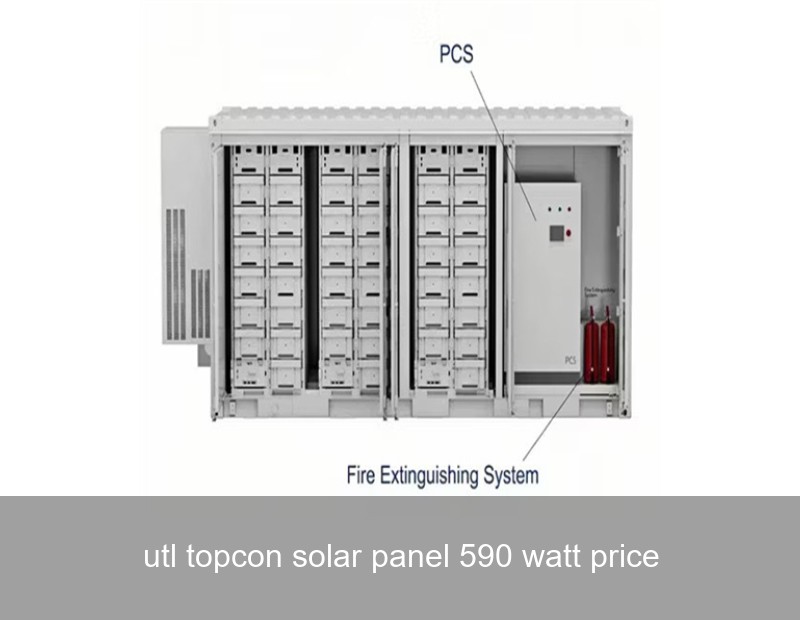
Table of Contents
If you're researching solar for your home or business, you've likely encountered the "UTL TOPCon solar panel 590 watt price" as a standout option. It's a phrase that combines a leading brand, cutting-edge technology, impressive power output, and a crucial question: what does it cost? But focusing solely on the dollar-per-watt sticker price is like buying a car based only on its horsepower. The real value lies in understanding the technology behind it, its long-term performance, and how it integrates into a complete energy ecosystem. Let's unpack what you're truly investing in.
The Price Puzzle: More Than Just a Number
When evaluating solar panels, the initial purchase price is just the starting point. The key metric industry professionals use is the Levelized Cost of Energy (LCOE), which accounts for the panel's cost, efficiency, degradation rate, and energy production over its 25-30+ year lifespan. A panel with a higher upfront cost but superior efficiency and durability can deliver a lower LCOE, meaning cheaper electricity for decades. UTL's 590W TOPCon panels sit at the premium end of the market, and their price reflects advanced engineering designed for maximum energy harvest, especially in real-world conditions like low-light or high temperatures.
What Makes TOPCon Technology a Game-Changer?
TOPCon (Tunnel Oxide Passivated Contact) is the next evolutionary step after the dominant PERC technology. Think of it as a major software upgrade for your solar cells. Here’s why it matters:
- Higher Efficiency: TOPCon cells reduce energy loss at the silicon surface, converting more sunlight into electricity. This is how UTL achieves 590W+ power from a standard panel size.
- Better Temperature Coefficient: All panels lose efficiency as they heat up. TOPCon panels have a superior temperature coefficient (often around -0.30%/°C vs. -0.34%/°C for PERC), meaning they perform better on hot summer days, a critical factor in markets like the southern US or Southern Europe.
- Lower Degradation: They typically have a lower annual degradation rate (around 0.4% per year), ensuring they produce more power for longer compared to older technologies.
In essence, you're paying for a panel that will generate more kilowatt-hours over its lifetime, from dawn to dusk, across all seasons. The National Renewable Energy Laboratory (NREL) tracks these efficiency gains, confirming TOPCon's leading status.

Image Source: Unsplash - High-efficiency panels maximize roof space.
Decoding the 590W Price Tag: A Breakdown
The "590 watt price" is influenced by several factors beyond the cell technology itself:
| Cost Factor | Impact on Price & Value |
|---|---|
| Advanced N-Type Silicon | Uses purer silicon with higher longevity, adding to material cost but reducing degradation. |
| Bifacial Design | Many TOPCon panels, including UTL's, can capture light reflected onto the rear side, boosting yield by up to 15-25% in ideal installations (e.g., ground-mounted). |
| Durability & Warranty | Robust construction against weather, hail, and wind load. Premium products come with strong performance warranties (e.g., 92% output after 25 years). |
| Supply Chain & Logistics | For markets in Europe and the US, tariffs, shipping, and installer markup affect the final installed price. |
As of 2024, for the European and US markets, the installed system price for a high-quality rooftop system using panels of this caliber can range from $2.80 to $3.50 per watt DC, depending on location, system size, and complexity. This means the panel component itself is a significant, but not the sole, part of your investment.
Real-World Impact: A Case Study from Texas
Let's move beyond specs to real performance. Consider a commercial warehouse in Dallas, Texas, with a 500 kW rooftop system.
- Scenario A (Standard PERC): Used 415W panels. System generated an average of 720 MWh/year.
- Scenario B (UTL 590W TOPCon): Fewer panels needed for similar capacity. Due to higher efficiency and better heat tolerance, the system generated approximately 795 MWh/year—a 10.4% increase in energy yield.
This extra 75 MWh annually, at a local commercial rate of $0.12/kWh, translates to $9,000 in additional annual savings. Over 25 years, even with degradation, this performance delta dramatically alters the financial return, justifying the initial premium. The property also needed fewer roof penetrations and balance-of-system components, reducing installation time and potential failure points.
Maximizing Your Investment: The Role of Smart Storage
Pairing high-output panels like the UTL 590W with a smart battery storage system is where the true energy independence and financial payoff unlock. High-performance panels often produce more than you can use during peak sun. Without storage, this excess is sold back to the grid at lower rates. With storage, you capture that premium energy for use in the evening when electricity rates are highest.
This is where Highjoule's expertise becomes critical. As a global leader in advanced energy storage since 2005, we don't just sell batteries; we provide integrated, intelligent systems. Our HPS Series for commercial and industrial applications and HRS Series for residential use are designed to seamlessly integrate with high-efficiency solar arrays. Our AI-driven energy management system constantly optimizes when to store solar energy, when to use it, and when to interact with the grid, maximizing your self-consumption and ROI.

Image Source: Unsplash - A modern home battery system storing solar energy.
For a system built around UTL TOPCon panels, Highjoule's storage ensures no watt goes to waste. You're not just buying a panel; you're building a resilient, efficient, and cost-effective personal power plant. The U.S. Department of Energy highlights the benefits of pairing solar with storage, particularly for backup power and time-of-use rate management.
Is a High-Efficiency Panel the Right Choice for You?
So, should the UTL TOPCon 590W panel be at the top of your list? It's an excellent choice if:
- Your roof or installation space is limited, and you need to maximize power output per square foot.
- You live in a hot climate where temperature performance is crucial.
- Your goal is to achieve the lowest possible LCOE and highest lifetime yield.
- You plan to integrate with a sophisticated storage system like Highjoule's to leverage every kilowatt-hour.
The conversation about "price" ultimately shifts to "value." By choosing a top-tier panel, you're investing in a long-term asset that pairs perfectly with intelligent storage to form the backbone of a modern, decentralized energy system. The International Energy Agency discusses the innovation and diversification in solar PV supply chains, underscoring the importance of technology choice.
What specific energy goals—be it slashing your utility bill, achieving full backup power, or reducing your carbon footprint—will drive your decision between a standard system and a high-efficiency, storage-integrated solution?
 Inquiry
 Online Chat