


Nanotechnology Energy Storage: The Tiny Revolution Powering Our Future Grid
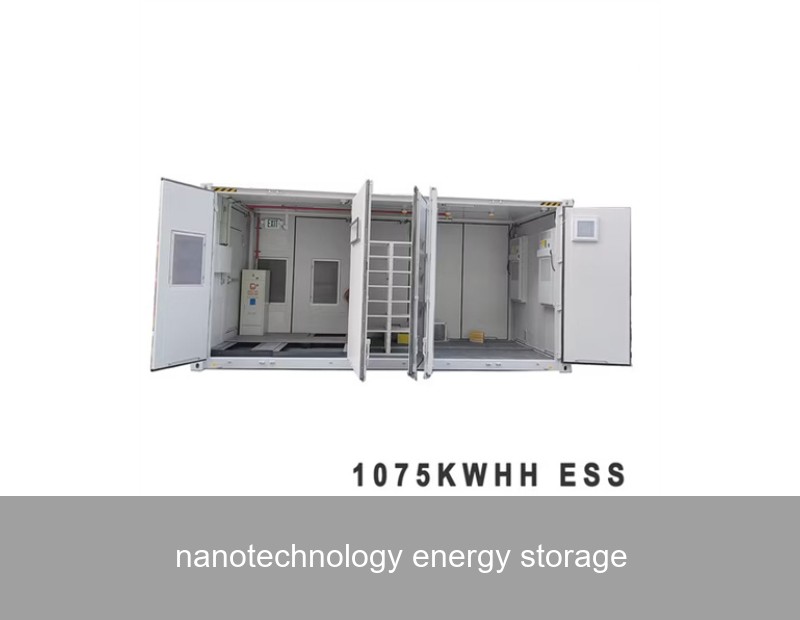
Imagine a world where your electric car charges in minutes, your home battery lasts for decades, and renewable energy flows seamlessly 24/7. This isn't science fiction; it's the promise of nanotechnology energy storage. By engineering materials at the scale of atoms and molecules—smaller than a human hair is wide—scientists are fundamentally rewriting the rules of batteries and supercapacitors. For businesses and homeowners navigating the energy transition, understanding this shift is key to unlocking unprecedented resilience and efficiency. At Highjoule, we are at the forefront, integrating these advanced principles into our next-generation storage systems to deliver smarter, longer-lasting power for commercial, industrial, and residential applications worldwide.
Table of Contents
The Bottleneck: Why Our Current Energy Storage Falls Short
Our renewable energy ambitions are hitting a persistent wall: storage. Solar panels don't generate at night, wind turbines are idle on calm days, and the grid struggles with peaks and troughs. Traditional lithium-ion batteries, while revolutionary, have inherent limitations—slow charging, finite lifecycles, energy density ceilings, and concerns over resource scarcity and safety. This "storage gap" is the single biggest hurdle to a fully decarbonized grid. We need a leap, not a step. That's where the fascinating world of the infinitesimally small comes in.
The Nano Solution: Engineering at the Atomic Level
Nanotechnology energy storage manipulates materials at the nanoscale (1-100 nanometers). At this level, materials exhibit unique properties—enhanced conductivity, extraordinary strength, and heightened chemical reactivity. This allows engineers to design storage devices from the atom up. Let's break down the key innovations:
1. Supercharging Electrodes: Surface Area is Everything
Think of a battery electrode as a sponge. A traditional electrode is a smooth, dense block. A nano-engineered electrode is that same block transformed into a labyrinth of tunnels and pores, increasing its surface area exponentially. This means more sites for chemical reactions, leading to:
- Faster Charging/Discharging: Ions have shorter distances to travel.
- Higher Energy Density: More active material can be packed in the same volume.
- Longer Lifespan: Nano-structures can better accommodate physical stress during charging cycles, reducing degradation.
Materials like graphene, carbon nanotubes, and nano-silicon are game-changers here. For instance, silicon can hold 10x more lithium ions than traditional graphite anodes, but it swells. Nano-structuring silicon into tiny particles or wires prevents it from cracking, making high-capacity, durable batteries a reality.
2. Reinventing Electrolytes: The Conductive Highway
The electrolyte is the medium that carries ions between electrodes. Nano-engineered solid-state electrolytes are replacing flammable liquid ones. These ceramic or polymer-based nanomaterials offer:
- Enhanced Safety: No fire risk from liquid leaks or thermal runaway.
- Higher Voltage Tolerance: Enabling batteries with greater power.
- Longer Cycle Life: They suppress the growth of dendrites—metallic filaments that can short-circuit batteries.
3. The Rise of Nano-Supercapacitors
Batteries store energy chemically; supercapacitors store it electrostatically. By using nano-materials like graphene, supercapacitors can achieve energy densities approaching batteries while retaining their legendary power density (instant charge/discharge) and million-cycle lifespans. They are perfect for applications requiring quick, powerful bursts of energy.
| Feature | Traditional Li-ion | Nano-Enhanced Battery | Nano-Supercapacitor |
|---|---|---|---|
| Charge Time | 1-3 hours | Minutes | Seconds |
| Cycle Life | 1,000 - 3,000 | 5,000 - 10,000+ | 100,000+ |
| Energy Density | Medium-High | Very High | Medium (Improving Rapidly) |
| Key Nano-Material | N/A | Nano-silicon, Lithium-Metal | Graphene, CNTs |
From Lab to Grid: The Real-World Impact
The theoretical benefits are staggering, but what does this mean on the ground? For a utility, it means grid-scale batteries that can absorb midday solar oversupply and release it during the evening peak with minimal loss over 20+ years. For a factory, it means ultra-fast buffer storage to shave peak demand charges and protect sensitive machinery from power sags. For a homeowner, it's a solar battery system that charges fully during a short period of winter sun and powers the house through the night.
Case Study: Stabilizing a German Industrial Microgrid
A concrete example comes from a manufacturing plant in Bavaria, Germany. The facility operates a large solar array and a combined heat and power (CHP) unit but faced challenges with frequency instability and sudden load changes from heavy machinery, risking production quality.
The Solution: In 2023, they deployed a 2 MWh/1.5 MW advanced battery storage system utilizing silicon-dominant anode technology—a prime example of nanotechnology energy storage in action. The nano-silicon anode provided rapid response and high cycle stability.
The Data-Driven Results (First 12 Months):
- Frequency Response Time: Improved from several seconds (with previous tech) to under 100 milliseconds.
- Peak Shaving: Reduced grid power draw during peak hours by 40%, translating to six-figure annual savings on demand charges.
- Renewable Self-Consumption: Increased from 68% to 89%, drastically cutting energy costs and carbon footprint.
- System Degradation: Projected capacity loss after one year was less than 1%, far superior to standard batteries. (Data sourced from project monitoring reports and published in industry analysis from Energy-Storage.news).
This case highlights how nano-engineering directly translates to superior economic and technical performance in demanding real-world conditions.

Image: A modern industrial battery energy storage system (BESS) similar to those integrating advanced nanomaterials. Credit: Unsplash.
Highjoule's Role: Bridging Advanced Tech and Reliable Application
At Highjoule, our mission since 2005 has been to translate cutting-edge research into robust, field-proven solutions. We don't just sell batteries; we provide intelligent, integrated energy storage systems that leverage these material advances for maximum client benefit.
Our H-Series Commercial & Industrial (C&I) systems are designed with next-generation cell chemistry in mind. We partner with leading cell manufacturers to incorporate nano-enhanced electrodes and advanced electrolytes, then package them with our proprietary Adaptive Grid Intelligence (AGI) software. This system doesn't just store energy; it learns your facility's load patterns, weather forecasts, and tariff schedules to autonomously optimize every charge and discharge cycle for longevity and cost savings.
For residential users, our EchoHome Prime product line utilizes similar principles of cell longevity and fast response, ensuring your home remains powered during outages and maximizes your solar investment. And for the most complex needs, our microgrid controllers seamlessly orchestrate solar, wind, storage, and generators, where the rapid response of nano-enhanced storage is critical for stability.
We act as your trusted guide, ensuring the "tiny revolution" delivers massive, reliable results for your specific application.
Future Horizons and Considerations
The journey is ongoing. Research into nanomaterials like MXenes (2D metal carbides) and solid-state architectures promises even greater leaps. However, challenges remain in scaling up nanomaterial production cost-effectively and ensuring full lifecycle sustainability—areas where continuous innovation is focused.
For an organization or homeowner today, the key takeaway is this: the storage technology you choose today should be architected for tomorrow's advancements. Systems must be software-upgradable and designed to accommodate future improvements in cell technology.

Image: Nanotechnology research in a materials science lab is the foundation of next-generation storage. Credit: Unsplash.
So, as you evaluate your energy resilience strategy, ask yourself: Is your storage solution built on the paradigms of the past, or is it engineered to harness the atomic-scale innovations defining the future of power? What single energy challenge—be it cost, reliability, or sustainability—could solving your storage bottleneck unlock for your operation?
 Inquiry
 Online Chat