


How a New Energy Systems Group is Transforming Power Management for Businesses
Have you noticed your business's electricity bill becoming less predictable, or felt a growing pressure to meet ambitious sustainability targets? You're not alone. Across Europe and the US, commercial and industrial leaders are grappling with a dual challenge: rising energy costs and the urgent need to decarbonize. This is where the concept of a new energy systems group becomes critical. More than just a collection of solar panels or batteries, a modern energy system is an integrated, intelligent platform that generates, stores, and manages power autonomously. It's the key to unlocking resilience, cost savings, and true energy independence. For nearly two decades, Highjoule has been at the forefront of this transformation, providing smart, efficient, and sustainable power solutions that act as the central nervous system for modern energy management.
Table of Contents
- The Problem: Volatile Grids and Rising Costs
- The Data: The Compelling Case for Integrated Systems
- The Solution: The Core Components of a Modern New Energy Systems Group
- Highjoule's Role: Intelligence at the System's Core
- Case Study: A European Manufacturing Plant's Success
- The Future: Your Energy Ecosystem
The Problem: Volatile Grids and Rising Costs
Let's face it, the traditional grid wasn't built for today's demands. The increasing frequency of extreme weather events, from heatwaves in Southern Europe to winter storms in Texas, exposes the fragility of centralized power networks. For a factory, a data center, or a hospital, a single outage can mean millions in lost revenue or, worse, compromised safety. Concurrently, the shift to renewable generation, while essential, introduces intermittency—the sun doesn't always shine, and the wind doesn't always blow. This volatility creates price spikes and complicates planning. Relying solely on the grid is no longer a viable or financially sound strategy for energy-intensive operations.

Image Source: Unsplash - Representative image of commercial solar integration.
The Data: The Compelling Case for Integrated Systems
The business rationale for a sophisticated new energy systems group is backed by hard numbers. According to the U.S. Energy Information Administration, commercial electricity prices have seen significant volatility, impacting operational budgets. More tellingly, a report by BloombergNEF highlights that the levelized cost of energy from solar PV and wind is now often lower than fossil fuels, but the integration cost is key. This is where storage shines. The global energy storage market is projected to attract over $1 trillion in investment by 2040, a testament to its critical role. The real value, however, isn't in standalone components but in their synergy. An intelligently managed system can:
- Reduce peak demand charges by 20-40%, often the largest portion of a commercial bill.
- Provide uninterrupted backup power, ensuring operational continuity.
- Maxize self-consumption of locally generated solar power, sometimes from 30% to over 70%.
- Open revenue streams through grid services in certain markets.
The Solution: The Core Components of a Modern New Energy Systems Group
So, what exactly constitutes this powerful group? Think of it as a team of specialized players working in perfect harmony, orchestrated by a master coach.
1. Generation: The Primary Producer
Typically, this is rooftop or ground-mounted solar PV. It's the workhorse, converting free sunlight into direct current (DC) electricity. For larger sites, small wind turbines can also play a role. The goal is to produce clean, low-cost energy right where it's consumed.
2. Storage: The Strategic Reserve
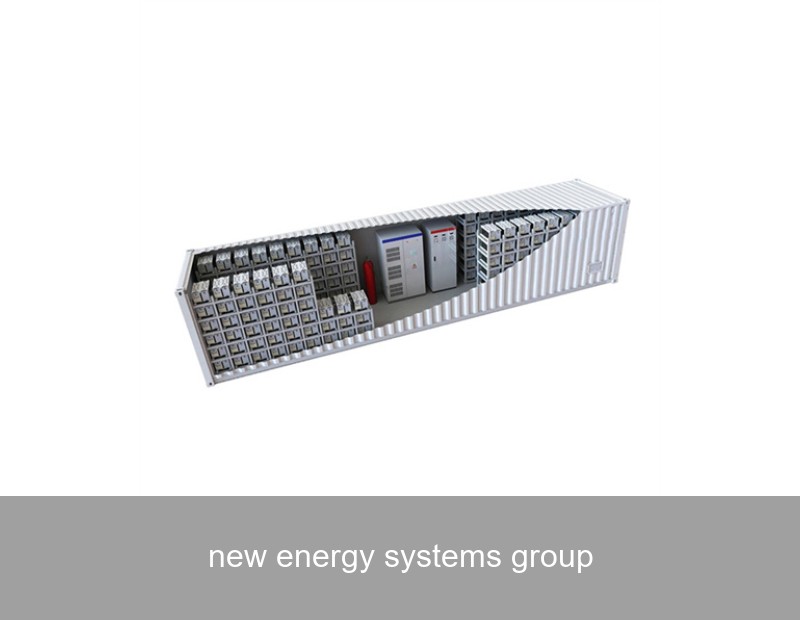
This is the heart of flexibility. Advanced battery energy storage systems (BESS), like Highjoule's H-Cube Industrial Series, store excess solar generation for use at night, during peak rate periods, or during a grid outage. Modern lithium-ion phosphate (LFP) batteries offer superior safety, longevity, and are perfectly suited for daily cycling.
3. Inversion & Conversion: The Skilled Translator
Inverters are the unsung heroes. They convert DC from solar panels and batteries into the AC power your equipment uses. More importantly, advanced hybrid inverters can manage multiple power flows simultaneously—from grid, solar, and batteries—making real-time decisions for optimal efficiency.
4. The Energy Management System (EMS): The Mastermind
This is the "intelligence." A cloud-based EMS, such as Highjoule's NeuroGrid AI Platform, is what transforms a collection of hardware into a true new energy systems group. It uses weather forecasts, electricity price signals, and consumption patterns to autonomously dispatch stored energy when it provides the most financial and operational value.
| System Component | Primary Role | Highjoule Solution Example | Business Benefit |
|---|---|---|---|
| Solar PV Array | Clean Energy Generation | Highjoule Solar Integration Design | Reduces energy procurement costs, lowers carbon footprint |
| Battery Storage (BESS) | Energy Time-Shifting & Backup | H-Cube Industrial Series | Manages demand charges, ensures resilience, enables arbitrage |
| Energy Management System | Intelligent Control & Optimization | NeuroGrid AI Platform | Maximizes ROI, automates complex decisions, provides actionable insights |
Highjoule's Role: Intelligence at the System's Core
Since 2005, Highjoule's mission has been to move beyond simply selling hardware. We architect and deliver intelligent ecosystems. Our approach starts with a deep analysis of your site's energy profile, tariff structure, and sustainability goals. We then design a system where our hardware—like the scalable, containerized H-Cube or the modular HomePower residential unit—is seamlessly governed by our NeuroGrid software. This integrated approach ensures that every kilowatt-hour is generated, stored, and consumed with a specific purpose: to save you money and bolster your resilience. For microgrid applications, this intelligence is paramount, allowing a facility to seamlessly island from the grid during an outage and reintegrate safely when power returns.

Image Source: Unsplash - Representative image of energy system monitoring.
Case Study: A European Manufacturing Plant's Success
Let's look at a real-world application. A major automotive parts manufacturer in Germany faced steep “Netzentgelt” (grid fees) based on its peak power draw and needed to stabilize operations against grid fluctuations. Their goal was to reduce costs, secure power for critical assembly lines, and contribute to corporate CO2 targets.
The Highjoule Solution: We deployed a turnkey new energy systems group comprising a 1.2 MWp rooftop solar array, a 2.4 MWh H-Cube battery storage system, and the NeuroGrid EMS for holistic control.
The Results (12-month period):
- Peak Demand Reduction: 28% reduction in peak load, drastically cutting grid fees.
- Energy Cost Savings: Over €185,000 saved annually through solar self-consumption and peak shaving.
- Reliability: Critical loads now have 4 hours of backup power, preventing production halts.
- Sustainability: Achieved 35% reduction in site-specific grid electricity consumption, a major step toward Scope 2 emission goals.
The NeuroGrid platform automatically decides when to charge the batteries from the solar excess, when to discharge to cap the plant's power draw, and when to hold reserve for backup. This case exemplifies the tangible ROI a cohesive system delivers. For further reading on industrial decarbonization strategies, see this report from the International Energy Agency (IEA).
The Future: Your Energy Ecosystem
The evolution from passive consumer to active energy manager is already underway. With vehicle-to-grid (V2G) technology and advanced demand response programs on the horizon, your new energy systems group could one day communicate with your fleet of electric delivery vehicles or dynamically trade power with neighboring facilities. The foundation for participating in this future energy landscape is an intelligent, integrated system today.
What is the single most pressing energy challenge—be it cost, reliability, or sustainability—that keeps you up at night regarding your operations, and have you considered how an integrated energy system could be designed to specifically solve it?
 Inquiry
 Online Chat