


Navigating the Surge: How New Solar Energy Companies Are Reshaping the Power Grid
The energy landscape is undergoing a seismic shift, and a new wave of new solar energy companies is at the forefront. These innovators are not just installing panels; they are reimagining how we generate, store, and consume electricity. For homeowners and businesses in Europe and the US, this presents an unprecedented opportunity for energy independence and sustainability. But as these companies proliferate, a critical question emerges: how do we ensure the sun's power is available when we need it most? The answer lies not just in generation, but in intelligent storage.
Table of Contents
- The Phenomenon: More Than Just Panels
- The Data Reality: Intermittency and the Duck Curve
- The Case Study: A German Bakery's Recipe for Resilience
- The Solution: Intelligent Storage as the Keystone
- Why Highjoule Partners with Forward-Thinking Solar Innovators
- The Future Horizon: Your Energy, Your Control
The Phenomenon: More Than Just Panels
Gone are the days when solar companies were simply equipment retailers. Today's new solar energy companies are holistic solution providers. They offer sleek, high-efficiency photovoltaic (PV) systems, often integrated directly into building materials. More importantly, they talk about "self-consumption," "load shifting," and "grid services." This evolution is driven by customer demand for true energy autonomy and a recognition of a fundamental technical challenge: solar power is intermittent. The sun doesn't shine at night, and clouds can appear unexpectedly. This creates a mismatch between supply and demand that pure generation cannot solve.

Image: A modern home solar-plus-storage setup. Credit: Unsplash
The Data Reality: Intermittency and the Duck Curve
Let's look at the data. Grid operators, particularly in sun-rich states like California, grapple with the infamous "duck curve." This refers to the sharp dip in net electricity demand during midday when solar floods the grid, followed by a steep ramp-up in the evening as the sun sets and demand peaks. In 2022, the California Independent System Operator (CAISO) reported that over 2.4 million MWh of renewable energy was curtailed—essentially wasted—because supply outstripped demand. This isn't just a Californian issue; countries like Germany and Spain face similar challenges. It's a clear signal: maximizing the value of solar requires a buffer.
The Storage Imperative
This is where Battery Energy Storage Systems (BESS) become non-negotiable. Think of storage as the essential "savings account" for your solar energy. Without it, excess daytime production is either sold back to the grid at low rates or wasted. With it, you can:
- Increase Self-Consumption: Use your solar power at night, dramatically reducing grid reliance.
- Provide Backup Power: Keep critical loads running during grid outages.
- Optimize Economics: Store energy when it's cheap (or self-produced) and use it during expensive peak-rate periods.
The Case Study: A German Bakery's Recipe for Resilience
Consider "Bäckerei Schmidt," a mid-sized artisan bakery in Bavaria. As energy costs soared, they partnered with a local new solar energy company that proposed a system with a crucial twist: a robust battery storage solution. The installation included a 100 kWp solar array paired with a 120 kWh lithium-iron-phosphate (LFP) battery system.
| Metric | Before Installation | After Installation (12-month avg.) |
|---|---|---|
| Grid Electricity Consumption | 100% | 35% |
| Energy Cost Savings | Base | 68% |
| Self-Consumption of Solar | ~40% (without storage) | 92% |
The bakery's ovens and refrigeration now run largely on stored solar energy, even for early morning baking shifts. During a planned grid maintenance outage, the bakery operated uninterrupted, saving thousands in potential lost revenue. This case exemplifies the new standard: solar is the engine, but storage is the transmission that delivers power on demand.
The Solution: Intelligent Storage as the Keystone
For new solar energy companies, choosing the right storage partner is as critical as selecting the right panels. The battery system must be safe, durable, intelligently managed, and adaptable. This is precisely where Highjoule's expertise becomes a force multiplier for innovative solar installers.
Highjoule doesn't just supply batteries; we provide integrated, AI-driven energy management platforms. Our systems are designed to think ahead, learning energy usage patterns and weather forecasts to optimize charge and discharge cycles automatically. For a solar company, this means they can offer clients a truly "set-and-forget" energy solution that maximizes financial return and reliability.
Why Highjoule Partners with Forward-Thinking Solar Innovators
Since 2005, Highjoule has been at the vanguard of advanced energy storage. We understand that the success of new solar energy companies hinges on the performance and trustworthiness of the entire system they deploy. Here’s how our products and services empower these partnerships:
Core Product Offerings:
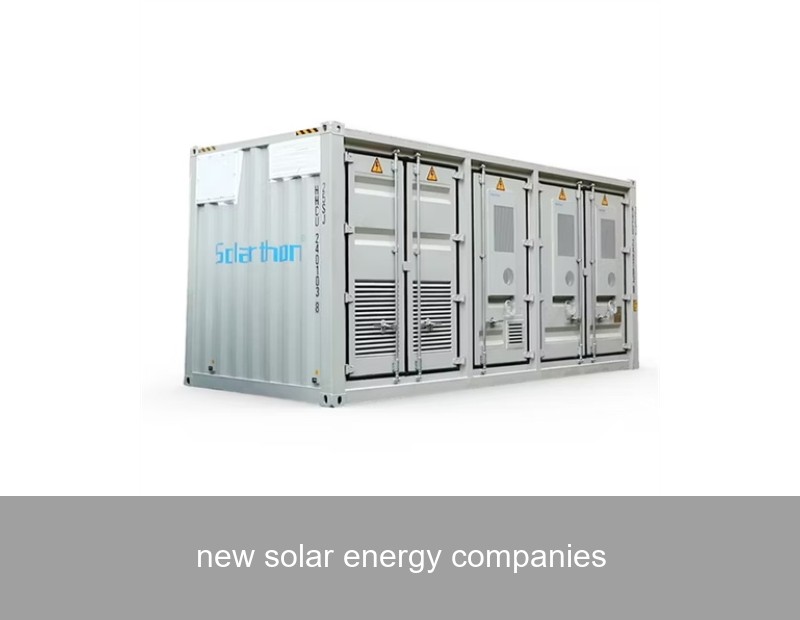
- H-Joule Commercial & Industrial (C&I) Series: Scalable, containerized or modular BESS solutions perfect for businesses, factories, and microgrids. Featuring industry-leading LFP chemistry and a 10-year warranty, they ensure project bankability and long-term client satisfaction.
- H-Joule Residential PowerVault: A sleek, high-capacity home battery system with integrated inverter and smart energy management. It seamlessly integrates with any new solar installation, giving homeowners a unified app for total energy control.

Image: A technician inspecting a commercial-scale battery storage system. Credit: Unsplash
Differentiating Services:
- Co-Design Support: Our technical experts work directly with solar company engineers to design the optimal storage configuration for each unique site and use-case.
- Grid Integration Expertise: We navigate the complex regulations and interconnection standards in both the US and European markets, smoothing the path to permitting and operation.
- Remote Monitoring & Analytics: Our platform provides partners and end-clients with real-time performance data, health status, and actionable insights, fostering transparency and proactive maintenance.
The Future Horizon: Your Energy, Your Control
The rise of new solar energy companies signifies a move away from centralized, one-way power grids toward decentralized, resilient energy networks. As the International Energy Agency (IEA) notes, solar PV is now the cheapest source of electricity in history in many markets. The next logical step is making it the most reliable.
For a homeowner in Texas or a small business owner in Italy, the question is no longer "should I go solar?" but "how can I build a complete energy system that protects me from volatility and gives me true independence?"
What energy challenge in your home or business could be solved if you had a perfectly predictable and controllable power source, 24 hours a day?
 Inquiry
 Online Chat