


How Many kWh Can a Solar Panel Produce? Your Practical Guide to Energy Yield
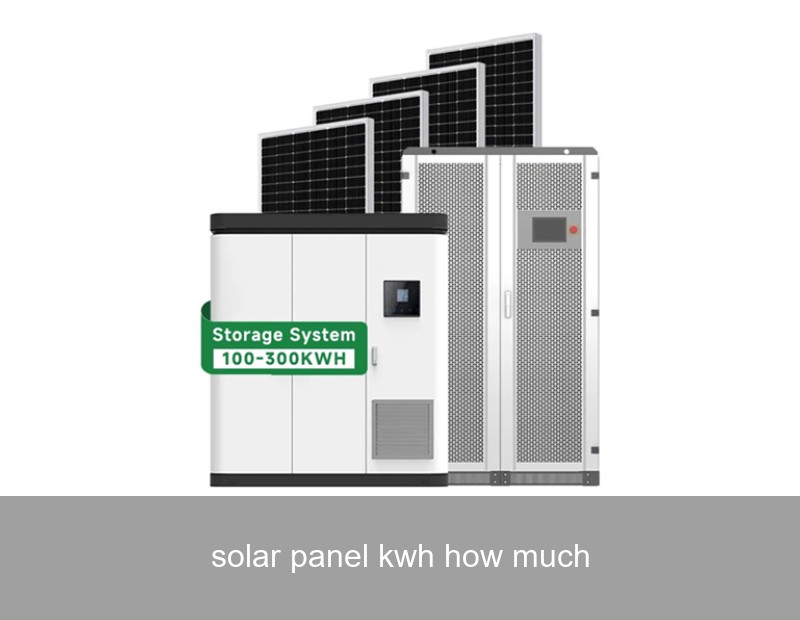
You've looked at your electricity bill, seen the rising rates, and now you're considering solar panels. The most common question that pops up is a practical one: "Solar panel kWh how much?" – as in, how much energy will they actually generate for my home or business? It's not just about the number of panels on the roof; it's about understanding your potential energy independence and return on investment. Let's demystify the factors that turn sunlight into usable kilowatt-hours and explore how modern energy storage is making every generated kWh more valuable than ever.
The Basics: From Panel Rating to Real-World kWh
First, let's clarify the units. A solar panel's power is rated in Watts (W) or kilowatts (kW) (1 kW = 1000W). This represents its peak output under ideal lab conditions. Energy, however, is what you use over time, measured in kilowatt-hours (kWh). Think of it this way: power (kW) is the speed, and energy (kWh) is the distance traveled.
A simple formula gives you a rough estimate: Panel kW x Peak Sun Hours x 0.75 = Daily kWh Output. That "0.75" is a crucial derate factor, accounting for real-world inefficiencies like temperature, dust, and inverter losses. "Peak Sun Hours" isn't just daylight hours; it's the equivalent number of hours per day when sunlight intensity averages 1 kW/m². In sunny Southern California, that might be 5.5 hours. In Germany, it could be closer to 2.8.

Image Source: Unsplash (Creative Commons) - Illustrating solar panel installation and sun measurement.
Key Factors That Dictate Your Solar kWh Output
To move from a rough guess to an accurate projection, you must consider these interconnected elements:
- Geography & Climate (The Irradiance Factor): This is the biggest variable. The National Renewable Energy Laboratory (NREL) provides detailed solar maps. A panel in Arizona will produce significantly more kWh annually than the same panel in Scotland.
- Roof Orientation and Tilt (The Angle Factor): In the Northern Hemisphere, south-facing roofs are ideal. A tilt angle roughly equal to your latitude often maximizes annual yield.
- Shading (The Deal-Breaker): Even partial shading from a chimney or tree can disproportionately reduce output. Modern systems use technologies like MLPEs (Module-Level Power Electronics) to mitigate this.
- Panel Efficiency and Degradation (The Technology Factor): Higher-efficiency panels (20%+) convert more sunlight per square foot, useful for space-constrained roofs. All panels degrade slightly each year (typically 0.5-0.8%), a factor in long-term kWh calculations.
- System Health (The Maintenance Factor): Dust, pollen, and debris can reduce output by 5-10%. Regular cleaning and professional monitoring ensure you get the kWh you paid for.
A Real-World Case Study: From Theory to Practice
Let's take a concrete example. Consider a medium-sized commercial warehouse in Munich, Germany.
- System Size: 100 kWp (Peak Kilowatt) rooftop installation.
- Location Data: Munich averages about 1,100 kWh/m² of solar irradiation annually. NREL data suggests approximately 2.8 peak sun hours per day on average.
- Theoretical Annual Yield: 100 kW * 2.8 sun hours/day * 365 days = 102,200 kWh/year.
- Real-World Adjusted Yield: Applying derate factors for temperature, inverter efficiency (97%), and soiling (95%), the realistic estimate becomes: 102,200 kWh * 0.97 * 0.95 * 0.96 (other losses) ≈ 90,500 kWh/year.
This 90,500 kWh is the tangible energy output. At a local commercial electricity price of, say, €0.28/kWh, this represents an annual saving of over €25,000. However, a critical challenge arises: a significant portion of this energy is generated in the middle of the day when the warehouse's consumption might be lower. Without a way to capture this surplus, it's fed back to the grid at a lower feed-in tariff, reducing the financial and energy resilience benefits.
Beyond Generation: Why Storing Your kWh is a Game-Changer
This leads us to the most important evolution in solar energy: storage. Asking "solar panel kWh how much" is only half the question. The full question is: "How many of those generated kWh can I actually use on my terms?"
A Battery Energy Storage System (BESS) transforms your solar array from a real-time generator into a personal energy asset. It allows you to:
- Increase Self-Consumption: Store daytime surplus to use in the evening, reducing grid reliance from 40% to 80% or more.
- Provide Backup Power: Keep critical loads running during grid outages, a feature increasingly valuable for businesses and homeowners alike.
- Optimize Economics: In regions with time-of-use rates, store solar when rates are low and use it when rates are high (peak shaving).
The true metric of a solar system's value is shifting from "kWh generated" to "kWh consumed on-site & controllable." This is where the expertise of a system integrator becomes paramount.

Image Source: Unsplash (Creative Commons) - Showing a modern home battery storage installation.
Highjoule Solutions: Maximizing Your Solar Energy Value
Since 2005, Highjoule has been at the forefront of this shift, moving beyond just generation to intelligent, integrated energy management. We understand that every kWh matters, and our solutions are designed to capture, store, and optimize every bit of solar energy you produce.
For our residential and commercial clients across Europe and the U.S., we provide Highjoule Hive™ energy storage systems. These aren't just batteries; they are intelligent energy hubs. The Hive integrates seamlessly with new or existing solar arrays, featuring:
- Scalable Capacity: Modular designs from 10 kWh to beyond 100 kWh, allowing you to start small and expand as your needs grow. Advanced AI-Driven Energy Management: Our software learns your consumption patterns, weather forecasts, and utility rate schedules to autonomously decide when to charge, discharge, or hold, maximizing your financial return and energy independence.
- Robust Safety & Longevity: Built with lithium iron phosphate (LFP) chemistry for enhanced safety and a long cycle life, backed by industry-leading warranties.
- Grid Services Ready: For commercial and microgrid applications, our systems can be configured to provide grid stability services, opening potential revenue streams.
For our industrial and microgrid clients, Highjoule's GridSynergy™ platform takes this further, managing multi-MW deployments that combine solar, wind, and other generation sources with large-scale storage. This creates resilient, self-optimizing energy ecosystems that significantly cut costs and carbon footprints. A recent IEA report highlights that pairing solar with storage is becoming the new standard for cost-effective decarbonization.
Making the Numbers Work for You
Let's revisit our Munich warehouse. By adding a 120 kWh Highjoule Hive storage system, they could increase their direct consumption of solar power from ~40% to over 70%. This simple addition transforms their energy profile and economics dramatically.
| Scenario | Annual Solar kWh Used On-Site | Annual Grid kWh Purchased | Estimated Annual Energy Cost |
|---|---|---|---|
| Solar Only (No Storage) | 36,200 kWh (40%) | 54,300 kWh | €15,200 + Grid Fees |
| Solar + Highjoule Hive Storage | 63,350 kWh (70%) | 27,150 kWh | €7,600 + Grid Fees |
The result is a near-doubling of self-consumption and a halving of grid purchases, dramatically improving payback time and providing a hedge against future energy price volatility.
Your Energy Future: What's Your Next Step?
So, when you ask "solar panel kWh how much," you're really starting a journey into energy resilience and intelligence. The answer begins with your location and roof, but its true potential is unlocked when you pair generation with smart storage and management.
What specific energy challenge is driving your curiosity about solar kWh – is it the desire to lock in energy costs, achieve backup power for your business, or simply maximize your contribution to a sustainable future?
 Inquiry
 Online Chat