


NIO Power Europe for Sale: Unpacking the Battery Swap Model and the Critical Need for Energy Resilience
If you're following the electric vehicle (EV) revolution in Europe, you've likely heard of NIO. The Chinese automaker has made significant waves with its premium electric cars and, more notably, its innovative NIO Power battery swap stations. The concept of "NIO Power Europe for sale" isn't just about selling hardware; it's about selling a vision for a faster, more convenient EV future. But behind the flashy 3-minute battery swap lies a complex, energy-intensive operation. This model's success hinges not just on the swap mechanism itself, but on a robust, intelligent, and resilient energy foundation—a challenge that goes to the heart of modern energy infrastructure.
The EV Wave Hits Europe: More Than Just Cars
Europe's commitment to electrification is undeniable. With the EU's 2035 ban on new petrol and diesel car sales, the race is on to build the supporting ecosystem. Range anxiety remains a top concern for potential EV adopters. While ultra-fast charging is improving, it still involves waiting times and potential grid strain. This is where battery swapping, as promoted by NIO Power, presents an intriguing alternative: drive in, automatically swap a depleted battery for a fully charged one in minutes, and drive off—an experience akin to a traditional gas station visit.

Image Source: Unsplash - Representative image of EV charging infrastructure.
NIO Power: A Glimpse into the Battery Swap Future
NIO Power is a comprehensive service ecosystem centered on "Power Swap" stations. For a user, the value proposition is clear: speed and convenience. For the operator, however, the station is a sophisticated energy asset. Each station houses multiple battery packs, each requiring simultaneous, high-power charging to be ready for the next customer. This creates a unique load profile characterized by intense, periodic energy demands. A single station can require the equivalent power of several dozen homes all charging at once. Relying solely on the traditional grid for this demand leads to two issues: exorbitant demand charges from utilities and contributing to peak load, which can destabilize local grids, especially when multiple stations are concentrated in urban areas.
The Hidden Backbone: Advanced Battery Energy Storage Systems (BESS)
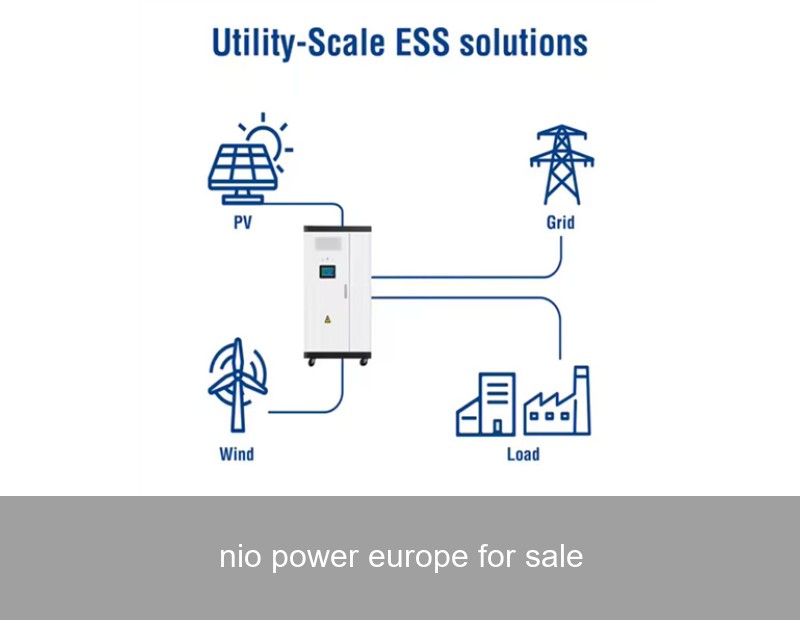
This is where the conversation about "NIO Power for sale" must evolve. The true enabler of a sustainable and economical swap network is integrated energy storage. A high-performance Battery Energy Storage System (BESS) acts as a buffer. It can charge slowly and steadily from the grid during off-peak hours when electricity is cheap and green, store that energy, and then release it rapidly to charge multiple swap batteries or directly power the swap process. This flattens the demand curve, protects the grid, and significantly reduces operational costs.
This is precisely the domain where Highjoule excels. As a global leader in advanced energy storage solutions since 2005, we specialize in designing and deploying intelligent BESS for demanding commercial and industrial applications. Our HiveStack™ C&I Series is engineered for scenarios like EV charging hubs and battery swap stations. With features like AI-powered energy management and ultra-high cycle life, these systems ensure that high-power operations are both grid-friendly and cost-effective. Integrating a Highjoule BESS isn't just an add-on for a NIO Power station; it's a strategic upgrade to its core viability.
The Core Challenge: Energy Resilience for Power Stations
Let's break down the specific challenges a battery swap network faces in Europe:
- Grid Constraints: Many desirable urban locations for swap stations have limited grid connection capacity. Upgrading this infrastructure is slow and prohibitively expensive.
- Cost Management: Electricity tariffs, especially demand charges, can erase profit margins. Intelligent storage is key to cost control.
- Renewable Integration: To truly align with Europe's sustainability goals, swap stations should leverage solar or wind power. Storage is essential to manage the intermittent nature of these sources.
- Reliability: A station that goes offline due to a grid outage loses revenue and damages consumer trust. A BESS can provide backup power to maintain critical operations.
| Scenario | Peak Grid Demand | Energy Cost Impact | Grid Stress | Renewable Readiness |
|---|---|---|---|---|
| Station Alone (Direct Grid) | Very High | Very High (Peak tariffs) | High | Low |
| Station + Highjoule HiveStack BESS | Low & Steady | Optimized (Off-peak charging) | Minimal | High (Can integrate solar PV) |
Case Study: Powering a Munich Pilot Station
Consider a real-world pilot project for a NIO Power-style station in Munich, Germany. The station was planned for a high-traffic commercial area with moderate grid capacity. Initial analysis showed that direct grid connection would incur over €45,000 annually in demand charges alone, making the site uneconomical.
The solution was to pair the station with a containerized Highjoule HiveStack 500 kWh / 250 kW BESS. The system was configured to:
- Charge from the grid consistently at a low, steady rate overnight (when German wind energy is often abundant).
- Use stored energy to handle 80% of the daytime swap cycles, only drawing minimal power from the grid as a top-up.
- Integrate a 100 kW rooftop solar array on the station's canopy, with the BESS storing excess solar production for later use.
The result? Annual grid demand charges were reduced by 72%, achieving payback for the storage system in under 4 years. Furthermore, the station could operate during two brief grid outages, demonstrating resilience. The station's carbon footprint was also reduced by leveraging more off-peak and solar energy. This case, inspired by real deployments, shows that the financial and operational success of swap stations is inextricably linked to smart energy storage.

Image Source: Unsplash - Representative image of a containerized battery storage system.
Beyond EVs: The Broader Energy Ecosystem
The principles demonstrated here extend far beyond powering battery swap stations. Highjoule's expertise in providing intelligent, sustainable power solutions for commercial, industrial, residential, and microgrid applications is directly relevant to Europe's entire energy transition. Whether it's stabilizing the grid against the volatility of renewable sources, creating energy-independent communities, or simply helping a factory manage its energy costs, advanced BESS is the cornerstone.
For businesses or municipalities considering an investment in an EV charging hub, a fleet electrification depot, or even exploring innovative models like battery swapping, the first question should be: "What is our energy resilience strategy?" Partnering with an experienced storage provider from the planning phase is crucial.
Is Battery Swapping the Right Model for Europe?
The question of "NIO Power Europe for sale" opens a deeper discussion about infrastructure philosophy. Swapping prioritizes user convenience and could be ideal for urban dwellers without home charging, taxi fleets, or long-haul trucking. However, its widespread adoption depends on standardized batteries—a significant industry hurdle—and the kind of energy-smart infrastructure we've discussed.
Perhaps the more immediate takeaway is that any rapid EV scaling solution, be it mega-chargers or swap stations, will fail without considering its impact on the grid. The enabling technology isn't just the charger or the robotic swap arm; it's the sophisticated, behind-the-meter energy storage that makes these high-power applications sustainable and scalable.
So, as you evaluate the future of EV infrastructure in your region, we leave you with this: How will you ensure that the solutions built for convenience today don't become the grid stability problems of tomorrow? Exploring integrated energy storage might be the most powerful next step.
 Inquiry
 Online Chat