


Understanding Your Paneles Fotovoltaicos Ficha Tecnica: A Guide to Smart Solar Decisions
So, you've decided to explore solar energy. That's fantastic! You're likely sifting through brochures and websites, and you keep encountering a crucial document: the paneles fotovoltaicos ficha tecnica, or the photovoltaic panel datasheet. To the untrained eye, it's a maze of numbers, graphs, and technical jargon. But here's the secret: this sheet is the DNA of your solar panel. It holds the key to understanding its true performance, durability, and value over the next 25+ years. Let's decode it together, turning complex specs into clear insights for your home or business.
What Exactly is a "Paneles Fotovoltaicos Ficha Tecnica"?
Think of it as the panel's passport and medical record combined. Issued by the manufacturer under standard test conditions (STC), it provides verified specifications that allow you to compare different models objectively. It's not marketing fluff; it's a technical contract defining what you can expect from the hardware. Ignoring it is like buying a car without knowing its fuel efficiency or engine power.
Key Parameters Decoded: Power, Efficiency, and Tolerance
Let's break down the three most headline-grabbing numbers.
1. Nominal Power (Pmax) - The "Nameplate" Figure
Measured in Watts-peak (Wp), this is the maximum power output under ideal lab conditions (STC: 1000W/m² irradiance, 25°C cell temperature). A 450Wp panel produces more power than a 350Wp panel of the same size, but raw power isn't everything.
2. Module Efficiency - The "Smart Use of Space" Metric
This percentage tells you how effectively the panel converts sunlight into electricity. Higher efficiency means you generate more power from the same roof area—a critical factor for space-constrained installations in urban European settings or for maximizing a commercial rooftop's yield.
3. Power Tolerance - The "Promise Zone"
This is often overlooked. A rating of "0 / +5%" means your 450Wp panel will actually output at least 450W, and possibly up to 472.5W, under STC. A panel with a negative tolerance (e.g., -3% / +3%) could output less than its nominal power. Always look for a positive or zero-negative starting point.
| Parameter | What It Means | What to Look For |
|---|---|---|
| Pmax (Nominal Power) | Maximum power output under ideal test conditions. | Higher Wp = more potential generation per panel. |
| Module Efficiency (%) | Percentage of sunlight converted to usable electricity. | Higher % = more power from limited space. Top-tier panels now exceed 22%. |
| Power Tolerance | The guaranteed range of actual power output. | Prefeer "0 / +X%" to ensure you get at least the rated power. |
| Temperature Coefficient (Pmax) | How much power output drops as panel temperature rises. | A number closer to zero (e.g., -0.30%/°C) is better. Crucial for hot climates. |
Beyond Power: The Critical Durability Factors
Performance under perfect sun is one thing. Surviving decades of hail, wind, heat, and cold is another. Your paneles fotovoltaicos ficha tecnica reveals this resilience.
- Temperature Coefficient of Pmax: Panels get hot, and power output falls. A coefficient of -0.34%/°C means a 20°C rise above STC (to 45°C) causes a 6.8% power loss. Lower magnitude (e.g., -0.29%/°C) means better performance on a hot summer day in Spain or California.
- Degradation Rate & Warranty: The datasheet should reference the product's linear power warranty. A 25-year warranty guaranteeing 92% output after 25 years is superior to one guaranteeing 85%. This reflects higher-quality materials and construction.
- Mechanical Load Ratings: Can it handle heavy snow (e.g., 5400Pa) or high wind uplift? These numbers are vital for installations in the Alps or coastal regions prone to storms.

Image: Panel construction directly influences datasheet values like efficiency and temperature coefficient. (Photo by American Public Power Association on Unsplash)
From Paper to Performance: A Real-World Case Study
Let's move beyond theory. Consider a mid-sized dairy farm in Bavaria, Germany. They compared two panel options for a 100kW rooftop installation:
- Panel A: 430Wp, 20.5% efficiency, Temp. Coeff. -0.35%/°C, 0/+3% tolerance.
- Panel B: 425Wp, 20.1% efficiency, Temp. Coeff. -0.29%/°C, 0/+5% tolerance.
On paper, Panel A seems superior. However, the detailed paneles fotovoltaicos ficha tecnica analysis revealed a different story. Panel B's significantly better temperature coefficient meant it would outperform Panel A during the farm's peak operational hours on warm, sunny days. Combined with the higher positive power tolerance, the actual annual yield of Panel B was projected to be 3-4% higher, despite its lower "nameplate" wattage. This translated to thousands of additional kilowatt-hours and a faster return on investment over the system's lifetime. The lesson? The devil—and the profit—is in the datasheet details.
Your Panel is Part of a System: The Integration Imperative
A stellar panel paired with a mediocre system is like a Formula 1 engine in a go-kart chassis. The paneles fotovoltaicos ficha tecnica defines the panel's potential, but an intelligent energy storage system (ESS) unlocks its true value. This is where companies like Highjoule transform energy from a commodity into a strategic asset.
Modern solar systems aren't just about generating power when the sun shines; they're about delivering reliable, controllable, and cost-effective power 24/7. This requires seamless integration between generation (your panels), storage, advanced power conversion, and smart energy management software.
The Highjoule Approach: Intelligent Integration from Panel to Power
At Highjoule, we view the solar panel as the first—and vital—component in a sophisticated energy ecosystem. Our expertise lies in designing and deploying integrated storage solutions that maximize the return on every watt described in your paneles fotovoltaicos ficha tecnica.
For our commercial and industrial clients across Europe and the U.S., this means:
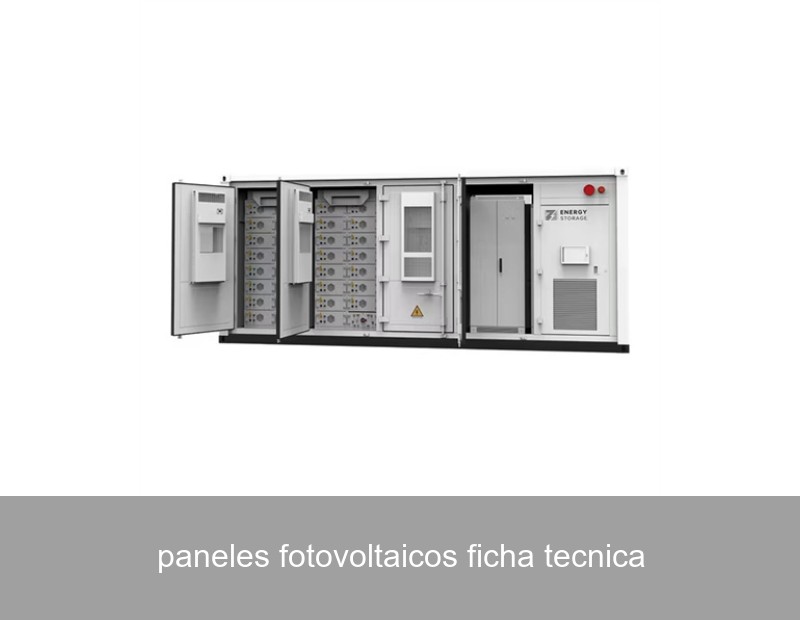
- Highjoule H-Series Commercial ESS: Scalable, containerized battery systems that store excess solar generation for use during peak tariff periods or at night, dramatically increasing energy self-consumption and reducing demand charges.
- Advanced Inverter & Power Conversion Technology: Our bi-directional inverters are optimized to work with high-efficiency panels, ensuring minimal energy loss during conversion from DC (panel) to AC (your business) or to storage.
- Highjoule Energy Management System (EMS): The brain of the operation. Our AI-driven EMS doesn't just react; it predicts. Using weather forecasts and consumption patterns, it autonomously decides when to store solar energy, when to discharge it, and when to participate in grid services, ensuring every kilowatt-hour is used in the most economically optimal way.
In essence, while the datasheet tells you what a panel can do, a Highjoule system ensures it does so at the lowest possible cost and highest possible reliability for your specific application.

Image: For businesses, integrating solar with storage, like Highjoule's solutions, maximizes financial returns. (Photo by Andreas Gücklhorn on Unsplash)
Asking the Right Questions
Now that you're equipped to read between the lines of a paneles fotovoltaicos ficha tecnica, your conversation with installers and energy partners should evolve. Don't just ask for the price per panel. Ask:
- "How do the temperature coefficients of these panels affect my annual yield in my local climate?"
- "How will this system integrate with storage, either now or in the future, to maximize my self-consumption?"
- "What kind of system-level intelligence (like Highjoule's EMS) can be added to optimize my total energy cost, not just my solar generation?"
For more on standardized testing and panel specifications, you can refer to resources from the National Renewable Energy Laboratory (NREL).
So, what's the first data point you'll look for when you review your next solar panel datasheet, and how will you envision it as part of your larger energy independence journey?
 Inquiry
 Online Chat