


Unlocking Peak Performance: The Power and Potential of the 500W Monocrystalline Solar Panel
If you're researching solar energy, you've likely come across the term "pannello fotovoltaico monocristallino 500w" – the 500-watt monocrystalline solar panel. This isn't just another incremental upgrade; it represents a significant leap in photovoltaic technology. For homeowners and businesses across Europe and the US, these high-efficiency panels are changing the calculus of solar investment, offering more power, better space efficiency, and faster returns. But what makes them so special, and how can you ensure you get the most out of this advanced technology? Let's dive in.
What is a 500W Monocrystalline Solar Panel?
At its core, a monocrystalline solar panel is built from single-crystal silicon. This pure silicon structure allows electrons, the particles that generate electricity when hit by sunlight, to move more freely than in other panel types. The result? Higher efficiency. While polycrystalline panels might typically offer 17-20% efficiency, modern monocrystalline panels, especially the 500W class, routinely achieve 21% and above. This means they convert a greater portion of sunlight into usable electricity.
The "500W" rating is the panel's power output under ideal laboratory conditions (Standard Test Conditions, or STC). In the real world, factors like temperature, angle, and shading affect output, but a 500W panel will consistently outperform a 400W or 350W panel on the same roof area. Think of it this way: with higher wattage panels, you need fewer of them to reach your energy goals, simplifying installation and maximizing constrained roof spaces.

Image Source: Unsplash - A close-up view of high-purity monocrystalline silicon cells.
Why the Move to 500W+ Panels is a Game Changer
The shift towards these high-wattage panels is driven by a clear phenomenon: the need for more energy density. As electricity demands rise and available roof or land space remains fixed, the solution is to generate more power per square meter.
- Space and Cost Efficiency: For a commercial installation needing 100kW, you would need approximately 250 units of 400W panels. With 500W panels, that number drops to just 200. This means fewer racking components, less labor, and potentially lower balance-of-system costs.
- Improved Performance in Low Light: Advanced monocrystalline cells, often paired with half-cut cell technology and sophisticated bypass diodes, perform better in partial shading and during morning/evening hours, squeezing more energy out of the day.
- Future-Proofing: Investing in the highest efficiency panel available today ensures your system remains competitive and capable as energy needs grow, perhaps with the addition of an electric vehicle.
However, here's a critical insight that's often overlooked: a high-power panel alone does not guarantee an optimal system. Its performance is fundamentally intertwined with the other components in your energy ecosystem, particularly the inverter and the energy storage system.
The Crucial Link: Inverters and Storage
Your shiny new 500W panel can only deliver its full potential if the inverter can handle its high current and voltage output. Furthermore, without intelligent storage, any excess energy you produce during peak sun hours is simply exported to the grid, often at a low rate. This is where companies like Highjoule redefine the value proposition. We don't just see a panel; we see a key component in an integrated energy system. Our HI-Energy Hub hybrid inverters are specifically engineered to pair seamlessly with high-power PV modules, ensuring every watt you generate is efficiently converted and managed. More importantly, coupling your array with a Highjoule BESS (Battery Energy Storage System) allows you to store that premium, self-generated power for use when the sun isn't shining, dramatically increasing your self-consumption and independence.
Real-World Impact: A Case Study from Spain
Let's move from theory to data-driven reality. Consider a medium-sized agricultural cooperative in Andalusia, Spain. They faced high operational costs from running irrigation pumps and cold storage units. Their goal was to reduce grid dependency and stabilize energy costs.
- System Installed (2023): 120kW rooftop array using 240 units of 500W monocrystalline panels.
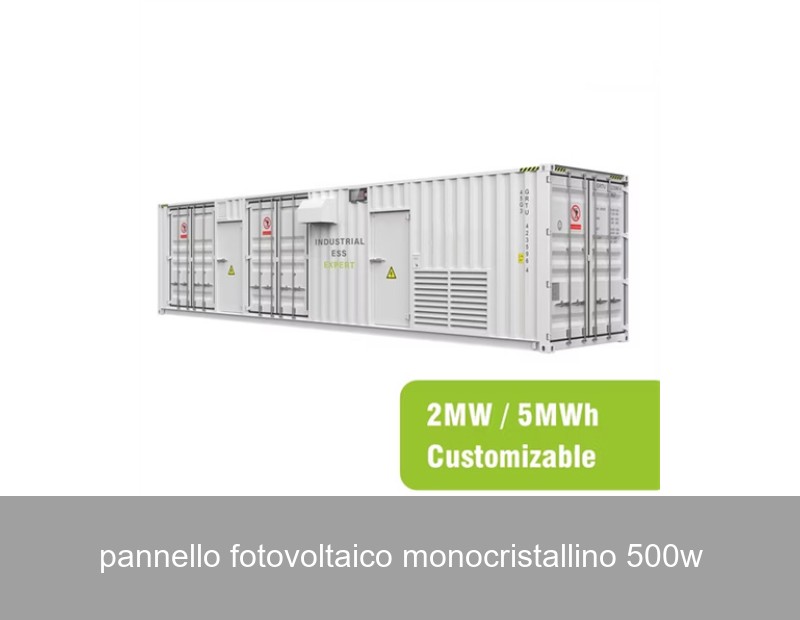
- Critical Addition: A 240kWh Highjoule containerized BESS and a master control system for energy management.
The results, monitored over one year, were compelling:
| Metric | Result | Impact |
|---|---|---|
| Annual Energy Generation | 182 MWh | Exceeded pre-installation models by 5% |
| Self-Consumption Rate | Increased from 35% to 94% | Via intelligent battery buffering |
| Grid Energy Cost Reduction | 68% | Substantial OPEX savings |
| ROI Period | Estimated 4.2 years | Accelerated by high panel output and storage arbitrage |
This case, documented in a International Renewable Energy Agency (IRENA) report on agricultural solar applications, highlights the synergy. The high-yield 500W panels provided the energy, but the intelligent storage and management system, like those provided by Highjoule, captured and deployed that energy strategically, transforming the solar array from a simple supplement into the core of their energy strategy.
Beyond the Panel: Maximizing Your 500W Investment
Choosing the right panel is step one. To truly build a resilient and cost-saving energy asset, you must consider the full picture.
Key Considerations for Your High-Power Solar Project:
- System Design & Compatibility: Ensure your inverter's maximum DC input voltage and current ratings can accommodate the string configuration of 500W panels. Our Highjoule technical team specializes in this precise optimization.
- Storage is Non-Negotiable: To maximize self-consumption, pairing with a battery system is essential. Highjoule's lithium iron phosphate (LFP) battery systems offer safety, longevity (over 6000 cycles), and seamless integration.
- Professional Installation: Higher power means higher currents. Proper wiring, grounding, and professional installation by certified partners are critical for safety and performance.
- Smart Monitoring: A system this valuable needs visibility. Highjoule's EnergyOS platform provides real-time insights into production, storage, consumption, and even predictive maintenance alerts.

Image Source: Unsplash - A modern home with solar panels and an EV, representing integrated clean energy living.
The Future: Smarter, More Integrated Energy Systems
The evolution of the pannello fotovoltaico monocristallino 500w is part of a larger trend towards integrated, smart, and resilient energy systems. We're moving beyond simple net metering towards energy independence and grid interaction. Technologies like vehicle-to-grid (V2G) and AI-driven energy forecasting are on the horizon.
At Highjoule, with nearly two decades of experience since 2005, our focus is on providing these complete, intelligent systems. Whether for a residential homeowner seeking backup power and bill savings, a commercial business targeting sustainability goals and cost predictability, or an industrial microgrid requiring utter reliability, our solutions are built around the principle that every component—from the 500W panel to the battery to the software—must work in perfect harmony. For deeper technical insights on cell technology, resources from the National Renewable Energy Laboratory (NREL) are invaluable.
So, as you contemplate harnessing the sun with these powerful new panels, we leave you with this question: Is your goal simply to generate solar energy, or is it to build a comprehensive, intelligent, and independent energy system that powers your life or business on your own terms? The choice in components and partners will define your answer.
 Inquiry
 Online Chat