


How Much Does Permitting a BESS Really Cost? A Clear Guide for Project Developers
So, you've crunched the numbers on your Battery Energy Storage System (BESS) project. The hardware costs, the revenue models, the long-term value—it all looks promising. But then comes a critical, often murky line item: permitting for BESS. "How much will that *actually* cost us?" is a question that keeps many developers awake at night. Unlike the standardized pricing of battery racks, permitting costs are a complex puzzle of local regulations, engineering studies, and time. This article cuts through the uncertainty, providing a transparent breakdown of the costs, timelines, and strategic considerations for permitting BESS projects in markets like the US and Europe.
Table of Contents
The Hidden Cost Drivers: More Than Just a Form
Let's be clear: permitting a BESS is not like getting a building permit for a shed. It's a multidisciplinary approval process that touches on fire safety, grid interconnection, environmental impact, and zoning. The primary cost drivers aren't the application fees themselves, but the specialized engineering and consultancy work required to satisfy authorities having jurisdiction (AHJs). A 2023 report by the U.S. National Renewable Energy Laboratory (NREL) highlighted that soft costs, including permitting, interconnection, and engineering, can constitute 15-30% of the total capital expenditure for a standalone storage project. The variability is enormous, with total permitting-related costs ranging from $50,000 for a straightforward commercial system to well over $500,000 for a large-scale, complex utility project.

Image Source: Unsplash - Professional site planning is foundational to a smooth permitting process.
Why Is BESS Permitting So Complex?
The complexity stems from the technology's novelty in many jurisdictions. Fire departments may be unfamiliar with lithium-ion battery hazard mitigation. Planning boards may have outdated zoning codes that don't mention "energy storage." This uncertainty leads to:
- Extended Review Cycles: Each question from an AHJ can mean weeks of delay.
- Requirement for Custom Studies: You may need a bespoke fire risk assessment or acoustic report where a standard one was expected.
- Evolving Code Compliance: Navigating between international codes (like NFPA 855, IEC 62933) and local amendments.
Breaking Down the BESS Permitting Cost Structure
To understand "how much," we must itemize the components. Here’s a typical breakdown for a mid-sized commercial/industrial (C&I) BESS project in the 5-20 MW range.
| Cost Category | Typical Scope | Estimated Cost Range (USD) | Notes & Variability |
|---|---|---|---|
| Pre-Application & Feasibility | Site due diligence, preliminary zoning review, initial utility dialogue. | $10,000 - $25,000 | Critical to de-risk the project early. Costs can be lost if site is unfeasible. |
| Engineering Design & Plan Sets | Detailed site plans, electrical schematics, civil/structural drawings, fire suppression system design. | $50,000 - $150,000+ | Largest variable. Depends on system complexity, site conditions, and AHJ drawing requirements. |
| Specialist Studies & Reports | Fire Risk Assessment (FRA), Arc-Flash Study, Geotechnical Report, Environmental Impact Assessment (if required). | $30,000 - $100,000+ | Often the most unpredictable cost bucket. Local mandates can require specific consultants. |
| Application & Review Fees | Direct fees paid to the city, county, fire district, and utility for plan review and permits. | $15,000 - $50,000 | More predictable, but can scale with project value or require recurring fees for re-submittals. |
| Contingency & Management | Project management of the permit process, consultant coordination, contingency for unexpected requirements. | 15-25% of Total Above | Essential. Underestimating this is a common pitfall leading to budget overruns. |
Total Estimated Range: For a 10MW C&I BESS in a moderately complex jurisdiction, a realistic all-in permitting budget often falls between $150,000 and $350,000. Time is also cost: a 6-month delay versus a 12-month permitting timeline can significantly impact project finance and ROI.
A Real-World Case: The 50MW Community Resilience Project
Let's ground this in reality. A developer in Central Europe recently navigated the permitting process for a 50MW / 100MWh BESS designed to provide grid stability and black-start capability. The project was located on a brownfield site, which added environmental layers to the permit.
- Initial Challenge: The local fire code had no specific provisions for BESS, leading to a request for a full-scale, third-party fire propagation test simulation.
- Cost Impact: This unanticipated study added €85,000 and 3 months to the schedule.
- Solution & Data: The developer partnered with a technology provider whose system had pre-certified designs meeting UL 9540A test standards. By submitting this existing test data and a detailed Fire Hazard Analysis (FHA) aligned with NFPA 855 guidelines, they satisfied the AHJ's safety concerns without the custom test. The total permitting cost settled at approximately €280,000.
This case underscores a key insight: choosing a BESS provider with a robust, pre-approved safety portfolio is not just a technical decision—it's a financial risk mitigation strategy.

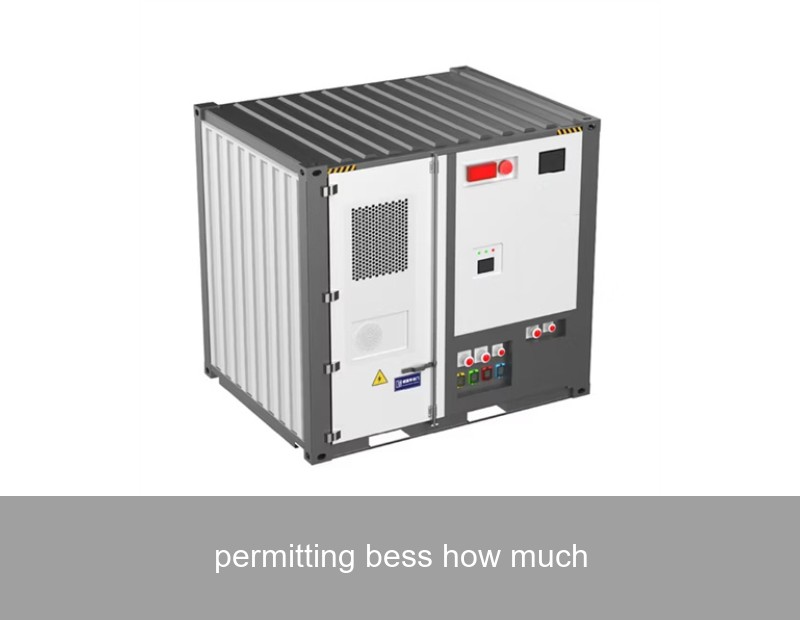
Image Source: Unsplash - A pre-engineered BESS unit with integrated safety systems.
Strategies for Streamlining Permitting and Cutting Costs
Proactivity is your greatest asset. Here’s how experienced developers are controlling permitting costs:
1. Engage Early and Often
Hold a pre-application meeting with all AHJs (fire, planning, building). Present a conceptual design. Their early feedback can steer your engineering in the right direction, avoiding costly redesigns later.
2. Leverage Standardized, Certified Designs
Opt for BESS solutions that are not just products, but pre-engineered systems with comprehensive certification packs (UL, IEC, CE). This turns your submission from a novel prototype into a compliant, repeatable installation. For instance, Highjoule's GridMax™ commercial and utility-scale systems are delivered with full documentation packs, including system-level UL 9540A test summaries, standardized single-line diagrams, and generic site layout templates. This dramatically reduces the engineering hours needed for custom plan sets.
3. Factor in the Total Cost of Delay
Budget for a contingency, but also model the financial impact of permitting delays on your project's net present value (NPV). Sometimes, investing more upfront in a comprehensive, clear submission saves millions in lost revenue down the line.
How Highjoule Simplifies the BESS Journey from Permitting to Operation
At Highjoule, we understand that the path to a profitable, operational BESS is paved with more than just cells and inverters. Our role as a global advanced energy storage provider is to be your partner in navigating the non-hardware complexities, especially permitting.
Our approach is built on proven, intelligent systems. The Highjoule GridMax™ and Highjoule EcoCell™ product lines are designed from the ground up with global compliance and streamlined deployment in mind. We provide:
- Permitting Support Dossiers: Tailored packages of technical documentation, safety certifications, and reference drawings that directly address common AHJ inquiries.
- Technical Advocacy: Our engineering team is available to support your consultants or directly engage with AHJs to explain system safety features and design philosophy.
- Integrated System Design: By providing a fully integrated solution—from battery racks and power conversion systems (PCS) to our proprietary Energy Management System (EMS)—we eliminate interface risks that often cause delays in interconnection studies and approvals.
For a recent 20MW frequency regulation project in Texas, our pre-packaged documentation and direct support helped the developer secure the building permit in 4.5 months, compared to the local average of 8 months for similar projects. This time saving translated directly into earlier commercial operation and revenue generation.
Looking Ahead: The Future of BESS Permitting
As energy storage becomes mainstream, jurisdictions are catching up. California's Energy Storage System Permitting Guidebook is a model for standardization. In Europe, harmonized standards under the EU's battery directive are emerging. The future points toward more predictable pathways, but for today's projects, preparation and partnership remain key.
Given the intricate dance between local regulations, evolving technology, and project economics, what specific permitting challenge in your upcoming BESS project are you most concerned about, and how are you planning to address it?
 Inquiry
 Online Chat