


Photovoltaic Ceramic Panels: The Next Frontier in Durable and Aesthetic Solar Energy
Imagine a solar panel that isn't just a functional energy generator, but a seamless, beautiful, and incredibly durable part of a building's architecture. For years, the solar industry has faced a common challenge: balancing high efficiency with long-term resilience and visual appeal, especially in demanding climates. This is where a groundbreaking innovation is making waves – photovoltaic ceramic panels. These aren't your standard glass-fronted modules. By integrating solar cells within a robust ceramic substrate, they offer a paradigm shift for projects where longevity, safety, and design are as critical as energy yield. As a senior product technology expert at Highjoule, a global leader in advanced energy storage since 2005, I see this technology as a perfect complement to intelligent storage systems, creating truly robust and sustainable power solutions for commercial, industrial, and residential applications.
Table of Contents
- What Are Photovoltaic Ceramic Panels?
- The Core Challenge: Durability vs. Efficiency
- The Data: Why Ceramic Makes a Difference
- Case Study: A European Landmark's Sustainable Transformation
- The Perfect Synergy: Ceramic PV Paired with Intelligent Storage
- The Future of Building-Integrated Photovoltaics (BIPV)
- Is Your Next Project a Candidate for Ceramic PV?
What Are Photovoltaic Ceramic Panels?
Let's break it down. Traditional solar panels typically use a tempered glass front sheet and a polymer backsheet for protection. Photovoltaic ceramic panels replace these elements with a sintered ceramic plate. This ceramic is not a thin coating; it's a dense, tile-like material engineered for extreme environments. The photovoltaic cells (often high-efficiency monocrystalline) are embedded and laminated within this ceramic structure, resulting in a module that is:
- Exceptionally Robust: Highly resistant to impact, abrasion, and extreme temperature cycling.
- Fire-Resistant: Ceramic is inherently non-combustible, offering superior fire safety – a key consideration for building codes and insurance, especially in wildfire-prone areas like California or Southern Europe.
- Chemically Inert: Unaffected by salt mist (crucial for coastal installations), ammonia, or corrosive industrial atmospheres. <
- Visually Versatile: The surface can be textured, colored, or finished to mimic traditional building materials like terracotta, stone, or slate, enabling true architectural integration.

Image: Ceramic-based solar tiles demonstrate the potential for seamless architectural integration. Photovoltaic ceramic panels take this concept further with larger, more robust formats.
The Core Challenge: Durability vs. Efficiency
For decades, the industry's focus has been squarely on increasing laboratory efficiency percentages. However, field data from harsh environments reveals a critical insight: a panel that degrades quickly in real-world conditions will lose its efficiency advantage over its lifetime. The phenomenon is clear. In industrial zones, chemical corrosion can degrade panel seals and contacts. In coastal regions, salt corrosion is a silent killer of conventional modules. In areas with high hail risk, physical damage leads to immediate and total power loss.
This creates a dilemma for architects, project developers, and homeowners: do you choose the highest efficiency panel on a spec sheet, or the one that will reliably produce energy for 40+ years with minimal degradation? Photovoltaic ceramic panels are designed to solve this very dilemma, prioritizing long-term performance and total cost of ownership over peak lab efficiency.
The Data: Why Ceramic Makes a Difference
Independent testing and research underscore the advantages of the ceramic approach. Let's look at some key performance indicators compared to standard glass-glass modules:
| Performance Indicator | Standard Glass-Glass PV Module | Photovoltaic Ceramic Panel |
|---|---|---|
| Hail Impact Resistance | IEC 61215 Standard (25mm hail at 23 m/s) | Often exceeds standard, withstanding larger hail (e.g., 35mm+) due to superior impact strength. |
| Fire Rating | Class C (or B with special construction) | Easily achieves Class A (the highest), as ceramic does not burn. |
| PID (Potential Induced Degradation) Resistance | Varies; can be a concern in humid climates | Exceptionally high resistance due to the hermetic nature of the ceramic encapsulation. |
| Estimated Annual Degradation Rate | ~0.5% - 0.7% | Potentially as low as ~0.2% - 0.3%, leading to significantly higher lifetime energy yield. |
| Typical Warranty Period | 25-30 years linear power output | Can be extended to 40+ years, given the material stability. |
Sources like the National Renewable Energy Laboratory (NREL) emphasize that durability is the next major frontier for PV technology. Ceramic panels directly address this frontier.
Case Study: A European Landmark's Sustainable Transformation
The theory is compelling, but how does it perform in practice? Consider the renovation of the historic "Bergwerk" cultural center in the Alpine region of Austria. The architects faced a strict mandate: preserve the building's iconic, steep-pitched roofline while achieving a high level of energy self-sufficiency. Standard panels would have been visually intrusive and posed a snow-shedding risk.
The solution was a 85 kWp installation using dark-toned photovoltaic ceramic panels. The data after three full years of operation is telling:
- Energy Production: Exceeded first-year projections by 5%, thanks to better-than-expected low-light and reflective (snow) performance.
- Durability Test: Survived two severe hail events with recorded hailstone diameters of over 4cm without a single damaged module.
- Aesthetic Outcome: The panels blended perfectly with the traditional slate roofs of the surrounding village, gaining immediate community acceptance and planning approval.
- System Longevity: The projected levelized cost of energy (LCOE) over 40 years is estimated to be 15% lower than a conventional system due to the extended lifespan and near-zero maintenance.
This case exemplifies the ideal application: a demanding environment where aesthetics, durability, and lifetime value are paramount.
The Perfect Synergy: Ceramic PV Paired with Intelligent Storage
Here's where the story becomes even more powerful. A durable, long-lasting generation asset deserves an equally robust and intelligent storage partner. This is precisely the synergy Highjoule provides. Our advanced battery energy storage systems (BESS) are engineered to maximize the value of every kilowatt-hour produced by specialized solar installations like ceramic PV arrays.
Think about it: if your solar panels are built to last 40+ years, you need a storage system with a similar lifecycle philosophy. Highjoule's H-Series commercial storage systems feature advanced lithium-iron-phosphate (LFP) chemistry, sophisticated thermal management, and adaptive battery optimization software that minimizes degradation. For a museum, a winery, a remote telecom site, or a historic estate using ceramic PV, our storage solutions ensure the self-produced clean energy is available on demand, day and night, maximizing independence from the grid.
Furthermore, for microgrid applications in industrial or community settings, Highjoule's integrated energy management system (EMS) can seamlessly orchestrate power from durable ceramic PV, long-life battery storage, and other sources to create a resilient and sustainable power island. It's about building a complete energy ecosystem designed for decades, not just years.

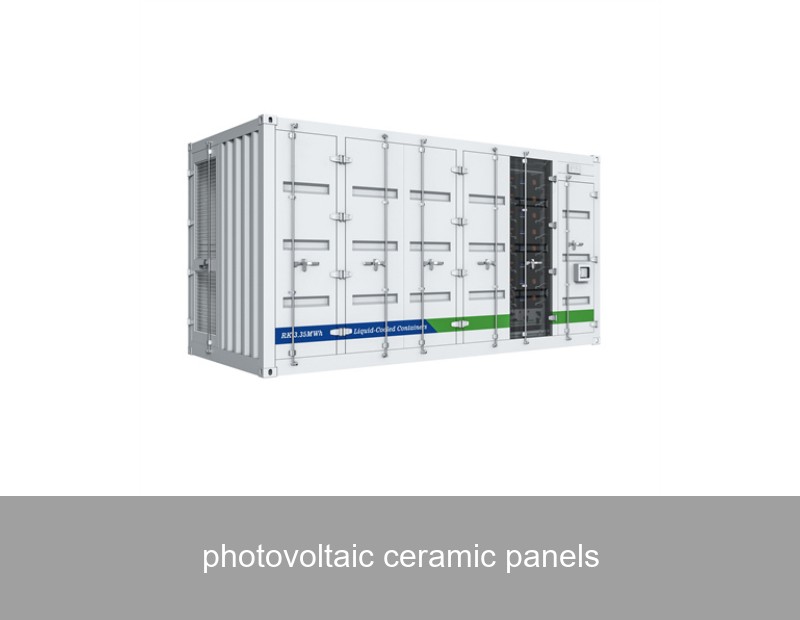
Image: Modern industrial energy solutions combine durable generation, like integrated PV, with robust battery storage for full energy independence.
Highjoule's Role in Your Durable Energy Project
Since 2005, Highjoule has been at the forefront of intelligent storage. When you consider a forward-thinking generation technology like photovoltaic ceramic panels, our role is to provide the storage and control backbone that unlocks its full potential. We offer:
- Tailored Storage Design: Systems sized and configured to match the unique long-term output profile of your ceramic PV installation.
- Lifecycle Alignment: Battery solutions designed for extended cycle life and calendar life, protecting your investment.
- Grid Services & Revenue Stacking: For commercial clients, our software enables participation in grid-balancing programs, turning your resilient energy asset into a revenue stream.
The Future of Building-Integrated Photovoltaics (BIPV)
Photovoltaic ceramic panels are a cornerstone of the next generation of Building-Integrated Photovoltaics (BIPV). As building codes worldwide move towards net-zero targets, the pressure to make every building surface energy-producing will grow. Ceramic technology answers the call for materials that are simultaneously structural, aesthetic, and energetic. Research institutions like the Fraunhofer Institute are actively developing new BIPV formats, with ceramics playing a key role due to their material properties.
Is Your Next Project a Candidate for Ceramic PV?
The question isn't whether photovoltaic ceramic panels are right for every rooftop – for standard residential suburbs, conventional panels remain cost-effective. The real question is: Do you have a project where the value of longevity, safety, and design integration outweighs the pure dollar-per-watt upfront cost? This includes heritage buildings, premium commercial constructions, harsh industrial environments, coastal resorts, or any facility where minimizing lifetime maintenance and risk is a top priority.
If you're an architect envisioning a net-zero landmark, a project developer building in hail-prone regions, or an industrial plant manager seeking energy security, the combination of durable ceramic photovoltaics and a Highjoule intelligent storage system might be the most strategic energy decision you can make. What unique challenge in your next project could this technology duo solve?
 Inquiry
 Online Chat