


How to Calculate Your Off-Grid Solar System: A Step-by-Step Guide for Energy Independence
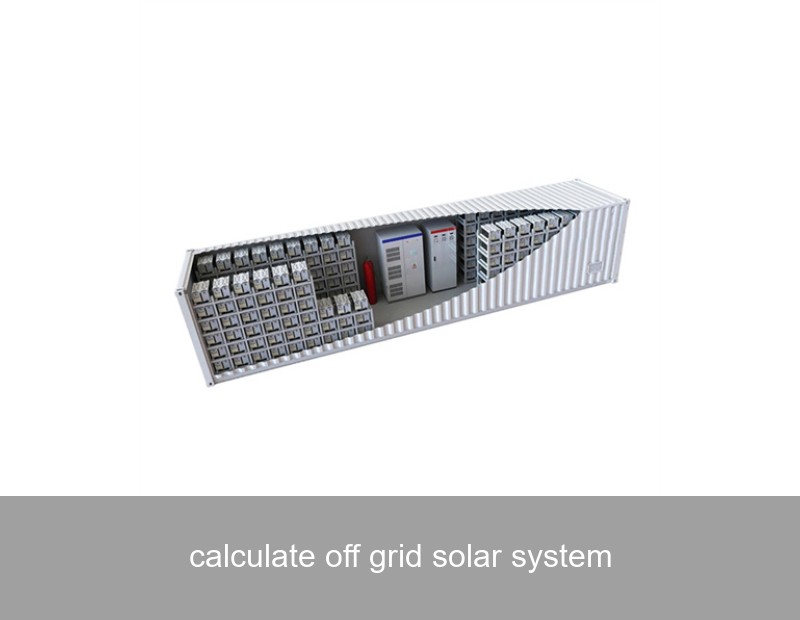
Imagine a life free from utility bills and power outages, where your energy comes directly from the sun. The dream of an off-grid solar system is compelling, but its success hinges on one critical task: performing an accurate calculation. An undersized system leaves you in the dark, while an oversized one strains your budget. This guide will walk you through the essential steps to calculate an off-grid solar system that meets your unique energy needs, ensuring reliability and maximizing your investment in energy independence.
The Off-Grid Calculation Challenge: Why "Guesstimates" Fail
Off-grid living means you are your own utility. There's no backup grid to tap into during a week of cloudy weather. Industry data suggests that the most common reason for off-grid system failure is chronic under-sizing, particularly of the battery storage component. It's not just about adding up wattages; it's about understanding consumption patterns, weather cycles, and the sophisticated interplay between components. A precise calculation isn't just math—it's the blueprint for your energy resilience.
Step 1: Conducting Your Energy Audit (The Load List)
Every calculation starts here. You need to know exactly what you're powering. Create a detailed table of all electrical loads, their power rating (in watts), and their daily usage hours.
| Appliance | Quantity | Power (Watts) | Hours/Day | Daily Watt-Hours |
|---|---|---|---|---|
| LED Lights | 10 | 10 | 5 | 500 |
| Refrigerator (Efficient) | 1 | 80 | 24 (on cycle) | 1,920 |
| Laptop | 1 | 60 | 4 | 240 |
| Water Pump | 1 | 800 | 0.5 | 400 |
Total Daily Energy Consumption: Sum the 'Daily Watt-Hours' column. For this example, let's say it's 3,060 Watt-hours (or 3.06 kWh). This is your foundational number. Remember to account for seasonal variations—using more lights in winter or a fan in summer.
Step 2: Sizing Your Battery Bank – The Heart of the System
Your battery bank is your energy reservoir. Sizing it correctly is paramount. You must consider your daily usage, how many days you need to cover without sun (days of autonomy), and the safe depth of discharge (DoD) for your battery type.
- Days of Autonomy: For most of Europe and the US, 3 days is a common standard to weather storms and low-light periods.
- Depth of Discharge (DoD): Modern lithium batteries, like those in Highjoule systems, can safely use 90-95% of their capacity. Lead-acid batteries should not exceed 50% DoD.
- System Voltage: 24V or 48V is standard for off-grid homes to reduce current and wiring costs.
Calculation Formula:
Battery Capacity (Ah) = [Daily kWh Usage × 1000 × Days of Autonomy] / [System Voltage (V) × DoD]
Example: For our 3.06 kWh daily load, 3 days autonomy, a 48V system, and using a Highjoule lithium battery at 95% DoD:
Capacity = (3.06 kWh × 1000 × 3) / (48V × 0.95) = 9,180 / 45.6 ≈ 201 Ah at 48V.
This is where a partner like Highjoule adds immense value. Our H-Joule Stack lithium battery systems are modular, allowing you to start with a base capacity and easily expand. Their high DoD, long cycle life (>6000 cycles), and integrated Battery Management System (BMS) ensure the bank you calculate delivers performance for decades, not just on paper.

Image Source: Unsplash (Representative image of modular energy storage)
Step 3: Sizing Your Solar Array – Catching Enough Sun
Now, your solar panels must replenish the battery bank while also covering daily use. You need to know your location's "peak sun hours"—the equivalent number of hours per day when sunlight intensity averages 1000W/m². This varies greatly; Southern Spain might average 5.5 hours, while Northern Germany gets around 2.8 in winter.
Calculation Formula:
Solar Array Power (W) = [Daily kWh Usage × 1000 × 1.3 (inefficiency factor)] / Peak Sun Hours
The 1.3 factor accounts for losses in wiring, inverters, and panel soiling. Let's take a challenging scenario: Winter in the Alps, with only 2.5 peak sun hours.
Solar Power = (3.06 kWh × 1000 × 1.3) / 2.5 = 3,978 / 2.5 ≈ 1,592 Watts.
You might need ten 400W panels, but with only 2.5 sun hours, you'd configure them to meet this wattage.
Highjoule's Smart MPPT Solar Charge Controllers are crucial here. They maximize energy harvest from your panels by up to 30% compared to older technology, squeezing every possible watt-hour out of those limited winter sun hours, directly impacting the efficiency of your calculated system.
Step 4: Choosing the Right Inverter and Charge Controller
These are the brains and the traffic cops of your system.
- Inverter Size: Must handle the total surge (starting) and running watts of all appliances that might be on simultaneously. From our table, the water pump (800W surge) plus others might require a 2,000-3,000W pure sine wave inverter. Highjoule's H-Power Hybrid Inverters seamlessly integrate solar charging, battery management, and AC power output, with models scalable for future expansion.
- Charge Controller Rating: Sized to the solar array's current. For a 1,592W array on a 48V battery bank: Current = 1592W / 48V = 33.2A. A 40A or 50A MPPT controller would be ideal.
Real-World Case Study: A Colorado Mountain Cabin, USA
Challenge: A family cabin at 10,000 ft elevation, completely off-grid, needed reliable year-round power for essentials, with temperatures ranging from -20°C to 25°C.
Solution & Calculation Outcome:
- Energy Audit: Determined a conservative daily need of 5 kWh.
- Battery Bank: Sized for 4 days of autonomy due to unpredictable mountain snow. Using Highjoule H-Joule Stack batteries (48V, 95% DoD), the calculation yielded a 440Ah bank.
- Solar Array: Based on winter low of 3.8 peak sun hours, a 5.2 kW array was installed.
- System: Integrated with a Highjoule H-Power 5kW Hybrid Inverter and dual MPPT charge controllers.
Result: After two full winters, the system has maintained 100% uptime, even during a historic 72-hour snowstorm. The intelligent system management allowed the family to monitor consumption remotely and optimize usage, with the batteries never dropping below 40% state of charge. This case underscores that a robust, well-calculated system with quality components like Highjoule's doesn't just meet specs—it provides peace of mind. For more on climate-specific solar data, refer to the National Renewable Energy Laboratory (NREL) solar maps.

Image Source: Unsplash (Representative image of off-grid solar in a snowy climate)
Beyond the Basics: The Role of Intelligent Energy Management
Today, calculating an off-grid system goes beyond static formulas. Modern systems like those from Highjoule incorporate AI-driven energy management platforms. Our Highjoule Neuron OS learns your consumption patterns, predicts weather based on local forecasts, and automatically optimizes charging and discharging cycles. This means your physically calculated system gains a layer of digital intelligence that can effectively "stretch" your battery bank and solar harvest, potentially allowing for more efficient sizing and longer component life. It's the difference between a calculator and a supercomputer managing your energy.
When you calculate your off-grid system, are you planning for the static numbers of today, or the intelligent, adaptive energy ecosystem of the next 20 years? The U.S. Department of Energy provides excellent foundational planning resources that align with this forward-thinking approach.
Your Calculation, Our Expertise
Calculating your off-grid solar system is a journey from your personal energy needs to a tailored technological solution. While the steps provide a framework, the nuances—component selection, environmental factors, and intelligent management—are where expertise matters. Highjoule partners with installers and homeowners globally to transform these calculations into robust, living energy systems. From our high-density, modular H-Joule Stack batteries to our smart H-Power inverters, every product is designed to deliver on the promise of your initial calculation.
What unique challenge does your location or lifestyle present for achieving true energy independence, and how can intelligent storage turn that challenge into a solved equation?
 Inquiry
 Online Chat