


Renewable Energy Procurement: Your Strategic Guide to a Cleaner, More Resilient Future
For businesses and communities across Europe and the US, the question is no longer *if* to switch to clean power, but *how* to do it effectively. Renewable energy procurement has moved from a niche sustainability goal to a core business strategy, driven by climate targets, consumer demand, and, increasingly, energy security and cost stability. But navigating the complex landscape of Power Purchase Agreements (PPAs), on-site generation, and grid integration can be daunting. This guide breaks down the strategic "how," helping you turn procurement from a challenge into a competitive advantage.
Table of Contents
- The "Why" Behind the Surge: More Than Just Green Goals
- The Strategic "Hows": Pathways to Procurement
- The Stability Imperative: Why Procurement Needs Storage
- Case Study: A German Manufacturer's Journey to Resilience
- How Highjoule Empowers Your Procurement Strategy
- What's the First Barrier Your Organization Needs to Overcome?
The "Why" Behind the Surge: More Than Just Green Goals
Renewable energy procurement is the process of sourcing electricity from clean sources like solar, wind, and hydro. While the environmental driver is powerful, the modern rationale is multifaceted. Think of it as a three-legged stool: sustainability, economics, and resilience.
- Regulatory & Consumer Pressure: With the EU's European Green Deal and ambitious net-zero targets in several US states, compliance is key. Furthermore, 83% of consumers globally believe companies should be actively shaping ESG best practices.
- Financial Sense: The levelized cost of energy (LCOE) for solar PV and onshore wind has fallen dramatically, often making them the cheapest source of new power generation. Procuring via long-term PPAs locks in energy costs, shielding businesses from volatile fossil fuel markets.
- Energy Independence: Recent geopolitical events have starkly highlighted the risks of over-reliance on centralized, imported fuels. On-site generation and local procurement bolster energy sovereignty.

Image Source: Unsplash (Free to use under the Unsplash License)
The Strategic "Hows": Pathways to Procurement
There is no one-size-fits-all approach. Your choice depends on your location, energy profile, capital, and risk appetite. Here are the primary models:
| Model | How It Works | Best For | Key Consideration |
|---|---|---|---|
| On-Site Generation | Installing solar PV or wind directly on your property. | Businesses with suitable roof/land space seeking maximum control and long-term savings. | High upfront CAPEX; output must be consumed or stored. |
| Off-Site PPAs | A long-term contract to buy power from a specific remote renewable project. | Large energy users wanting to impact additionality (fund new projects) and secure fixed prices. | Complex, long-term financial commitment; requires creditworthiness. |
| Utility Green Tariffs | Buying green power directly from your utility through a special rate. | Organizations seeking a simple, low-commitment entry point. | May not support "additional" new renewable projects; varies by utility. |
| Renewable Energy Certificates (RECs) | Purchasing the environmental attributes of renewable power separately from electricity. | Meeting sustainability reporting requirements quickly and flexibly. | Does not directly impact grid mix or lock in physical power prices. |
The Stability Imperative: Why Procurement Needs Storage
Here's the critical insight many miss: procuring renewable energy is only half the solution. Solar and wind are inherently intermittent—the sun sets, the wind calms. This creates a mismatch between when you *generate* clean power and when you *need* it. Without a solution, you're left relying on the traditional grid (often fossil-fueled) at night or during calm periods, undermining your sustainability and cost goals.
This is where advanced Battery Energy Storage Systems (BESS) become the indispensable linchpin. A smart BESS does three things:
- Time-Shifts Energy: Stores excess solar power generated at noon for use in the evening peak, maximizing self-consumption.
- Provides Grid Resilience: Acts as a backup power source during outages, ensuring operational continuity.
- Enables Market Participation: In many markets, stored energy can be used for grid services (like frequency response) or for peak shaving to avoid demand charges—turning your storage into a revenue or savings stream.
Case Study: A German Manufacturer's Journey to Resilience
Let's look at a real-world example from Bavaria, Germany. A mid-sized automotive parts manufacturer committed to 100% renewable power for its 24/7 production facility. They installed a 2.5 MW rooftop solar PV system. Initially, their solar self-consumption rate was only 35%, forcing them to buy expensive grid power at night.
The Solution & Data: They integrated a Highjoule HiveStack BESS with a capacity of 1.5 MW / 3 MWh. The system's AI-driven energy management software was programmed to:
- Prioritize storing excess solar production.
- Discharge during high-price evening hours (4 PM - 9 PM).
- Keep a reserve for backup power.
The Results (12-month period):
- Self-Consumption of Solar: Increased from 35% to 85%.
- Grid Energy Cost: Reduced by €142,000 annually.
- Carbon Footprint: Scope 2 emissions reduced by an additional 720 tonnes CO2e/year.
- ROI: Achieved in under 5 years, factoring in avoided costs and incentives.

Image Source: Unsplash (Free to use under the Unsplash License)
This case shows that true renewable energy procurement isn't just about the source—it's about intelligently managing the power to make it reliable and economical.
How Highjoule Empowers Your Procurement Strategy
At Highjoule, we understand that renewable energy procurement is a system-wide challenge. Since 2005, we've evolved from a battery innovator to a provider of integrated, intelligent energy solutions. Our role is to be the stability partner that makes your renewable ambitions work in the real world.
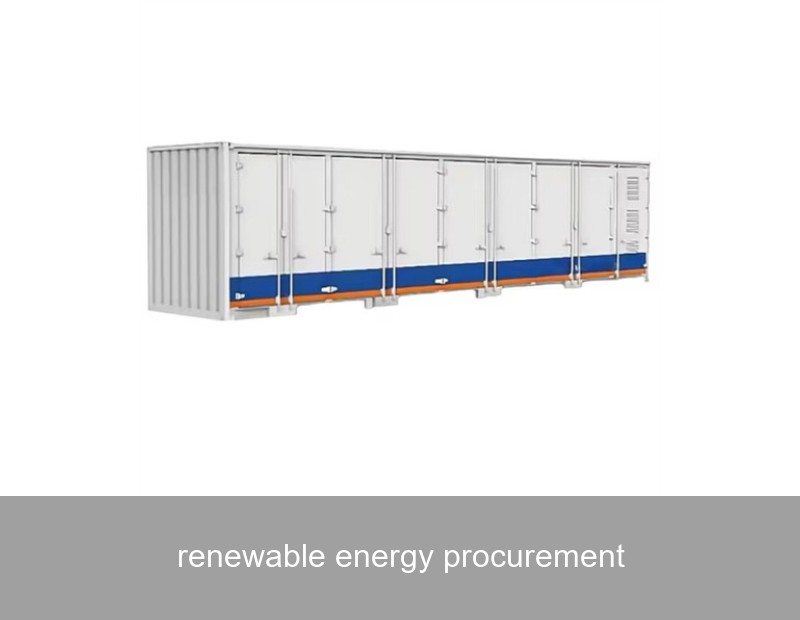
Our HiveStack Commercial & Industrial (C&I) Energy Storage Systems are engineered for this exact purpose. They feature industry-leading safety with integrated thermal runaway prevention, high cycle life, and seamless compatibility with both new and existing solar installations. More than hardware, our HiveMind AI Energy Platform is the brain. It optimizes every kilowatt-hour in real-time, deciding when to store, when to discharge, and when to sell back to the grid based on weather forecasts, energy prices, and your consumption patterns.
For larger-scale needs, such as microgrids for campuses or industrial parks, our GridStack Utility-Scale BESS provides the foundational infrastructure to balance high shares of variable renewables, ensuring grid stability and enabling community-wide procurement projects.
We partner with you and your renewable developer to design a holistic system where generation, storage, and management work as one intelligent unit. This transforms your procurement from a simple energy purchase into a controllable, resilient, and value-generating asset.
What's the First Barrier Your Organization Needs to Overcome?
Is it the perceived complexity of navigating PPAs? The concern about upfront capital for an integrated solar-plus-storage system? Or perhaps it's quantifying the long-term ROI amidst fluctuating energy policies? The journey to strategic renewable procurement starts by identifying that single, biggest hurdle. From there, the path—with the right technology and partners—becomes clear. What will your first step be?
 Inquiry
 Online Chat