


Rubber Band Energy Storage: A Stretchy Solution or a Serious Contender?
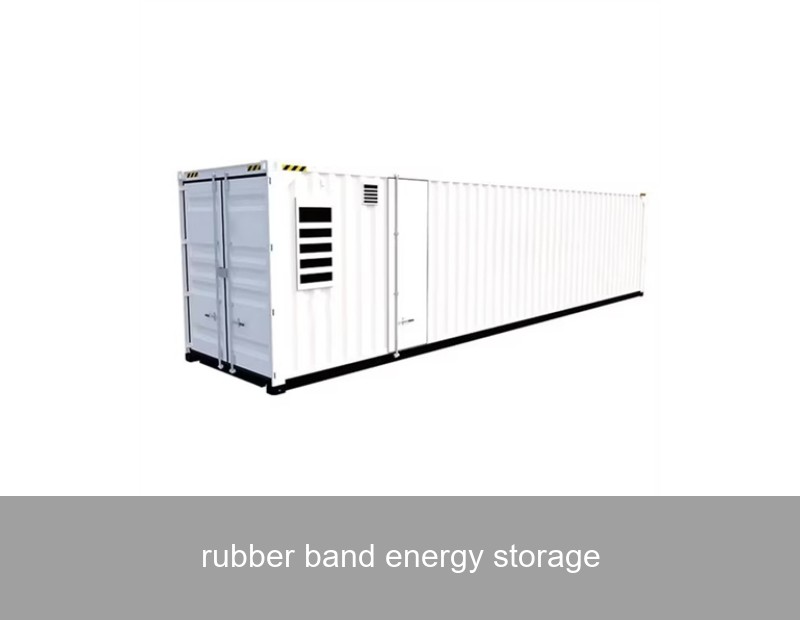
Imagine a world where we could store the sun's energy for a rainy day using something as simple as a giant rubber band. It sounds like a child's science project, but rubber band energy storage is a real, emerging field of mechanical energy storage research. As the world races to decarbonize, finding cheap, abundant, and sustainable ways to store renewable energy is the holy grail. While lithium-ion batteries dominate headlines, innovators are looking at everything from lifting weights to, yes, stretching elastic materials. But can twisting polymers really help power our homes and industries? Let's unravel the potential and the practicalities of this intriguing concept.
What is Rubber Band Energy Storage?
At its core, rubber band energy storage is a form of mechanical potential energy storage. It's based on the same principle you experienced as a kid: stretch a rubber band, and it stores energy. Release it, and that energy is converted back into motion. In a theoretical large-scale system, motors would use excess solar or wind power to twist or stretch massive bands or specially engineered elastomers (elastic polymers). When the grid needs power, the tension is released, spinning a generator. The appeal is undeniable. The primary materials could be low-cost polymers, potentially avoiding the supply chain and ethical concerns associated with mining for lithium, cobalt, and other battery metals.

Image source: Wired Magazine - Demonstrating the fundamental principle of elastic potential energy.
How It Works: The Science of Stretching
The technology isn't about office supplies. Advanced prototypes use high-strength, synthetic elastomers engineered for millions of cycles. The process follows a clear cycle:
- Charging (Energy Input): Excess electricity powers a motor that stretches or twists the elastomeric material, storing energy as molecular potential energy within the polymer chains.
- Storage: The material is held in its tensed state. A key challenge is minimizing "stress relaxation," where the material loses tension over time.
- Discharging (Energy Output): The tension is controllably released, causing the motor to act as a generator, converting the mechanical energy back into electricity.
Researchers at institutions like Harvard University have explored using "twisted polymer fibers" that can achieve impressive energy densities, in some lab cases rivaling lead-acid batteries. The theoretical simplicity is its strongest selling point.
Pros and Cons: A Realistic Look
Let's break down the potential advantages and the significant hurdles this technology faces.
| Advantages | Challenges & Limitations |
|---|---|
|
|
A Real-World Case Study: The Swiss Mountain Project
While pure rubber band energy storage remains nascent, a brilliant project in Switzerland demonstrates the power of its underlying principle: mechanical potential energy storage. The Nant de Drance pumped-storage hydropower plant, operational in 2022, is like a giant, ultra-efficient rubber band for the European grid.
Here’s how it works and what the data shows:
- Concept: It uses two reservoirs at different altitudes. When there's surplus wind or solar power in Europe, it uses that cheap electricity to pump water 425 meters up the mountain, storing energy.
- Discharge: When demand peaks, water is released downhill through turbines, generating 900 MW of power—equivalent to a large nuclear reactor—in under 5 minutes.
- The Data: With a staggering capacity of 20 GWh and an efficiency of around 80%, it's a grid stabilizer. In 2023, it played a crucial role in balancing frequency during a major grid disturbance in Western Europe, preventing blackouts. (Source: Nant de Drance official site).
This case isn't about rubber, but it validates the economic and technical viability of large-scale mechanical storage. It sets a high bar for any new technology like elastic storage, which must compete on cost, scale, and efficiency.
The Bigger Picture: Grid-Scale Storage Needs
The European and American grids need diverse storage solutions for different durations: seconds for frequency regulation, hours for daily solar shifting, and days for resilience. The International Renewable Energy Agency (IRENA) emphasizes that no single technology will win. We need a portfolio.
- Short-Duration: Lithium-ion batteries excel here (seconds to 4 hours).
- Long-Duration (LDES): For 10+ hours to multiple days, technologies like pumped hydro, flow batteries, compressed air, and, potentially one day, advanced mechanical systems like metal or elastic bands are being explored.
The Highjoule Approach: Proven Tech for Today's Grid
While the future of innovations like rubber band energy storage is fascinating to watch, businesses and communities need reliable, bankable solutions today. This is where Highjoule delivers. With nearly two decades of experience since 2005, we focus on deploying advanced, intelligent battery energy storage systems (BESS) that are proven, efficient, and sustainable.
Our GridMaster Pro and Industrial PowerHub series are built with the latest lithium-iron-phosphate (LFP) cell technology, prioritizing safety, longevity (over 10,000 cycles), and a 95%+ round-trip efficiency. Unlike theoretical solutions, our systems are integrated with AI-driven energy management software that autonomously optimizes energy usage, maximizes self-consumption of rooftop solar, and provides grid services. For a manufacturing plant in Germany or a microgrid in California, the equation is about financial ROI and energy security now. Highjoule's smart BESS provides immediate savings, backup power, and a tangible step toward sustainability without compromising on performance.

Image source: Unsplash - Representative image of a modern industrial battery storage installation.
Our Services: From Analysis to Long-Term Support
Highjoule is more than a hardware provider. We partner with clients through a full lifecycle service:
- Feasibility & Financial Modeling: We analyze your load profile and energy costs to model the perfect system size and ROI.
- Turnkey Integration: Seamless integration with existing solar PV, generators, and building management systems.
- Smart Software & Grid Services: Our platform can aggregate systems to participate in demand response or frequency regulation markets, creating new revenue streams.
- O&M and Performance Guarantee: We offer comprehensive service plans with guaranteed performance, ensuring your asset delivers for decades.
The Future of Energy Storage Innovation
The journey of rubber band energy storage highlights a critical truth: the path to a 100% renewable grid is paved with both incremental improvements and moonshot ideas. It reminds us to think creatively about fundamental physics. Perhaps elastomers will find a niche in low-cost, long-cycle-life applications for off-grid settings. Meanwhile, the steady progress in flow batteries, thermal storage, and next-generation lithium technologies will continue.
The key for any energy manager is to balance optimism for the future with pragmatism for the present. So, as we watch researchers stretch the limits of polymer science, what is the most impactful step you can take this year to reduce your energy costs and carbon footprint with the technology that's ready today?
 Inquiry
 Online Chat