


Understanding Servokon Battery 200Ah Price: A Smart Buyer's Guide to Energy Storage
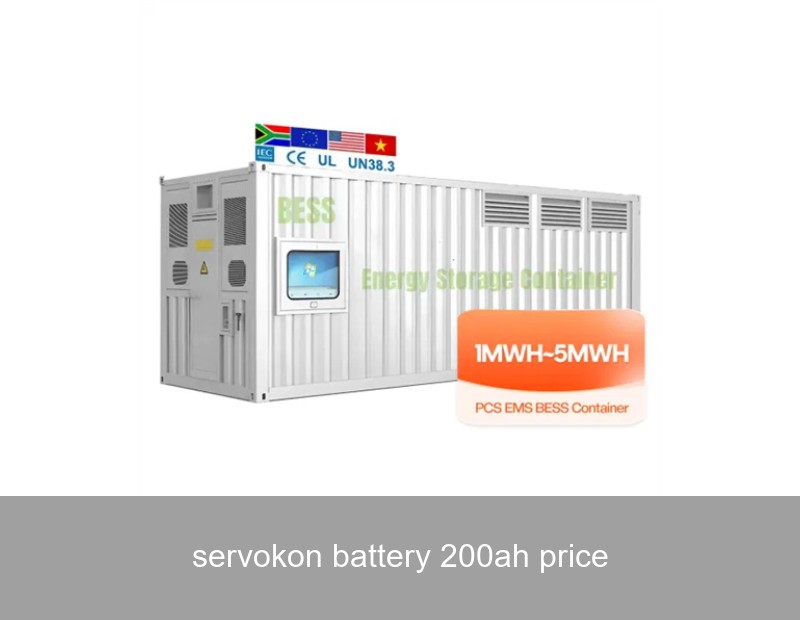
If you're searching for "Servokon battery 200Ah price," you're likely evaluating options for a reliable and powerful energy storage solution. Whether for backup power, an off-grid solar system, or an industrial application, the price tag is just one piece of the puzzle. In today's dynamic energy landscape, understanding the value behind the cost—longevity, performance, and integration—is what truly empowers your decision. This article will demystify the factors influencing battery pricing and guide you toward a future-proof investment.
Table of Contents
Key Factors Influencing 200Ah Battery Prices
Why does the price for a 200Ah battery vary so dramatically? You might find quotes ranging from a few hundred to several thousand dollars. The discrepancy isn't random; it's a direct reflection of core components and capabilities.
- Battery Chemistry: This is the primary cost driver. Traditional flooded lead-acid batteries are the most affordable upfront. Sealed AGM (Absorbent Glass Mat) batteries come at a moderate premium. Lithium Iron Phosphate (LiFePO4) batteries command a higher initial price but offer transformative benefits.
- Brand & Quality Assurance: Established brands with rigorous testing, safety certifications (like UL, IEC), and robust warranties inherently cost more. They invest in quality control that mitigates the risk of premature failure.
- Cycle Life & Depth of Discharge (DoD): A battery rated for 500 cycles is cheaper than one rated for 6000 cycles. Crucially, a lithium battery that allows 90-100% DoD provides nearly its entire rated capacity, whereas discharging a lead-acid battery beyond 50% regularly drastically shortens its life.
- Additional Features: Integrated Battery Management Systems (BMS), smart communication capabilities (like Bluetooth or CAN bus), and modular designs for scalability add value and cost.

Different battery chemistries and constructions lead to significant variations in performance, lifespan, and ultimately, price.
Battery Technology Showdown: Lead-Acid vs. LiFePO4
Let's put the two dominant technologies head-to-head. While Servokon is known for its lead-acid offerings, the global shift is toward lithium. Here’s why.
| Feature | Traditional Lead-Acid (Flooded/AGM) | Modern LiFePO4 (Lithium Iron Phosphate) |
|---|---|---|
| Approximate Price Point (200Ah) | Low to Medium | High (2-3x upfront) |
| Cycle Life (to 80% capacity) | 300 - 1,200 cycles | 3,000 - 6,000+ cycles |
| Usable Depth of Discharge (DoD) | ~50% recommended | 90-100% usable |
| Energy Density & Size | Bulky, heavy | Compact, lightweight (approx. 1/3 the weight) |
| Maintenance | Regular watering (flooded), ventilation needed | Virtually maintenance-free |
| Efficiency | ~70-85% | >95% |
The table reveals a critical insight: the cost-per-cycle of LiFePO4 is often significantly lower. You're purchasing decades of reliable service, not just ampere-hours.
The Real Cost: Beyond the Initial Price Tag
Think of a battery as a long-term partner in your energy journey. The total cost of ownership (TCO) includes:
- Replacement Costs: You may need to replace a lead-acid bank 3-4 times before a single LiFePO4 bank reaches end-of-life.
- Energy Losses: Lower efficiency means more solar energy is wasted as heat during charge/discharge cycles, requiring a larger solar array to do the same job.
- Installation & Ventilation: Heavy lead-acid batteries may require reinforced flooring. Flooded types need dedicated, ventilated battery rooms to manage hazardous gassing.
- Opportunity Cost: A compact, high-DoD lithium system frees up space and allows you to utilize more of your stored renewable energy, maximizing your solar investment.
Case Study: A German Bakery's Transition to Calculated Value
Let's ground this in reality. Bäckerei Schmidt (a mid-sized bakery in Bavaria) operated a 20kWh backup system using premium AGM batteries. Their bank needed replacement every ~5 years at a cost of €6,500, with only 10kWh usable due to DoD limits. Frequent deep discharges during winter power dips accelerated wear.
In 2021, they upgraded to a modern Highjoule H-Stack lithium-ion system. The upfront investment was €18,000. However, the analysis showed:
- Usable Capacity: Full 20kWh available (100% DoD).
- Projected Lifespan: 15+ years (based on NREL lifecycle data).
- TCO over 15 years: AGM System: €6,500 x 3 replacements = €19,500 (plus downtime & labor). Highjoule System: €18,000 one-time.
The bakery now enjoys guaranteed backup for critical refrigeration, reduced energy waste, and a system that integrates seamlessly with their solar PV. The "cheaper" option was, in the long run, more expensive and less capable.

Modern commercial battery storage systems, like those from Highjoule, are designed for seamless integration and long-term operational savings.
Modern Solutions: Where Highjoule Excels
At Highjoule, we believe your energy storage should be an intelligent asset, not a disposable commodity. Founded in 2005, we design systems where the value is measured in decades of reliable, efficient performance.
For clients considering a 200Ah-class solution, we often guide them toward our H-Stack Modular Battery System. It's a different paradigm altogether:
- Intelligent by Design: Each module features an advanced BMS that communicates with our EnergyOS platform, optimizing performance, providing real-time health data, and enabling remote updates.
- True Scalability: Start with what you need and add modules seamlessly, without complex reconfiguration. It's like building with powerful energy bricks.
- Built for Integration: Whether paired with a new solar array, a wind turbine, or a generator for a microgrid, our systems are engineered to be the perfect team player, maximizing renewable self-consumption and providing grid independence.
- Global Support: With projects across Europe and North America, we provide localized service and monitoring, ensuring your system performs optimally in your specific climate and utility landscape.
Our focus isn't on selling a standalone battery; it's on delivering a holistic power resilience solution for homes, businesses, and communities.
Your Actionable Buying Guide: What to Do Next
So, how do you move forward? Shift your question from "What is the Servokon battery 200Ah price?" to "What is the optimal storage solution for my specific needs over the next 20 years?"
- Audit Your Energy Profile: Calculate your critical load (in kWh) and peak power demand (in kW). How many hours of backup do you truly need? Tools like the U.S. DOE Energy Saver guides can help.
- Evaluate Total Cost of Ownership: Model different technologies over a 15-year period. Include all replacement, efficiency, and maintenance costs.
- Prioritize Integration: Will this system work with your existing or planned solar inverter? Can it be managed easily? Ensure compatibility is a cornerstone, not an afterthought.
- Demand Transparency: Request detailed specifications, warranty terms (covering both capacity retention and years), and real-world case studies from your provider.
Ready to Explore a Solution Engineered for the Future?
The conversation about energy storage is evolving from simple price-per-amp-hour to intelligent value-per-cycle. What specific challenge—be it rising energy costs, unreliable grid power, or a desire for true energy independence—is motivating your search today? How can a system that thinks for itself transform your relationship with power?
 Inquiry
 Online Chat