


The Slim Lithium Battery 200Ah: Powering a New Era of Energy Density and Design
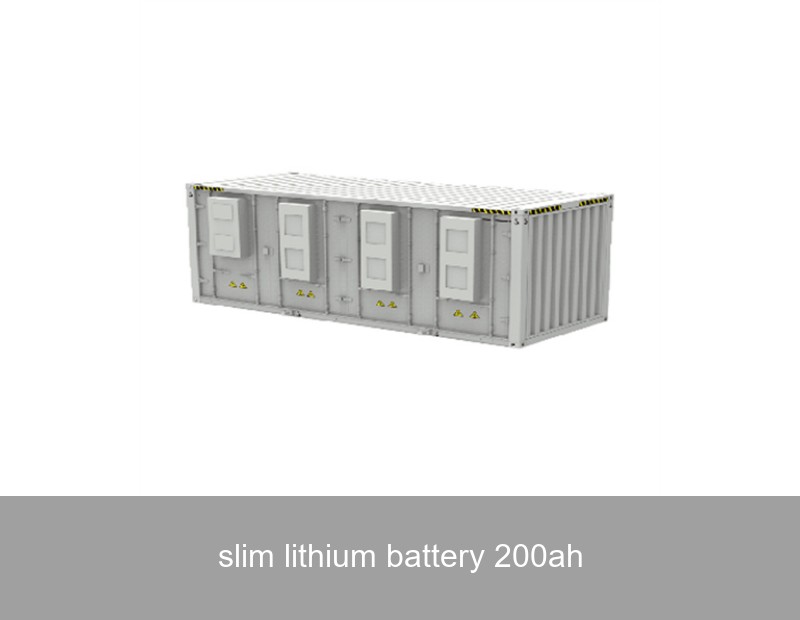
Imagine needing a powerful, long-lasting energy source but being constrained by space. This is a common challenge in modern energy storage, from sleek RVs and off-grid cabins to compact commercial backup systems. The quest for more power in less space is driving innovation, and the answer lies in a specific technological advancement: the slim lithium battery 200Ah. This isn't just a battery; it's a design philosophy that prioritizes energy density and form factor without compromising on the legendary performance of lithium chemistry. For homeowners, businesses, and adventurers across Europe and the US, this evolution means freedom—freedom to design, to optimize, and to utilize space like never before.
Table of Contents
- The Space Problem: Why Size and Shape Matter
- What Exactly is a Slim Lithium Battery 200Ah?
- Key Benefits Unpacked: More Than Just a Thin Profile
- A Real-World Case: The German Boutique Hotel Transformation
- Choosing the Right Slim Battery for Your Application
- Future Trends: Where is Slim Battery Tech Heading?
The Space Problem: Why Size and Shape Matter
For decades, energy storage was bulky. Lead-acid banks demanded dedicated rooms, vented enclosures, and heavy structural support. Even early lithium solutions, while better, often came in rigid, boxy formats. But modern applications have outgrown these designs. Think about the electric marine sector, where every cubic inch below deck is precious. Or residential retrofits, where battery systems must integrate seamlessly into existing garages or utility closets without a major footprint. The data is clear: a McKinsey report highlights that alongside cost and longevity, energy density (the amount of energy stored in a given volume) remains a top priority for adoption. The "slim" form factor is a direct response to this market need, optimizing the physical layout of cells and internal components to create a profile that is as practical as it is powerful.
What Exactly is a Slim Lithium Battery 200Ah?
Let's break down the terminology. "200Ah" (Amp-hours) refers to capacity—a measure of the battery's energy reservoir. A 200Ah battery can theoretically deliver 200 amps for one hour, or 10 amps for 20 hours, under ideal conditions. It's a substantial capacity suitable for significant daily energy needs. "Slim" defines the physical architecture. Unlike a standard cube-shaped battery, a slim variant is engineered to be significantly thinner in one dimension, often resembling a large, flat panel. This is achieved through advanced cell stacking and modular internal design. Crucially, this slimming down does not sacrifice performance. These batteries still boast the core advantages of Lithium Iron Phosphate (LiFePO4) chemistry: safety, stability, and a cycle life that dwarfs lead-acid, often exceeding 6000 cycles.

Image Source: Unsplash - Representative image of modern, space-efficient battery installation.
Key Benefits Unpacked: More Than Just a Thin Profile
The advantages of a slim 200Ah lithium battery extend far beyond its shape.
- Unmatched Space Efficiency: They can be mounted on walls, slid into narrow compartments, or stacked in unique configurations, freeing up valuable floor space.
- Enhanced Cooling & Safety: The larger surface-area-to-volume ratio can improve passive thermal management, a critical factor for longevity and safety. Highjoule's designs, for instance, integrate intelligent thermal monitoring systems that leverage this form factor.
- Design Flexibility: Architects and system integrators are no longer forced to design around a bulky battery. The battery can now adapt to the design.
- Simplified Installation & Scalability: Their lighter weight and manageable dimensions make handling safer and easier. Their uniform shape also simplifies building larger capacity systems through parallel connections.
A Real-World Case: The German Boutique Hotel Transformation
Consider the challenge faced by a historic boutique hotel in Bavaria, Germany. Committed to sustainability, they wanted to add solar storage to reduce grid reliance and peak demand charges. However, their century-old building had a severely constrained basement utility room, already housing essential services. Traditional battery boxes were impossible to fit.
The solution was a custom-configured energy storage system built around high-density, slim lithium battery 200Ah modules. By utilizing the vertical wall space that was previously unused, the installers fitted a 40kWh system without any structural modifications. The system's slim profile allowed for adequate airflow and easy service access. Post-installation data over 12 months showed a 68% reduction in grid electricity draw during peak tariff hours and an increase in self-consumption of onsite solar from 30% to over 85%. The hotel manager noted, "The system disappeared into the walls. It gave us the future without asking us to rebuild the past." This case underscores how form factor can be the deciding factor between a project's feasibility and failure.
The Highjoule Approach: Engineering Intelligence into Every Millimeter
At Highjoule, we view the slim lithium battery not just as a product, but as an integrated component of a smarter energy ecosystem. Our Highjoule H-Series SlimStack 200Ah modules are engineered with this philosophy. We start with automotive-grade LiFePO4 cells, renowned for their safety and cycle life, and arrange them in a proprietary, ultra-compact matrix. Each module is then equipped with our proprietary Battery Management System (BMS) that provides cell-level monitoring, state-of-charge accuracy, and seamless communication with Highjoule energy inverters and monitoring platforms.
What truly sets our solution apart is its system intelligence. These slim batteries are designed to be the building blocks of scalable storage for residential, commercial, and microgrid applications. They communicate with each other and with Highjoule's energy management software, allowing for dynamic control based on time-of-use rates, solar production, and load demand. For a business in California navigating complex NEM 3.0 rules or a household in Germany aiming for Energieautarkie (energy independence), this intelligence maximizes financial return and energy resilience. Our global service network provides support and performance monitoring, ensuring your investment is protected for the long term.
| Feature | Slim Lithium (e.g., Highjoule SlimStack) | Traditional Box Lithium | Lead-Acid Bank |
|---|---|---|---|
| Space Efficiency | Excellent (Wall-mountable, flexible layout) | Moderate | Poor (Requires large footprint & ventilation) |
| Weight per kWh | ~6-8 kg/kWh | ~8-10 kg/kWh | ~25-30 kg/kWh |
| Thermal Management | Enhanced passive cooling due to surface area | Standard | Requires active ventilation (off-gassing) |
| Installation Flexibility | High | Medium | Very Low |
| Typical Cycle Life (to 80% capacity) | 6000+ | 3000-5000 | 300-500 (if deeply cycled) |
Choosing the Right Slim Battery for Your Application
So, is a slim 200Ah battery right for you? Ask these questions:
- What is my primary constraint? Is it physical space (e.g., RV, boat, small utility room) or is it purely capacity? If space is key, slim is likely ideal.
- What is my total energy need? A single 200Ah battery at 12.8V offers about 2.56kWh of usable energy. Calculate your daily kWh consumption to see how many modules you might need in parallel.
- How important is system integration? For a hassle-free, high-performance setup, choose a battery like Highjoule's that is designed to work seamlessly with compatible inverters and software, ensuring safety and unlocking advanced features.
Always consult with a certified installer. They can assess your site, load profile, and goals to specify the optimal configuration. Reputable sources like the U.S. Department of Energy provide excellent foundational guidance for planning.
Future Trends: Where is Slim Battery Tech Heading?
The trajectory is toward even greater integration and intelligence. We are moving towards "structural" or "building-integrated" storage, where batteries are embedded into the fabric of buildings or vehicles. The slim form factor is a critical enabler of this trend. Furthermore, advancements in solid-state electrolyte technology, as noted by research institutions like Fraunhofer, promise even higher energy densities and safety profiles in similarly slim packages in the coming decade. The future battery won't just be a box you connect; it will be a seamless, intelligent layer of your property's infrastructure.

Image Source: Unsplash - Conceptual image of battery integration in architectural planning.
Your Energy, Your Space
The evolution to the slim lithium battery 200Ah represents a fundamental shift: energy storage should adapt to your life and your space, not the other way around. It empowers you to think differently about where and how you store power. What previously impossible project could you enable by unlocking that narrow, unused space on your wall?
We invite you to share your unique space challenge with our Highjoule design team. What's the most constrained environment where you've ever wished you could install reliable, high-capacity power?
 Inquiry
 Online Chat