


Solar 2kV Price: How Much Does a True Energy Independence System Really Cost?
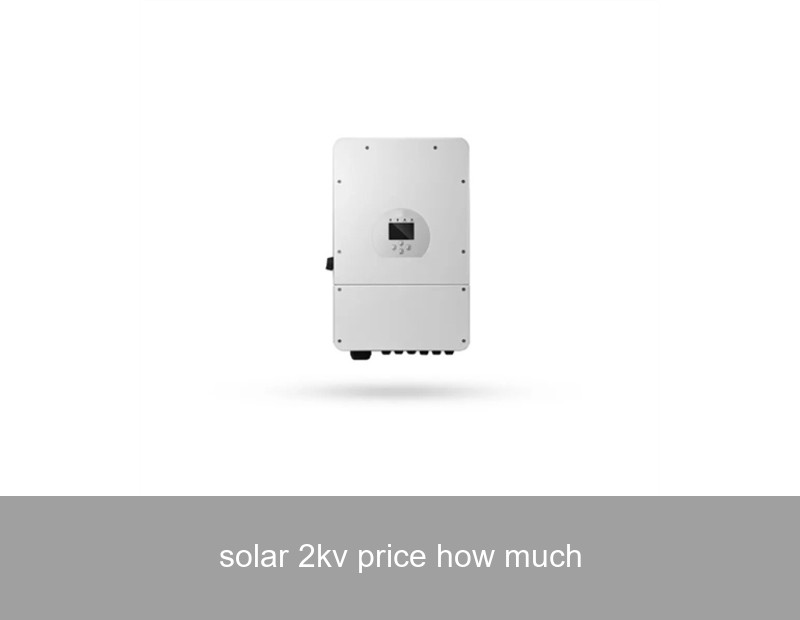
If you're searching for "solar 2kV price how much?", you're already on the right path towards energy independence. But here's the crucial insight: you're not just shopping for a piece of hardware. You're investing in a complete energy ecosystem. The term "2kV" typically refers to a battery energy storage system (BESS) with a power rating of 2 kilowatts (kW). However, focusing solely on this battery price is like asking for the price of an engine without considering the car, the fuel, and the intelligence of the driver. A 2kW battery is a key component, but its value is unlocked only when paired with solar panels, a compatible inverter, smart management, and professional installation. Let's demystify the true cost and value of building a resilient, money-saving solar and storage solution.
Breaking Down the "Solar 2kV Price": It's More Than Hardware
The total investment for a functional system revolves around several core components. Think of it as a symphony where every instrument plays a vital role.
- The Solar Array (The Fuel Source): This is your power plant. The number of panels directly impacts how quickly you can charge your battery and offset grid consumption. For a system designed to feed a 2kW battery effectively, you might need a 3-6 kWp solar array, depending on your location and energy goals.
- The Battery (The Energy Reservoir): The "2kV" star of the show. Its capacity, measured in kilowatt-hours (kWh), determines how much energy you can store. A 2kW power rating means it can deliver a continuous flow of 2,000 watts. A common pairing might be a 2kW inverter with a 5-10 kWh battery capacity (like Highjoule's ResiCore 5 or 10 models) to provide meaningful backup during evenings or outages.
- The Hybrid Inverter (The Brain & Brawn): This critical device manages energy flow between solar panels, the battery, and your home's circuits. It converts DC from panels and battery to AC for your home, and vice-versa for charging. Its quality defines system efficiency and safety.
- Balance of System & Installation: This includes wiring, electrical panels, mounting, monitoring hardware, and most importantly, certified professional labor. Proper installation is non-negotiable for safety, performance, and warranty validation.
| Component | Description | Estimated Cost Range (Pre-Incentive) |
|---|---|---|
| Solar Panels (4-6 kW) | High-efficiency monocrystalline panels | $4,000 - $8,000 |
| 2kW Battery + Hybrid Inverter | e.g., Highjoule ResiCore Kit with 5-10 kWh capacity | $3,500 - $7,000 |
| Balance of System & Installation | Hardware, labor, permits, and grid connection fees | $2,000 - $4,000 |
| Total System Cost | Fully installed, operational system | $9,500 - $19,000+ |
Key Takeaway: The "solar 2kV price" for a complete system is a significant investment, but one that pays dividends for decades. Crucially, government incentives can drastically reduce the net cost. In the US, the federal Investment Tax Credit (ITC) covers 30% of the total system cost, including storage. Many European countries and individual states offer similar rebates and tax benefits.
The Real Cost of Power: A Case Study from Sunny Spain
Let's move from theory to practice. Consider a real-world scenario for a family home in Valencia, Spain, an area with high electricity prices and abundant sunshine.
The Phenomenon: The García family faced rising energy bills, frequent afternoon price peaks, and concern over grid reliability. They wanted to maximize self-consumption of their existing solar panels.
The Data & Solution: Their average daily consumption was 20 kWh, with a peak load of 2.5 kW. They installed a Highjoule ResiCore 10 system (2kW continuous power, 10.2 kWh capacity) with a compatible hybrid inverter. The total installed cost was approximately €8,500. After a local energy efficiency subsidy, their net investment was around €6,300.
The Outcome: The system increased their solar self-consumption rate from 35% to over 85%. It automatically powers the home during expensive peak tariff hours (6-10 PM) using stored solar energy. In the first year, they reduced their annual electricity bill by €1,400. This translates to a simple payback period of just under 4.5 years on their net investment. For the system's expected 15+ year lifespan, that's over a decade of nearly free electricity for critical loads and massive long-term savings.

Image: A modern home energy setup with solar panels and a wall-mounted battery unit. (Source: Unsplash, Photographer: Vivint Solar)
Highjoule's Intelligent Energy Ecosystem: Maximizing Your Investment
As a leader since 2005, Highjoule understands that the true value of a "2kV system" isn't just in the lithium cells; it's in the intelligence that manages them. Our solutions are designed to turn your system from a passive backup into an active financial asset.
- Highjoule ResiCore Series: Our flagship residential battery systems, scalable from 5 kWh to beyond 20 kWh, with a 2kW or higher power output. They feature built-in safety mechanisms, high-cycle life LiFePO4 chemistry, and seamless integration with most major solar inverter brands.
- Smart Energy Gateway (SEG): This is the true brain. Our proprietary software platform can learn your consumption patterns, forecast weather, and even integrate with dynamic electricity tariffs. It automatically decides the most economical moment to charge from solar or the grid, and when to discharge to power your home or sell back to the grid where permitted.
- Grid Services & Future-Proofing: For commercial and microgrid applications, Highjoule's larger-scale systems can provide services like peak shaving and frequency regulation. For homeowners, our modular design means you can easily add more battery capacity as your needs evolve, protecting your initial investment.
This intelligent management is what transforms a static price quote into a dynamic return on investment. According to a 2023 report by the National Renewable Energy Lab (NREL), pairing solar with advanced, software-driven storage significantly increases customer bill savings and grid value compared to solar alone.
The Future of Energy is Modular and Smart
The energy landscape is shifting from centralized, one-way power delivery to a decentralized, interactive network. Your home can become a node in this smart grid. With the right system, you're not just a consumer; you're a "prosumer" – producing, storing, and managing your own energy. This autonomy is becoming increasingly valuable, not just for savings, but for resilience during extreme weather events and grid instability, a concern growing in both the US and Europe.

Image: A homeowner monitoring and managing their energy production and consumption via a smart device. (Source: Unsplash, Photographer: Andreas Gücklhorn)
Making the Right Investment for Your Energy Independence
So, when you ask "solar 2kV price how much?", the most honest answer is: "It depends on the intelligence and completeness of the system you choose." The upfront cost is a gateway to long-term control. A cheaper, isolated battery might seem attractive, but it could lack the software intelligence to maximize savings or the scalability to grow with you.
Your journey shouldn't start with a price tag; it should start with a conversation about your goals. What are your daily and seasonal energy needs? What are your local utility rates and net metering policies? What level of backup power is essential for your home? By answering these questions, you can design a system that delivers true value for decades.
Ready to move beyond a simple price quote and explore what a tailored Highjoule intelligent energy system can do for your home's efficiency, resilience, and financial future? What's the first load you would power during an outage, and how would you value the peace of mind that comes with it?
 Inquiry
 Online Chat