


Navigating the Landscape of Solar Businesses for Sale: A Strategic Guide
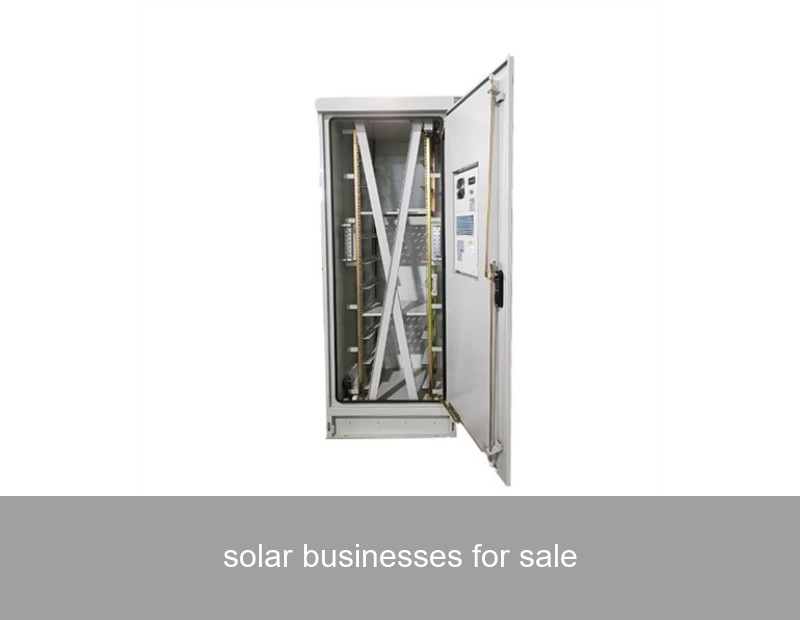
If you're exploring the market for solar businesses for sale, you're looking at one of the most dynamic and promising sectors in the global energy transition. Whether you're an entrepreneur, an investor, or an established energy player, acquiring a solar enterprise isn't just a financial transaction—it's a bet on a sustainable future. But what truly makes a solar business a valuable, future-proof asset? Beyond the panel installations and customer lists, the real competitive edge increasingly lies in one critical capability: intelligent energy storage and management. Let's unpack the key considerations and hidden opportunities in today's market.
Table of Contents
- The Solar Market Evolution: Beyond Installation
- Key Valuation Drivers for Solar Businesses
- The Critical Role of Storage and Energy Management
- Case Study: Transforming a German Solar Installer
- Highjoule: Your Partner in Enhancing Asset Value
- Essential Due Diligence Checklist
- The Future-Proof Solar Business Model
The Solar Market Evolution: Beyond Installation
The solar industry has matured dramatically. A decade ago, a solar business was primarily an installation contractor. Today, it's a sophisticated energy service provider. Customers—whether homeowners, factories, or municipalities—don't just want panels on their roofs; they want reliable, low-cost, and resilient power. This shift is driven by volatile energy prices, grid stability concerns, and ambitious decarbonization goals, particularly in markets like the United States and Europe.
When evaluating solar businesses for sale, savvy buyers now look for companies that have moved up the value chain. The most attractive assets are those offering comprehensive solutions: solar generation plus battery storage, smart energy management, and ongoing service packages. This integrated approach locks in customer lifetime value and creates recurring revenue streams, making the business far more resilient and valuable.

According to the International Energy Agency (IEA), solar PV is set to dominate global capacity additions, but growth is increasingly intertwined with storage deployment. A standalone solar installer is like a car dealership selling vehicles without fuel tanks; functional, but missing a critical component for long journeys.
Key Valuation Drivers for Solar Businesses
What should you scrutinize in a potential acquisition? Look beyond the immediate financials.
- Recurring Revenue Mix: What percentage of income comes from O&M (Operations & Maintenance), monitoring fees, or energy service contracts? A high percentage indicates stability.
- Technology Stack: Does the company use proprietary software for design, monitoring, or customer management? Is its storage offering a branded, integrated solution or a generic white-label product?
- Grid Service Readiness: In markets like the U.S. (FERC Order 2222) and Europe, can the company's installed systems participate in grid services (frequency regulation, virtual power plants)? This unlocks massive new revenue.
- Supplier & Partner Relationships: Long-term agreements with tier-1 technology providers are a significant asset, ensuring product quality and supply chain stability.
The Critical Role of Storage and Energy Management
Here's the pivotal insight: storage is the new solar. A solar array without storage often exports excess power to the grid at low rates, while the owner buys back power at night at high rates. Adding a battery fundamentally changes this economics, allowing customers to maximize self-consumption, gain backup power, and participate in energy arbitrage.
For a solar business, offering integrated storage solutions isn't just an add-on product; it's a transformative upgrade to its core value proposition. It increases the average deal size, improves customer satisfaction and retention, and future-proofs installations against changing grid policies. The question for any buyer of a solar business for sale becomes: Does this company have the expertise and partnerships to deliver this integrated value effectively?
Case Study: Transforming a German Solar Installer
Let's examine a real-world example from Bavaria, Germany. In 2021, a mid-sized solar installation company with a strong residential customer base was acquired by a renewable energy fund. The company had solid installation revenues but faced margin pressure and low customer retention post-installation.
The Strategy: The new owners immediately partnered with a leading storage system provider to retrofit a high-performance battery and energy management system (EMS) into their sales package. They targeted homeowners with existing solar systems (a retrofit market) and new build projects.
The Data-Driven Results (18 Months Post-Acquisition):
| Metric | Pre-Acquisition | Post-Integration |
|---|---|---|
| Average Project Value | €18,500 (solar only) | €32,000 (solar + storage) |
| Customer Retention Rate | ~15% (for add-ons) | ~65% (for EMS services) |
| Recurring Revenue Stream | Negligible | €200-€500/year/customer (monitoring & VPP participation) |
| Company Valuation Multiple | ~4x EBITDA | ~7x EBITDA (estimated) |
This case, documented in part by the Fraunhofer ISE, highlights how integrating storage and smart energy management can radically enhance the financial profile and strategic value of a solar business. The ability to bundle hardware with ongoing software-based services was the key multiplier.
Highjoule: Your Partner in Enhancing Asset Value
This is where Highjoule comes into the picture. As a global leader in advanced energy storage systems since 2005, we don't just sell batteries; we provide the intelligent backbone that transforms a simple solar installation into a comprehensive power resilience and optimization asset.
For an entrepreneur or investor evaluating solar businesses for sale, a partnership with Highjoule represents a powerful lever to increase the acquired company's worth. Our H-Series commercial & industrial (C&I) energy storage systems and Voltstream residential storage solutions are designed for seamless integration. They come with our proprietary NeuroGrid AI energy management platform, which automatically optimizes energy flow for self-consumption, cost savings, and even generates revenue by participating in grid-balancing programs where available.

By aligning an acquisition target with Highjoule's technology, you're not just buying a company with a past; you're equipping it with a clear, high-margin roadmap for the future. We provide the training, technical support, and co-branded marketing materials to help the sales team confidently sell integrated solutions, thereby boosting close rates and project value from day one.
Essential Due Diligence Checklist
When you find a promising solar business for sale, augment your financial due diligence with these technical and strategic questions:
- Does the company have certified storage installation capabilities? If not, what training is needed?
- What storage brands does it currently use? Are they scalable, software-upgradable, and have a strong track record?
- What is the existing customer base's potential for storage retrofits? (A huge latent opportunity).
- Does the company's software platform allow for the aggregation of distributed assets into a Virtual Power Plant (VPP)?
- What are the local grid codes and incentive programs (e.g., U.S. Investment Tax Credit for storage, European capacity markets) that could benefit an integrated solar-storage offering?
The Future-Proof Solar Business Model
The most successful solar enterprises of this decade will be those that act as decentralized energy architects. They will design, install, and manage systems that generate, store, and intelligently dispatch electricity. This model provides unparalleled value to end-users besieged by energy uncertainty and creates a robust, defensible business with multiple revenue lines.
Acquiring a solar business for sale is the first step. The strategic imperative is to have a clear plan for its technological evolution. Will you be content with a company that sells a commodity, or will you transform it into an indispensable provider of energy resilience and intelligence?

As you consider your next move in this vibrant market, we invite you to reflect: Is your acquisition strategy merely capturing today's installed base, or is it building the energy platform that customers will depend on tomorrow? What would it mean for your investment if, on the day of acquisition, you already had a proven pathway to double the average customer lifetime value?
 Inquiry
 Online Chat