


Solar Companies in the World: Powering a Sustainable Future Beyond Panels
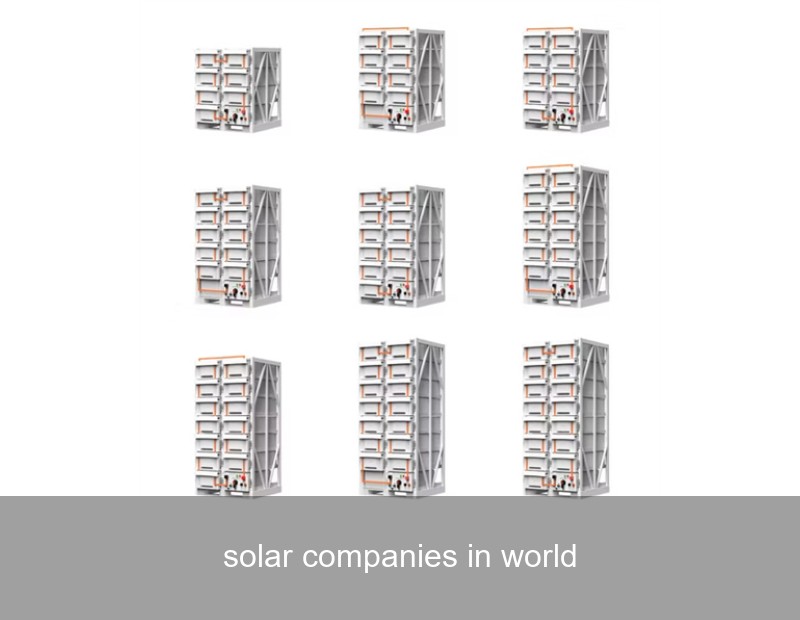
When you think of the top solar companies in the world, names of panel manufacturers likely come to mind. But the true leaders of today's energy revolution are those solving the next critical puzzle: what happens when the sun goes down? The solar industry has matured, and the conversation has shifted from mere generation to intelligent, reliable, and around-the-clock clean power. This is where advanced energy storage becomes the defining technology, transforming solar from a variable source into a firm, dispatchable powerhouse for homes, businesses, and entire grids.
Table of Contents
- The Phenomenon: Solar's Success Creates a New Challenge
- The Data: Quantifying the Solar Duck Curve and Storage Demand
- Case Study: How a German Industrial Park Solved Its Solar Dilemma
- The Insight: Storage is the Intelligence Layer for Modern Solar
- Highjoule's Role: The Engine Behind Intelligent Solar Systems
- The Future: What's Next for Global Solar Leaders?
The Phenomenon: Solar's Success Creates a New Challenge
Across Europe and the U.S., rooftops and fields are gleaming with photovoltaic panels. Solar is often the cheapest form of new electricity generation, a testament to the innovation of global solar companies. Yet, this success has revealed a fundamental grid dynamic: temporal mismatch. Solar production peaks midday, while energy demand often peaks in the early evening. This creates a dramatic swing—a surplus of solar power when it's not fully needed, and a deficit when it is. Without a solution, this can lead to grid instability, curtailment (wasting clean energy), and continued reliance on fossil-fuel peaker plants.

Image Source: National Renewable Energy Laboratory (NREL), depicting the evolving "Duck Curve."
The Data: Quantifying the Solar Duck Curve and Storage Demand
The numbers paint a clear picture of the opportunity and urgency for storage. According to the International Energy Agency (IEA), global renewable capacity additions jumped nearly 50% in 2023, with solar PV accounting for three-quarters of that growth. However, the U.S. Energy Information Administration notes that curtailment of solar and wind in some markets can exceed 5% of annual generation—a significant waste of clean energy and capital.
Conversely, the demand for energy storage is exploding. BloombergNEF forecasts global energy storage installations will hit a staggering 1,200 gigawatt-hours (GWh) by 2030, a 15-fold increase from the end of 2023. This isn't just about adding batteries; it's about integrating sophisticated Battery Energy Storage Systems (BESS) that manage charge/discharge cycles, grid interactions, and maximize financial returns.
Case Study: How a German Industrial Park Solved Its Solar Dilemma
Consider a real-world example from Bavaria, Germany. A mid-sized manufacturing park with a 2 MW rooftop solar system faced two problems: 1) They were exporting excess solar power to the grid at low feed-in tariffs during midday, and 2) They were drawing expensive power from the grid during morning and evening peaks, eroding their solar savings.
The Solution: The park partnered with a system integrator who deployed a 1.5 MWh / 750 kW DC-coupled battery storage system. The results over 12 months were compelling:
| Metric | Before Storage | After Storage |
|---|---|---|
| On-Site Solar Consumption | 35% | 85% |
| Grid Peak Demand Charges | €48,000 annually | €11,000 annually |
| Grid Energy Imports | 4.2 GWh | 1.8 GWh |
This case underscores that for commercial and industrial entities, the value of solar is now critically dependent on storage. The battery system acts as a "buffer" and "profit center," shifting solar energy to the most valuable times.
The Insight: Storage is the Intelligence Layer for Modern Solar
The leading solar companies in the world now understand that their value proposition is evolving. They are no longer just selling kilowatt-hours of generation; they are selling energy resilience, predictability, and independence. The core insight is that the solar inverter has become the gateway, but the storage system and its software are the brain.
An advanced BESS does much more than store electricity. It:
- Optimizes Economics: Automatically decides when to store, use, or sell energy based on time-of-use rates, demand charges, and market signals.
- Ensures Resilience: Provides backup power during grid outages, a critical feature for businesses and communities.
- Stabilizes the Grid: Can provide frequency regulation and other grid services, turning a solar+storage asset into a grid-citizen.
This is the new benchmark for a complete solar solution. As the Solar Energy Industries Association (SEIA) emphasizes, "solar-plus-storage" is becoming the default model for new projects.
Highjoule's Role: The Engine Behind Intelligent Solar Systems
This is precisely where Highjoule, as a global leader in advanced energy storage systems since 2005, partners with forward-thinking solar installers and developers. We provide the core technology that transforms a solar installation into a smart, integrated energy asset.
For our partners across Europe and North America, Highjoule's H-Series commercial and industrial storage systems offer the robust, high-cycle performance required for daily energy arbitrage and demand charge management. Our integrated Energy Management System (EMS) is the intelligence layer, making real-time decisions to maximize ROI.

Image Source: Highjoule product portfolio - H-Series C&I storage solution.
For residential and smaller commercial applications, our EchoHome all-in-one storage system allows solar companies to offer seamless backup power and self-consumption optimization with a sleek, simple design. Furthermore, for large-scale microgrid and utility applications, Highjoule's containerized MegaJoule solutions provide utility-grade storage that can firm up massive solar farms.
Our role is to be the trusted technology backbone. We empower solar companies in the world to deliver more value to their customers, differentiate their offerings, and participate in the full energy transition value chain—from generation to consumption to grid services.
The Future: What's Next for Global Solar Leaders?
The trajectory is clear. The next phase of growth for the solar industry will be defined by integration and intelligence. We are moving towards virtual power plants (VPPs), where thousands of distributed solar-plus-storage systems are aggregated to act as a single, flexible power plant. This creates new revenue streams and enhances grid stability on a massive scale.
The question for solar companies is no longer just "how many panels can we install?" but rather, "how can we architect our customers' entire energy ecosystem for resilience, savings, and sustainability?" The companies that master the synergy between solar generation and advanced storage will lead the market.
As you look at your next project—whether it's a warehouse rooftop, a community solar garden, or an industrial microgrid—what is your strategy to capture the full value of every photon, not just during the day, but around the clock?
 Inquiry
 Online Chat