


Demystifying Solar Hybrid Battery Price: A Smart Investment for Energy Independence
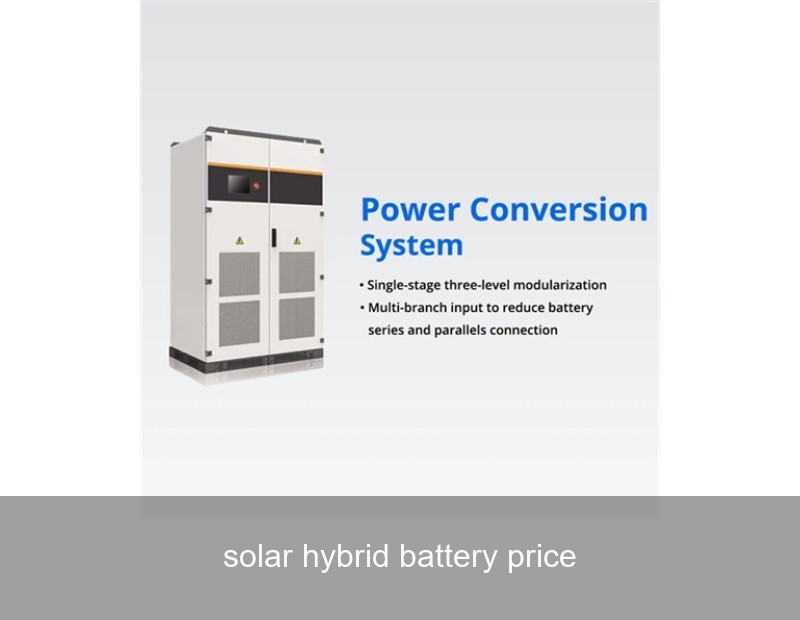
If you're exploring a solar panel system, you've likely encountered the term "solar hybrid battery" and wondered about the price. It's a common question with a nuanced answer. The cost isn't just a number on a quote; it's an investment in resilience, self-sufficiency, and long-term energy savings. In this guide, we'll break down the factors influencing solar hybrid battery price, present real-world data, and show you how to evaluate the true value of bringing reliable, intelligent storage into your home or business.
Table of Contents
Key Factors Influencing Solar Hybrid Battery Price
Think of a solar hybrid battery system as the brain and heart of your modern energy setup. It doesn't just store energy; it intelligently manages when to draw from solar panels, the grid, or its own reserves. The price you pay is shaped by several core components:
- Battery Capacity & Power: Measured in kilowatt-hours (kWh), capacity is how much energy you can store. Power, in kilowatts (kW), is how much energy you can use at once. A larger home with high simultaneous loads (like an EV charger and air conditioning) will need a system with higher power and capacity, impacting the price.
- Battery Chemistry: Lithium-ion phosphate (LFP) is now the dominant, safer, and longer-lasting chemistry for residential use. While sometimes slightly higher in upfront cost than older NMC variants, LFP batteries offer superior cycle life and safety, providing better long-term value.
- System Integration & Intelligence: A true hybrid system requires a sophisticated inverter that seamlessly integrates solar, battery, and grid. The "brains" of the system—its energy management software—is a critical value driver. Can it learn your habits, respond to utility price signals, and provide fail-safe backup? This intelligence is a key part of the investment.
- Installation Complexity: Is it a new build or a retrofit? Does your electrical panel need an upgrade? Installation costs vary significantly based on site-specific challenges and local labor rates.

Image Source: Unsplash
Beyond the Sticker: Understanding Total Cost of Ownership
Focusing solely on the upfront solar hybrid battery price can be misleading. The smarter approach is to consider the Total Cost of Ownership (TCO) over the system's 15+ year lifespan.
| Cost Component | What It Covers | Impact on TCO |
|---|---|---|
| Upfront Equipment & Install | Battery, hybrid inverter, hardware, labor, permits. | The major initial outlay. Quality here reduces future costs. |
| Financial Incentives | Tax credits (e.g., U.S. ITC), local rebates, feed-in tariffs. | Can reduce net cost by 30% or more. Always check current programs! |
| Operational Savings | Reduced grid electricity bills, earnings from grid services. | Directly offsets monthly expenses, accruing over decades. |
| Resilience Value | Avoided costs of power outages (food spoilage, business disruption). | Significant but often overlooked non-monetary benefit. |
| Longevity & Warranty | Degradation rate, warranty period (years and cycles). | A battery that lasts longer with guaranteed performance offers a lower TCO. |
For example, a robust system with a 25-year warranty might have a higher initial tag than a budget option with a 10-year warranty. However, the longer-lasting system avoids a costly replacement in year 11, making it more economical over time.
Real-World Impact: A California Case Study
Let's move from theory to practice. Consider a typical suburban home in California, a leader in both solar adoption and grid challenges. The home has a 8kW solar array but faces Time-of-Use (TOU) rates where electricity costs over $0.50/kWh in the evening peak, and occasional Public Safety Power Shutoffs (PSPS).
The Phenomenon: The homeowners were generating excess solar energy midday (when rates are low) but buying expensive power from the grid each evening. Their solar investment wasn't maximizing its potential.
The Data & Solution: They installed a 13.5 kWh solar hybrid battery system. The system stores cheap, self-generated midday solar for use during the expensive 4-9 pm peak period. According to data from the National Renewable Energy Lab (NREL), pairing solar with storage in high-TOU areas can increase bill savings by 40-80% compared to solar alone.
The Outcome: For this household, the system reduced their grid electricity purchases during peak times by over 90%. It also provided seamless backup during grid outages. Their simple payback period, after the 30% federal tax credit, dropped to under 7 years. For the remaining 18+ years of the system's life, the energy they use is essentially free, locking in decades of predictable, low-cost power.
How Highjoule Delivers Value in Advanced Energy Storage
At Highjoule, we understand that the conversation about solar hybrid battery price is really a conversation about value, reliability, and peace of mind. Since 2005, we've engineered our systems to optimize for Total Cost of Ownership, not just initial price.
Our HPS Series for residential and commercial applications is built with premium LFP chemistry, designed for a long service life of 6,000+ cycles. What sets it apart is the Highjoule Energy Operating System (EOS). This AI-driven platform doesn't just react—it forecasts. By analyzing weather patterns, your consumption history, and real-time utility rate data, EOS autonomously optimizes your energy flow to maximize savings. It asks, "Should I store solar now, sell it back, or prepare for a predicted outage?"
For larger-scale needs, our microgrid solutions integrate multiple storage units, generators, and renewables into a single, resilient grid. This is where our expertise truly shines, providing communities and businesses with energy independence. The price of a Highjoule system reflects this deep integration, superior cycle life, and intelligent software—factors that deliver a lower cost per kilowatt-hour over the system's entire lifespan compared to many commodity alternatives.

Image Source: Unsplash
The Future of Storage: Are Prices Coming Down?
It's a dynamic market. According to BloombergNEF, lithium-ion battery pack prices fell 14% in 2023, continuing a decade-long trend. However, for end consumers, this is balanced against supply chain factors, rising demand, and the increasing value of advanced features like grid-forming inverters, which are crucial for backup power.
The future isn't just about cheaper cells; it's about smarter, more valuable systems. As virtual power plants (VPPs) become more prevalent, your battery could earn revenue by supporting the grid, turning a cost center into an asset. When evaluating price, consider a provider's roadmap for participating in these future value streams.
Your Energy, Your Decision
So, what is the right solar hybrid battery price for you? It's the one that aligns with your goals for savings, resilience, and sustainability over the next 20 years. It's an investment that goes beyond hardware to include the software intelligence and support that will maximize your return.
We invite you to consider: If your power grid became less reliable or electricity prices rose another 30%, what would the value of a self-sufficient, intelligent energy system be to your home or business? We're here to help you calculate that.
Ready to move beyond the price tag and explore the long-term value of a truly intelligent energy system? Connect with our energy solutions team for a personalized assessment.
 Inquiry
 Online Chat