


Unlocking Resilience and Savings with an Active Energy Li-Ion Battery System
your business is humming along, machines are running, and then—a sudden spike in energy demand hits. Your utility bill skyrockets, or worse, the grid falters. For years, this was a passive, reactive experience. But what if your energy storage could anticipate and act? This is the core promise of an active energy Li-ion battery system. Unlike simple backup power, these intelligent systems continuously manage energy flow, making real-time decisions to optimize costs, enhance grid stability, and maximize the use of renewable sources like solar. For facility managers, business owners, and communities on both sides of the Atlantic, moving from passive storage to active energy intelligence is the next critical step in energy independence.
Why "Active" Energy Management is a Game-Changer
Let's break down the "active" in active energy Li-ion battery system. A traditional battery backup is like a spare tire—it sits idle until an emergency. An active system, however, is more like a sophisticated co-pilot for your entire energy ecosystem. It uses advanced software and power electronics to perform multiple revenue-generating or cost-saving functions daily. Think of it as an always-on asset, not an insurance policy you hope never to use.
The driving forces behind this shift are clear. In Europe and the U.S., electricity prices are increasingly volatile, with demand charges constituting a significant portion of commercial bills. Simultaneously, grid infrastructure is aging, and the frequency of extreme weather events is rising, as noted in reports from the International Energy Agency (IEA). An active system directly addresses these challenges by:
- Peak Shaving: Automatically discharging during short periods of high demand to slash peak demand charges.
- Energy Arbitrage: Storing energy when prices are low (often at night or during high renewable output) and using it when prices are high.
- Renewable Integration: Soaking up excess solar or wind generation and releasing it when production drops, smoothing out the "duck curve."
- Grid Services: In some markets, providing frequency regulation or voltage support to the local utility, creating a new income stream.

Image Source: Unsplash - Representative image of a commercial battery storage installation.
The Highjoule Approach to Active Energy
At Highjoule, we've been engineering intelligence into storage since 2005. Our ActivESS platform is the brain behind the brawn. It doesn't just store energy; it continuously analyzes weather forecasts, utility rate schedules, on-site generation, and consumption patterns. Our systems make predictive decisions to ensure every kilowatt-hour is used or stored at the optimal time for economic and operational benefit. For a commercial site, this can translate to a reduction in energy costs by 20-40%, while significantly boosting sustainability metrics.
Key Components of a Modern Active Energy System
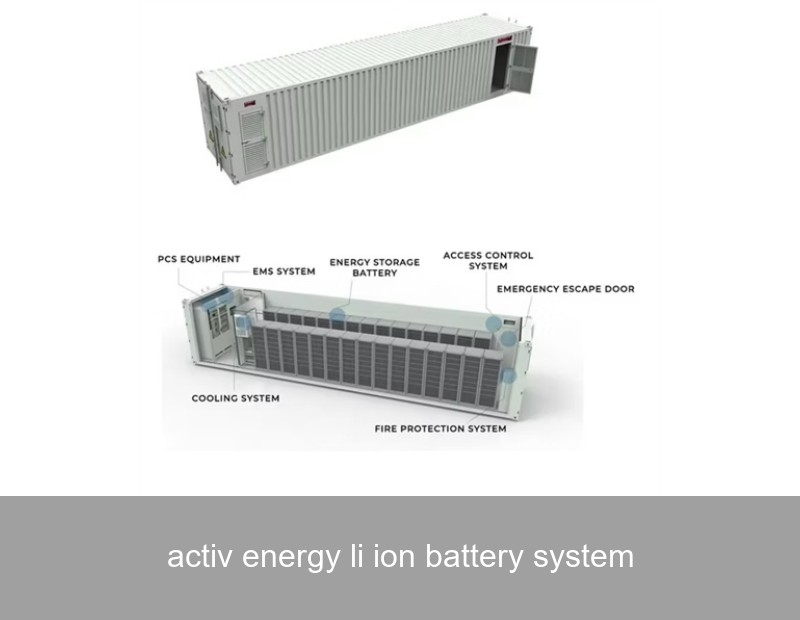
Building a truly effective active energy Li-ion battery system requires a seamless integration of hardware and software. Here’s what makes up a state-of-the-art solution:
| Component | Role | Highjoule's Solution |
|---|---|---|
| Li-Ion Battery Racks | The core energy storage medium. Lithium Iron Phosphate (LFP) chemistry is now preferred for its safety, long cycle life, and stability. | Our H-Joule Cell series uses premium LFP chemistry with built-in thermal runaway prevention and a 10+ year design life. |
| Bi-Directional Inverter (PCS) | The "translator" between DC battery power and AC building/grid power. It controls the charge and discharge cycles. | Highjoule's modular PowerSync Inverter offers high efficiency (>98%) and seamless mode switching between grid-tied and off-grid operation. |
| Energy Management System (EMS) | The system's brain. This software platform controls the entire system based on algorithms, forecasts, and set objectives. | The ActivESS platform, with cloud and on-premise options, provides customizable control strategies and real-time dashboards. |
| Thermal Management & Safety | Critical for performance and longevity. Maintains optimal battery temperature and includes comprehensive fire suppression. | Our patented ClimateGuard system provides liquid cooling for superior temperature uniformity and integrated multi-sensor safety monitoring. |
A Real-World Case: Peak Shaving in a German Manufacturing Plant
Let’s move from theory to practice. A mid-sized automotive parts supplier in Bavaria, Germany, faced a classic industrial challenge: their production lines caused sharp, unpredictable peaks in power demand, leading to exorbitant demand charges from their utility. Their existing solar PV system helped with overall consumption but did nothing to tame these short-duration spikes.
The Solution: Highjoule deployed a 500 kWh / 750 kW active energy Li-ion battery system integrated with their existing solar infrastructure. The ActivESS platform was programmed with a primary objective of peak shaving, using load forecasting to predict when the plant's demand would approach its contracted threshold.
The Data-Driven Outcome: Within the first year of operation:
- Peak Demand Reduction: The system reduced the plant's peak power draw from the grid by an average of 22%.
- Cost Savings: This resulted in a €31,000 annual reduction in demand charges, a significant portion of the system's ROI.
- Increased Solar Self-Consumption: By storing midday solar surplus and using it during the late afternoon production push, the plant increased its on-site renewable consumption from 55% to over 78%.
- Grid Support: The system also provided local frequency containment reserve (FCR) services, generating a small additional revenue stream, as part of Germany's support for grid stability (Federal Ministry for Economic Affairs and Climate Action).
This case exemplifies how an active system transforms a cost center into a strategic, profit-protecting asset.

Image Source: Unsplash - Engineer monitoring an industrial energy management system.
Choosing the Right Active Energy System for Your Needs
Whether you're a hospital in California needing resilience, a data center in Ireland targeting 24/7 carbon-free energy, or a residential community in Spain forming an energy collective, your goals define the system. Here’s a quick guide:
For Commercial & Industrial (C&I) Users:
Your primary drivers are likely cost reduction (peak shaving, arbitrage) and backup power for critical operations. Scalability and robust software are key. Highjoule's Commercial ActivESS suites are pre-configured for these market rules, whether you're under a TOU rate in California or participating in a flexibility scheme in the UK.
For Microgrids & Utilities:
Stability, renewable firming, and deferred grid upgrades are top priorities. Systems here are larger and require advanced grid-forming capabilities. Our GridMax series is engineered for this, featuring black-start functionality and seamless islanding to keep communities powered during outages.
For Residential Aggregations:
Virtual Power Plants (VPPs) are the future. Home batteries, like those in our HomeJoule line, can be aggregated via the ActivESS cloud to act as a single, grid-stabilizing resource, offering homeowners compensation for their participation—a concept gaining rapid traction in markets like Texas and Australia (National Renewable Energy Laboratory).
The journey to a smarter, more resilient energy footprint starts with a question: What specific energy challenge—be it a monthly bill, a sustainability target, or a reliability concern—is most active in your mind today?
 Inquiry
 Online Chat