


Demystifying Solar Off Grid Battery Prices: A Smart Buyer's Guide
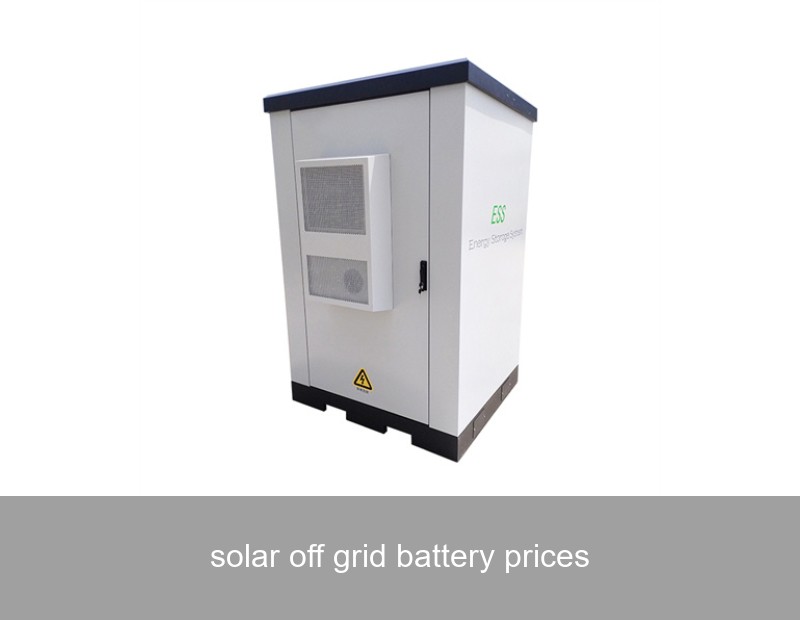
So, you're exploring the freedom of an off-grid solar system. You've looked at panels, calculated your energy needs, and then you encounter the heart of the system: the battery bank. A quick search for solar off grid battery prices can be a dizzying experience. Quotes range from a few thousand to tens of thousands of dollars. Why the vast difference? Is the cheapest option a bargain, or a future headache in disguise? As a product technology expert at Highjoule, I've spent years navigating this landscape. Let's peel back the layers and understand what truly drives cost, value, and long-term satisfaction in off-grid battery storage.
The Price Breakdown: What You're Really Paying For
The sticker price of a battery module is just the beginning. True cost is measured in levelized cost of storage (LCOS)—the total cost of owning and operating the system over its lifetime, divided by the total energy it will deliver. Think of it like buying a car: the purchase price matters, but fuel efficiency, maintenance, and how long it lasts define the real cost. Several core factors directly influence solar off grid battery prices:
- Battery Chemistry & Technology: Lead-acid batteries have a lower upfront cost but a shorter lifespan (4-8 years) and lower depth of discharge. Lithium-ion (Li-ion), particularly Lithium Iron Phosphate (LFP), dominates modern systems due to longer lifespan (10-15+ years), higher efficiency, and safer chemistry. While LFP has a higher initial price, its LCOS is often lower.
- Usable Capacity & Power Rating: Capacity (kWh) is your "fuel tank." Power (kW) is how fast you can empty or fill it. A system that can run your well pump (high power) and your fridge (continuous load) needs both adequate capacity and power, impacting price.
- System Complexity & Integration: A true off-grid solution isn't just a box of batteries. It includes a sophisticated inverter/charger, energy management software, safety systems, and often integration with backup generators. An all-in-one, pre-integrated system like Highjoule's HPS Series might have a defined price point but saves significantly on installation, commissioning, and long-term reliability.
- Durability & Warranty: A battery for a mild climate differs from one rated for extreme temperatures. A robust warranty (e.g., 10 years at 70% capacity retention) signals quality and reduces long-term risk, often reflected in the price.

Image Source: Unsplash (Professional lithium battery installation)
According to a 2023 report by the National Renewable Energy Laboratory (NREL), the installed cost for residential lithium-ion battery storage systems in the U.S. showed a wide range, heavily dependent on system size and configuration. For off-grid applications, which require larger capacities and more robust components, prices per kWh can be higher than grid-tied systems, but the value of total energy independence is the key metric.
Case Study: From Cost to Value in California
Let's move from theory to a real-world scenario. Consider a small, family-run vineyard in Sonoma County, California. Their goal: power their irrigation systems, processing equipment, and tasting room entirely off-grid, eliminating unreliable grid supply and rising utility costs.
| Challenge | Initial "Low-Cost" Quote | Highjoule HPS Solution | Outcome & Value Realized |
|---|---|---|---|
| Powering high-surge irrigation pumps & steady cooling loads. | Lead-acid bank, basic inverter. Lower upfront cost by ~30%. | Highjoule HPS-30 with LFP batteries, integrated hybrid inverter, and smart load management. | No power issues during peak irrigation. Smart management prioritized critical loads, extending battery life. |
| System lifespan & maintenance. | Expected battery replacement in 6 years. Regular water level checks needed. | 10-year performance warranty. Sealed, maintenance-free LFP batteries. | Projected lifetime cost of the HPS system was 20% lower over 15 years, with zero maintenance downtime. |
| Managing variable weather (foggy mornings, sunny afternoons). | Manual generator start during low solar periods. | Built-in generator start/stop control and predictive energy forecasting via Highjoule OS. | Generator runs automatically only when essential, cutting fuel costs by an estimated 40% annually. |
For this vineyard, the initial solar off grid battery price was not the deciding factor. The total cost of ownership, reliability during harvest season, and operational simplicity provided by an intelligent, integrated system delivered far greater value. Their energy independence is now a competitive advantage, not a management burden.
Highjoule: Intelligent Solutions Maximizing Your Investment
At Highjoule, we engineer systems with this total-value philosophy. Since 2005, we've moved beyond being just a battery provider to delivering intelligent energy platforms. Our products, like the HPS (Hybrid Power System) for residential/small commercial and the scalable GridShieldTM series for industrial & microgrid applications, are designed to optimize every dollar you invest.
How does this affect your effective price?
- High-Density LFP Technology: We use automotive-grade LFP cells, offering superior cycle life and safety. This means more cycles per dollar over the system's life.
- All-in-One Design: By integrating the battery, inverter, charger, and controller, we reduce installation time and points of failure. You get a predictable, turnkey price.
- Adaptive Energy Management (Highjoule OS): Our software is the brain. It learns your consumption patterns, weather forecasts, and prioritizes loads. This intelligent operation can reduce the required battery capacity by up to 15% for the same outcome, directly impacting the initial system size and cost you need.

Image Source: Unsplash (Off-grid solar home)
The Future of Off-Grid Battery Costs
Where are solar off grid battery prices heading? The long-term trend is downward, thanks to manufacturing scale and technology advances. The International Energy Agency (IEA) notes continued cost reductions for battery storage, driven by the electric vehicle revolution. However, for off-grid users, the future is less about the bare cell cost and more about system intelligence.
The next frontier is interoperability and grid-forming capabilities. Imagine your off-grid system seamlessly integrating a future fuel cell or a neighbor's wind turbine. Highjoule's systems are built with this open, adaptive architecture in mind, protecting your investment from becoming obsolete.
Making the Right Investment
Navigating solar off grid battery prices is ultimately about asking the right questions. Don't just ask "how much per kWh?" Ask: "What is the levelized cost over 15 years?" "How does it handle my single largest load?" "Can it adapt to new energy sources?"
Your off-grid power system is the foundation of your energy independence. Does your current quote provide a foundation of cheap, disposable components, or an intelligent, evolving platform for long-term resilience? We invite you to share your project's specific load profile and goals with our technical team for a tailored analysis that goes beyond price to reveal true value.
 Inquiry
 Online Chat