


Solar Panda Products and Prices in Kenya: Your Guide to Smart Solar & Storage Solutions
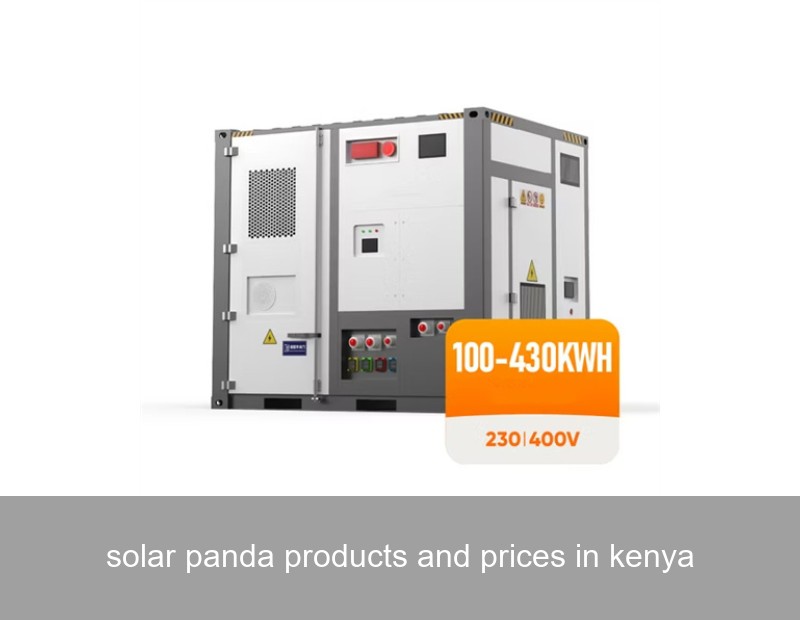
If you're exploring solar energy in Kenya, you've likely stumbled upon the term "Solar Panda." It sounds friendly, affordable, and perfectly packaged. But what does it really mean for your home or business? As energy costs rise and grid reliability remains a concern for many, turning to the sun is a brilliant move. However, navigating the market between catchy brand names and genuine, long-term performance can be tricky. This article will demystify "solar panda products and prices in Kenya," moving beyond the label to help you understand the components of a reliable system and how global leaders like Highjoule bring industrial-grade technology to ensure your investment truly pays off for years to come.
What Are "Solar Panda" Products? Decoding the Buzzword
Primarily, "Solar Panda" refers to a range of all-in-one solar kits often marketed in East Africa. Think of them as a starter bundle for energy independence. A typical "Panda" kit might include:
- Solar Panels: The photovoltaic modules that capture sunlight.
- Inverter: The device that converts the DC electricity from the panels into AC electricity for your appliances.
- Battery Storage: Usually a lead-acid or sometimes a lithium-ion battery to store excess energy for use at night or during cloudy periods.
- Mounting Structure & Cables: The necessary hardware for installation.
These kits are popular for a reason: they simplify the initial purchase. However, it's crucial to look under the hood. The long-term value isn't just in the boxed price, but in the quality, compatibility, and scalability of each component. A cheap inverter can fail prematurely, and low-cycle-life batteries might need replacing far too soon, turning a seemingly low upfront cost into a recurring expense.
Solar Panda Products and Prices in Kenya: A Realistic Breakdown
Prices vary widely based on component quality, brand, and system capacity. Here’s a general market overview of what you might expect for different system sizes, focusing on the common kit structure.
| System Size (Ideal For) | Typical Components | Estimated Price Range (KES) | Key Considerations |
|---|---|---|---|
| Small (500W - 1kW) Lights, TV, Phone Charging |
1-2 Panels, PWM/Simple Inverter, 1-2 Lead-Acid Batteries | 80,000 - 150,000 | Limited expansion. Battery replacement cost is high over time. |
| Medium (3kW - 5kW) Small Home or Business, Essential Appliances |
6-10 Panels, 3-5kW Inverter, 2-4 Lithium or 4-8 Lead-Acid Batteries | 350,000 - 700,000 | The most common "solar panda" range. Lithium batteries offer better long-term value. |
| Large (8kW+) Large Homes, Commercial Operations |
15+ Panels, Hybrid Inverter, Lithium Battery Bank | 1,000,000+ | Requires professional design. Component quality is critical for ROI. |
Image: A professionally installed rooftop solar system. Credit: Unsplash

Remember, the kit price is often just the beginning. Factor in professional installation, potential electrical upgrades, and maintenance. This is where thinking in terms of a complete energy system, rather than just a product kit, becomes vital.
Thinking Beyond the Kit: The Importance of a Complete System
At Highjoule, with nearly two decades of experience powering homes and businesses across Europe and North America, we've learned that reliability comes from system integration and intelligence. A collection of parts is not a solution. A true energy solution is where every component communicates seamlessly for optimal efficiency, safety, and lifespan.
For instance, our approach for the Kenyan market involves adapting our core technology principles:
- Intelligent Hybrid Inverters: Unlike basic inverters, Highjoule's inverters are the brain of the system. They intelligently manage power flow between solar panels, batteries, the grid, and your loads, prioritizing solar energy to maximize savings.
- High-Cycle Life Lithium Batteries: We move beyond entry-level batteries. Our lithium iron phosphate (LiFePO4) battery systems, like the ones we deploy in commercial settings globally, offer thousands of deep cycles, translating to a decade or more of reliable daily use, significantly reducing the total cost of ownership.
- Remote Monitoring & Management: Imagine controlling and monitoring your energy system from your phone. This isn't just convenient; it allows for proactive maintenance and maximizes self-consumption of solar energy, a feature once reserved for large-scale industrial systems.
A Case Study from Nakuru: From Shedding Loads to Powering Growth
Consider the real-world example of a medium-sized poultry farm in Nakuru. Facing daily power outages that threatened ventilation, feeding systems, and chick survival, they initially installed a standard 5kW "solar panda" kit with lead-acid batteries. While it provided basic backup, the batteries degraded quickly under daily deep cycling, needing replacement within 18 months. The inverter also lacked the surge capacity to reliably start their water pumps.
They then partnered with a Highjoule-certified installer to upgrade to a designed system featuring a 6kW Highjoule hybrid inverter and a 10kWh Highjoule lithium battery bank. The results were transformative:
- Energy Cost Reduction: Grid consumption dropped by over 90%, with the system paying for itself in under 4 years.
- Zero Downtime: The intelligent system handles grid failures instantaneously. The farm has reported zero production loss due to power issues for over two years.
- Scalability: As the farm expands, they can easily add more panels and battery modules without replacing the core inverter.
This case highlights that the true metric isn't just the initial price per watt, but the cost per reliable kilowatt-hour over the system's lifetime.
Leveraging Global Expertise for Local Solutions
Kenya's energy landscape is dynamic, with great solar potential and specific challenges. Highjoule's strength lies in applying global technology standards to local needs. Our products are built for durability and are tested in diverse climates, from Scandinavian winters to Mediterranean summers. This engineering rigor ensures they can perform exceptionally in the Kenyan context.
We support a network of trained, local installers and partners across Kenya. This means you get a system that isn't just a box of parts, but a professionally engineered solution backed by local service and global expertise. Whether for a residential bungalow in Karen or a manufacturing plant in Mombasa, the principle is the same: deliver intelligent, efficient, and sustainable power.
Image: A modern, modular lithium battery storage system. Credit: Unsplash

Making the Right Energy Choice for Your Needs
So, when you research "solar panda products and prices in Kenya," use it as a starting point. Ask deeper questions: What is the cycle life of the battery? Is the inverter a hybrid model that can manage grid, solar, and battery simultaneously? Does the system come with smart monitoring? Can it be expanded in the future?
We encourage you to look at energy as a critical infrastructure investment. For more independent information on solar technology and benefits, you can refer to resources like the International Renewable Energy Agency (IRENA) or the U.S. Department of Energy's solar guide.
What is the one critical load in your home or business that you simply cannot afford to lose power for, and how would a truly intelligent energy system change your daily life or operational resilience?
 Inquiry
 Online Chat