


Solar Panel for 250Ah Battery: Your Complete Sizing and System Guide
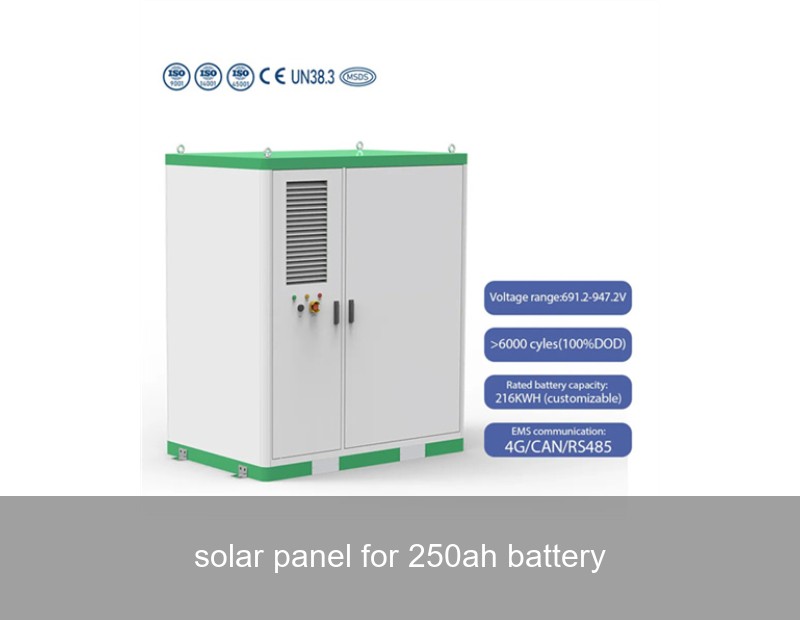
You’ve got a powerful 250Ah battery, perhaps for your RV, boat, cabin, or home backup system. It’s a solid energy reservoir. But here’s the puzzle many face: which solar panel for a 250Ah battery is actually the right one to keep it consistently charged and maximize its lifespan? The answer isn't a single wattage. It's a harmony of components, governed by sunlight, energy needs, and smart management. As a global leader in intelligent energy storage since 2005, Highjoule specializes in creating this harmony. Let's demystify the process and ensure your solar investment delivers reliable, sustainable power.
Table of Contents
- Understanding the Core: Your 250Ah Battery
- The Solar Math: From Battery Capacity to Panel Watts
- Key Factors Beyond Basic Math
- A Real-World Case Study: Off-Grid Cabin in Colorado
- The Highjoule Solution: Beyond Just Panels and Batteries
- Essential System Components You Can't Ignore
- Frequently Asked Questions
Understanding the Core: Your 250Ah Battery
First, let's clarify what "250Ah" means. Amp-hours (Ah) measure charge capacity. A 250Ah battery can, in theory, deliver 10 amps for 25 hours, or 25 amps for 10 hours, before being fully discharged. But the critical number is the usable energy in watt-hours (Wh). For a common 12V 250Ah battery:
250Ah × 12V = 3,000 Wh (or 3 kWh) of total energy.
However, you should never fully drain most batteries. For lead-acid, use only 50% (1.5 kWh usable). For modern Lithium Iron Phosphate (LiFePO4) batteries, like those in Highjoule's ResiPower and Commando series, you can safely use 80-90% (2.4-2.7 kWh usable) without damaging the battery. This depth of discharge is a game-changer for solar system sizing.
The Solar Math: From Battery Capacity to Panel Watts
Your solar panel's job is to replenish the energy you use daily. The formula considers:
- Daily Energy Consumption (Wh): How much do you use from the battery per day?
- Sunlight Hours (Peak Sun Hours): Not daylight hours, but the equivalent hours of full sun. This varies massively by location. Southern Europe might average 4.5-5.5 PSH, while Northern Germany gets 2.5-3.5 PSH. In the U.S., Arizona gets ~6.5 PSH, while Washington state gets ~3.5.
- System Efficiency Losses (~30%): Factor in losses from charge controllers, wiring, heat, and dust.
Basic Calculation: Solar Array Size (W) = (Daily Wh Usage) ÷ (Peak Sun Hours) ÷ (0.7 for efficiency).
Example: To recharge 2 kWh (2000 Wh) used from your battery in a location with 4 peak sun hours:
2000 Wh ÷ 4 h ÷ 0.7 = ~714 watts of solar panels.
So, for a 250Ah battery, you're typically looking at a solar array between 600W and 900W, depending on your specific usage and location. This could be two 350W panels or three 300W panels.

Image: A well-sized solar array is key for reliable off-grid power. Source: Unsplash
Key Factors Beyond Basic Math
- Battery Chemistry: LiFePO4 batteries charge more efficiently and at a higher rate than lead-acid. A Highjoule LiFePO4 battery can accept a higher solar current, allowing you to potentially use a larger array for faster recharging.
- Charge Controller Type: A Pulse Width Modulation (PWM) controller is budget-friendly but less efficient. A Maximum Power Point Tracking (MPPT) controller, a standard in Highjoule's integrated systems, can increase energy harvest from your panels by up to 30%, especially in cloudy or cold weather.
- Seasonal Variation: Design for the worst month, not the average. If you need year-round power, size your array for winter sun hours.
- Future Expansion: Will you add an appliance? Get a charge controller and inverter that can handle more panel input or load output.
A Real-World Case Study: Off-Grid Cabin in the Bavarian Alps
Let's look at a real scenario. A family owns a weekend cabin in southern Germany (Bavaria). Their energy audit showed a daily need of 2.4 kWh. They used a 12V 250Ah lead-acid battery bank (usable: 1.2 kWh) and a 400W solar panel with a PWM controller. They constantly faced power shortages in winter, leading to deep battery discharges and rapid battery degradation.
- Upgraded Storage: They replaced the lead-acid bank with a single Highjoule ResiPower 12V 250Ah LiFePO4 battery, unlocking 2.4 kWh of usable energy (90% DoD).
- Optimized Solar Harvest: Added one more 400W panel (800W total) paired with a Highjoule Smart MPPT 60A Charge Controller.
- Result: Even with Bavarian winter peaks sun hours of 1.8, the system now generates: 800W * 1.8h * 0.85 (MPPT efficiency) = ~1,224 Wh daily. Combined with better summer harvests, the battery stays above 50% state of charge year-round. The client reported zero power shortages and expects the battery lifespan to double from their previous 3-year cycle. This aligns with studies on the superior cycle life of LiFePO4 chemistry (NREL Report on Battery Lifespan).
The Highjoule Solution: Beyond Just Panels and Batteries
At Highjoule, we understand that a sustainable energy system is more than a commodity panel connected to a battery. It's an intelligent ecosystem. Our approach for commercial, industrial, and residential clients focuses on integration and intelligence.
For systems built around a 250Ah battery scale, our PowerStack Modular Units are ideal. You can start with a 5kWh stack (effectively two 250Ah 24V units) and scale seamlessly. These modules integrate our proprietary battery management system (BMS) and communication bus, ready to connect to our Hybrid Solar Inverter/Chargers.
This inverter is the brain: it manages the solar input from your panels, prioritizes charging your battery, powers your AC loads, and can even feed excess power back to the grid if permitted. For a cabin or RV, our Commando Series All-in-One Units combine a LiFePO4 battery, MPPT charge controller, and inverter in a rugged, compact package, simplifying the "solar panel for 250Ah battery" question into a plug-and-play power station.

Image: A modern, modular lithium battery installation. Source: Unsplash
Essential System Components You Can't Ignore
| Component | Purpose | Highjoule's Value Addition |
|---|---|---|
| Solar Panels | Generate DC electricity from sunlight. | We partner with tier-1 manufacturers and provide compatibility assurance with our systems. |
| Charge Controller (MPPT) | Regulates voltage/current from panels to safely charge the battery. | Our Smart MPPT controllers feature remote monitoring and adaptive charging algorithms to prolong battery life. |
| Battery (250Ah LiFePO4) | Stores energy for use when the sun isn't shining. | Our batteries use automotive-grade LiFePO4 cells, with a 10+ year design life and superior thermal stability. |
| Inverter | Converts battery DC power to AC power for household appliances. | Our hybrid inverters offer seamless switchover, grid support, and intelligent load management. |
| Monitoring & Management | Provides system data, control, and diagnostics. | The Highjoule EnergyOS platform gives you real-time insights and control via a smartphone app, a critical tool for maximizing self-consumption. |
Frequently Asked Questions
Can I use a single 400W panel for a 250Ah battery?
It depends on your daily consumption and location. In a sunny area (5+ PSH) with minimal usage, it might suffice for maintenance charging. For regular, meaningful energy replenishment, a larger array (600W+) is recommended.
How long will it take to charge a 250Ah battery with solar?
With a 12V 250Ah LiFePO4 battery (3 kWh to fill from 20% to 100%) and an 800W array in 4 peak sun hours: (3000Wh * 0.8) / (800W * 0.85 efficiency) = ~2.8 hours of ideal sun. In reality, it will take a full sunny day due to varying irradiance.
What's the biggest mistake people make?
Undersizing the solar array and using a low-quality charge controller. This leads to chronically undercharged batteries—the #1 cause of premature battery failure, especially for lead-acid. Investing in an efficient MPPT controller and adequate panels is non-negotiable for system health. For more on system sizing best practices, you can refer to the U.S. Department of Energy's guide.
Ready to Design Your Optimal System?
The journey to pairing the perfect solar panel for your 250Ah battery is unique to your site, consumption, and goals. It’s a balance of physics, engineering, and real-world conditions. With nearly two decades of experience, Highjoule's experts are here to help you navigate this complexity—not just with superior products like our ResiPower batteries and Smart MPPT controllers, but with the system-level intelligence that guarantees performance.
What's the one energy-consuming appliance in your setup that you absolutely cannot live without, and how does that shape your solar power equation?
 Inquiry
 Online Chat