


Understanding Solar Panel for Commercial Use Price: An Investment Guide for Businesses
If you're a business owner or facility manager considering a switch to renewable energy, one of the first questions is inevitably about the solar panel for commercial use price. It's a crucial starting point, but focusing solely on the upfront cost per watt can be misleading. The true value lies in understanding the total cost of ownership, the long-term financial benefits, and the strategic advantages a commercial solar installation brings. This guide will break down the factors influencing commercial solar pricing and provide a clear framework for evaluating your return on investment.
What Drives the Commercial Solar Panel Price?
The sticker price of photovoltaic modules is just one piece of the puzzle. A commercial solar power system is a complex engineered solution. The total installed cost is influenced by a matrix of factors:
- System Size & Scale: Commercial projects benefit from economies of scale. A 500 kW system will have a lower cost per watt than a 50 kW system due to fixed costs (engineering, permitting) being spread over more capacity.
- Equipment Tier & Technology: High-efficiency monocrystalline panels cost more than polycrystalline but produce more energy in limited space. Inverter choice (central vs. string vs. micro) and brand reputation significantly impact price and long-term reliability.
- Site-Specific Complexity: Is your roof a simple, new, metal standing-seam design, or an older flat roof requiring ballasted systems and structural reinforcement? Electrical upgrades, distance to the interconnection point, and roof condition all add to the project scope.
- Regional Labor & Permitting Costs: Installation costs and the complexity of the permitting process vary greatly between, say, California, Germany, and Texas. Local incentives can offset these regional differences.
According to the National Renewable Energy Laboratory (NREL), the median installed price for commercial solar in the U.S. in 2023 ranged significantly, but understanding the value requires looking past installation day.
Beyond the Panels: The Critical Role of Storage & System Intelligence
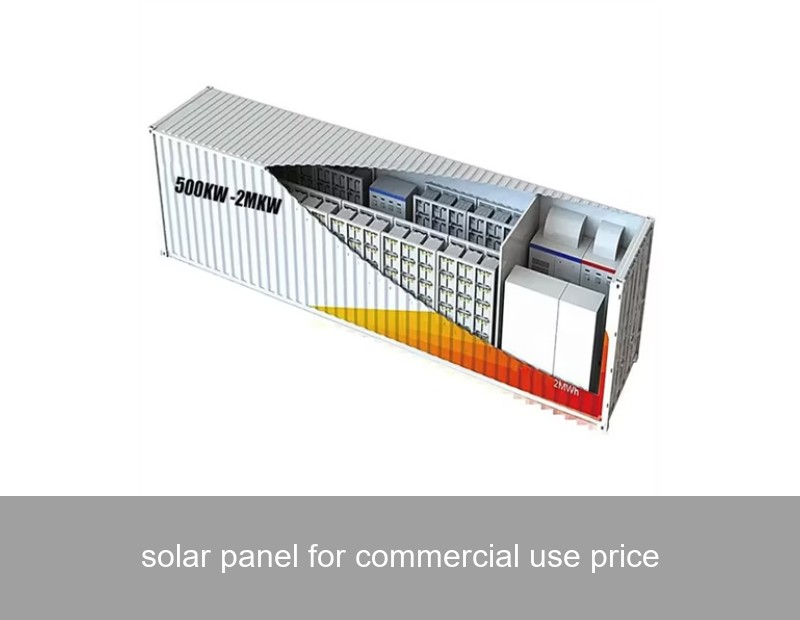
For a modern business, solar generation is only half the story. To maximize the financial return and energy resilience, integrating a battery energy storage system (BESS) is becoming standard. This shifts the conversation from "solar panel for commercial use price" to "integrated energy management system value."
A system like Highjoule's H-Series Commercial ESS allows businesses to:
- Arbitrage Energy Costs: Store excess solar energy generated during the day and use it during peak evening hours when grid electricity is most expensive, dramatically reducing demand charges.
- Ensure Resilience: Provide backup power during grid outages, keeping critical operations online.
- Participate in Grid Services: In some markets, businesses can earn revenue by allowing their storage system to provide grid stability services.
Therefore, the most forward-thinking pricing analysis includes storage. The initial investment is higher, but the payback period can be shorter due to the multiplicative savings on energy bills.

Image Source: Unsplash - A typical commercial rooftop solar array.
The Real Financial Framework: LCOE and ROI
To move beyond simple price comparisons, finance and energy professionals use a metric called the Levelized Cost of Energy (LCOE). It calculates the net present cost of electricity generation over the system's lifetime. A high-quality system with a higher upfront price but superior efficiency, longer warranty, and integrated storage often yields a lower LCOE than a cheaper, bare-bones installation.
Let's illustrate with a simplified table comparing two conceptual approaches for a 250 kW system:
| Cost Component | Basic Solar-Only System | Integrated Solar + Highjoule Storage System |
|---|---|---|
| Upfront Installed Cost | $500,000 | $750,000 |
| Estimated Annual Energy Bill Savings | $70,000 | $140,000 (savings + demand charge avoidance) |
| Simple Payback Period | ~7.1 years | ~5.4 years |
| 25-Year Net Savings (Est.) | $1.25 million | $2.75 million |
As you can see, the integrated solution, while more expensive initially, creates far greater long-term value and a faster payback. This is where Highjoule's expertise transforms a capital expense into a strategic investment.
Case Study: A European Logistics Center's Journey
Let's look at real-world data. A major logistics company operating a 40,000 sqm distribution center in Northern Germany faced rising energy costs and corporate sustainability mandates. Their goal: reduce grid dependence and operational costs.
- Challenge: High daytime energy use, but significant evening sorting shifts coincided with peak grid tariffs.
- Solution: A 1.2 MW rooftop solar PV system coupled with a 600 kWh Highjoule H-Series battery storage unit and our proprietary Energy Management System (EMS).
- Outcome: The system covers 65% of the facility's annual electricity needs. By intelligently dispatching stored solar power during the 6-10 PM peak window, they reduced their peak demand charges by over 90%. The project achieved an ROI in under 5 years and is on track to save an estimated €4.2 million over its lifetime. The EMS automatically optimizes the flow of energy between solar, storage, and the grid in real-time, ensuring maximum financial return without manual intervention.

Image Source: Unsplash - Representative image of a commercial battery storage system interior.
How Highjoule Optimizes Your Commercial Solar Investment
Since 2005, Highjoule has evolved from a component supplier to a global provider of intelligent, integrated storage solutions. We understand that the solar panel for commercial use price is just the entry point for a broader conversation about energy independence and fiscal prudence.
Our approach for commercial and industrial clients includes:
- End-to-End System Design: We don't just sell batteries; we design the entire DC-coupled or AC-coupled system architecture for optimal performance and longevity, ensuring seamless integration between your solar inverters and our storage.
- Advanced Battery Technology: Our H-Series and I-Series ESS products use lithium iron phosphate (LFP) chemistry, known for its safety, long cycle life (over 6,000 cycles), and stability—critical for a 20+ year asset.
- Intelligent Software Platform: The Highjoule EMS is the brain of the operation. It uses AI-driven forecasting and real-time energy market data (where available) to make decisions that maximize your savings, whether through self-consumption optimization, peak shaving, or participation in grid programs.
- Comprehensive Service & Monitoring: We offer remote performance monitoring and proactive maintenance plans to ensure your system delivers the promised ROI for decades.
By partnering with Highjoule, you're not just buying hardware; you're acquiring a long-term energy partner dedicated to making your commercial solar investment a resounding success.
Your Next Step: From Price Inquiry to Power Strategy
The landscape of commercial solar is maturing from a simple cost-per-watt equation to a sophisticated analysis of energy intelligence and storage integration. The most successful projects are those planned with the entire system lifecycle in mind.
So, instead of asking "What is the price for commercial solar panels?", we invite you to consider a more powerful question: What is the optimal pathway for my business to achieve maximum energy cost savings and resilience for the next 25 years?
To begin crafting your tailored energy strategy, what are the three largest pain points in your current monthly energy bill that you would like to solve?
 Inquiry
 Online Chat