


Solar Group Pro: How Much Does a Commercial Solar + Storage System Really Cost?
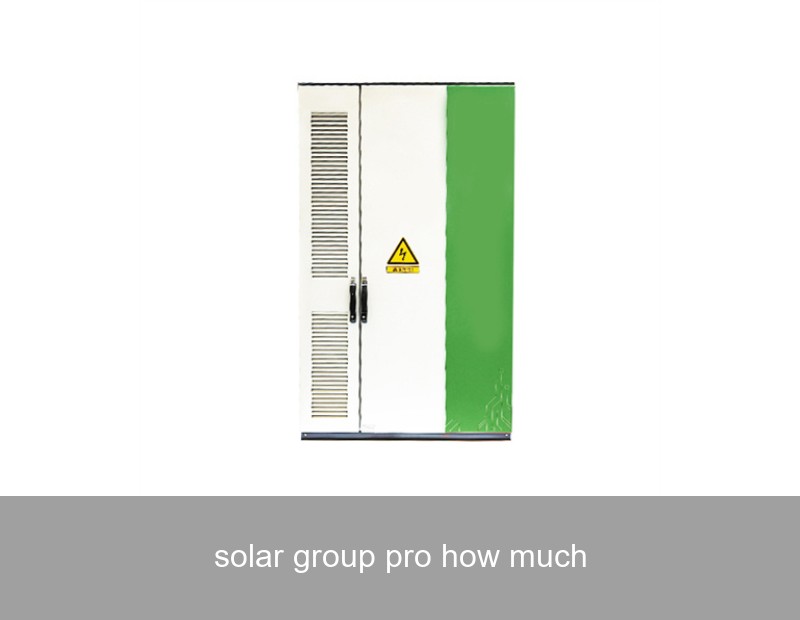
If you're managing a business, factory, or a community project, you've likely asked the question: "Solar group pro how much?" It's the logical first step when considering a transition to solar energy, especially for larger-scale applications. But the sticker price on the panels is just the beginning. The true value—and the true cost—of a commercial or industrial solar system today is inseparable from one critical component: the battery energy storage system (BESS). This article will demystify the costs, explore the hidden value drivers, and show you how a strategic approach to solar and storage can transform your energy expenses from a variable cost into a controlled asset.
Table of Contents
- The Real Question Behind "How Much?"
- Cost Breakdown: Beyond the Panels
- Why Storage is No Longer Optional
- Case Study: A European Manufacturing Plant
- The Highjoule Solution: Intelligent Energy Management
- Maximizing Your ROI: It's About Control
- Your Next Step Towards Energy Independence
The Real Question Behind "How Much?"
When business leaders inquire about solar, the underlying question isn't just about equipment expense. It's, "How much will this investment save me and protect my operations?" The landscape has shifted dramatically. With volatile energy prices in Europe and demand charges impacting commercial bills in the US, a solar-only system leaves significant value on the table. Your solar array might produce a surplus at noon, but what happens at 6 PM when the sun sets and your facility is still running, or during a grid outage? Without storage, you're still reliant on the grid during your most expensive periods.

This is where the "pro" in "solar group pro" comes into play. A professional, holistic system integrates generation with storage and intelligent software. The initial capital outlay is higher, but the financial and operational returns are fundamentally superior. Let's break down the components.
Cost Breakdown: Beyond the Panels
A comprehensive commercial solar-plus-storage project cost is typically measured in dollars per watt ($/W) of solar capacity or as a total turnkey price. Costs vary widely based on scale, location, and complexity.
| System Component | Cost Consideration | Impact on "How Much?" |
|---|---|---|
| Solar Panels (PV Modules) | Scales with system size (e.g., 500 kW) | ~15-25% of total project cost. Economies of scale apply. |
| Inverters & Balance of System | Mounting, wiring, transformers, etc. | ~15-20% of cost. Crucial for efficiency and safety. |
| Battery Energy Storage (BESS) | Measured in power (kW) and energy (kWh) | ~30-40% of cost. The key to flexibility and ROI. |
| Energy Management Software | The "brain" of the operation | ~5-10% of cost. Often a subscription. Essential for smart control. |
| Installation, Permitting, Grid Interconnection | Labor, engineering, fees | ~20-30% of cost. Highly variable by region and utility. |
For a mid-sized 500 kW solar array paired with a 1 MWh storage system in the US or Western Europe, a total turnkey cost could range from $1.2 to $2 million, before incentives. This is where understanding value, not just price, becomes critical.
Why Storage is No Longer Optional
Think of storage as your energy insurance and arbitrage tool. It allows you to:
- Shift Energy: Store cheap solar power from the day for use during expensive peak evening hours.
- Reduce Demand Charges: A major line item on commercial bills. Storage can discharge to "shave" peak grid demand, leading to massive savings. According to the National Renewable Energy Laboratory (NREL), demand charge management is often the primary economic driver for commercial storage.
- Ensure Resilience: Provide backup power during grid outages, keeping critical operations online.
- Participate in Grid Services: In some markets, you can earn revenue by providing frequency regulation or capacity services to the utility.
Without storage, you are missing out on these revenue streams and cost-saving mechanisms, effectively extending your payback period.
Case Study: A German Automotive Parts Manufacturer
Let's look at real data. A Highjoule client, a mid-sized automotive supplier in Bavaria, faced rising energy costs and sought to stabilize their budget and carbon footprint.
- Challenge: High daytime energy consumption with a sharp evening peak. Volatile electricity prices.
- Solution: A 750 kW rooftop solar PV system integrated with a Highjoule H-Series Industrial BESS (1.2 MWh capacity) managed by our OptiGrid AI software.
- Outcome (Annual):
- 70% reduction in grid-sourced electricity during peak periods.
- 40% reduction in overall demand charges.
- €85,000 in annual energy cost savings.
- Backup power for critical assembly lines for up to 4 hours.
The system's payback period, factoring in German incentive programs, was calculated at under 7 years. For the client, the question shifted from "Solar group pro how much?" to "How much risk are we avoiding and how much value are we capturing?"

The Highjoule Solution: Intelligent Energy Management
At Highjoule, we've been designing advanced储能 systems since 2005. We understand that the hardware is only as good as the intelligence that controls it. Our approach to the "solar group pro" question is integrated by design:
- Highjoule H-Series Commercial BESS: Our scalable, containerized or skid-mounted systems feature lithium-iron-phosphate (LFP) battery chemistry for safety and longevity. They are built for high-cycle, daily use in demanding environments.
- Highjoule OptiGrid AI Platform: This is the true "pro" element. OptiGrid doesn't just react; it predicts. Using weather forecasts, energy price signals, and consumption patterns, it autonomously decides when to charge, discharge, or hold to optimize for your specific financial and operational goals.
- End-to-End Service: From initial feasibility and financial modeling to system design, installation, commissioning, and ongoing performance monitoring, Highjoule provides a single point of accountability.
We don't just sell components; we deliver a guaranteed energy outcome—whether your priority is maximum savings, resilience, or sustainability.
Maximizing Your ROI: It's About Control
The ultimate answer to "how much" is defined by the intelligence of the system. A well-optimized solar+storage asset can deliver ROI through multiple, stacked value streams:
- Energy Bill Savings: Reduced consumption and demand charges.
- Incentives: Leveraging programs like the Investment Tax Credit (ITC) in the US (which now stands at 30-70% for standalone storage) or various EU member state grants.
- Revenue Generation: Grid services in eligible markets.
- Risk Mitigation: The financial value of avoiding downtime and hedging against future price spikes.
The key is an adaptive system. As utility rates and market structures evolve (a trend well-documented by the International Energy Agency), a static system loses value. Our OptiGrid platform receives continuous updates to navigate these changes, protecting your investment.
Your Next Step Towards Energy Independence
So, "solar group pro how much?" The honest answer is: it's a sophisticated investment that requires a tailored analysis. The more pertinent question for your board or community is: What is the cost of inaction in the face of unpredictable energy markets and the increasing need for operational resilience?
To move from a generic price guess to a precise value proposition, the process starts with your data. What does your last year of utility bills look like? What are your critical loads? What are your sustainability goals?
We invite you to use these questions as a starting point for an internal discussion. Then, reach out. Highjoule's experts can provide a complimentary, high-level assessment of the savings potential for your specific site. What would a 30% reduction in your net energy cost do for your bottom line this year?
 Inquiry
 Online Chat