


Understanding Solar Panel Price Government Policies: A Guide for Homeowners and Businesses
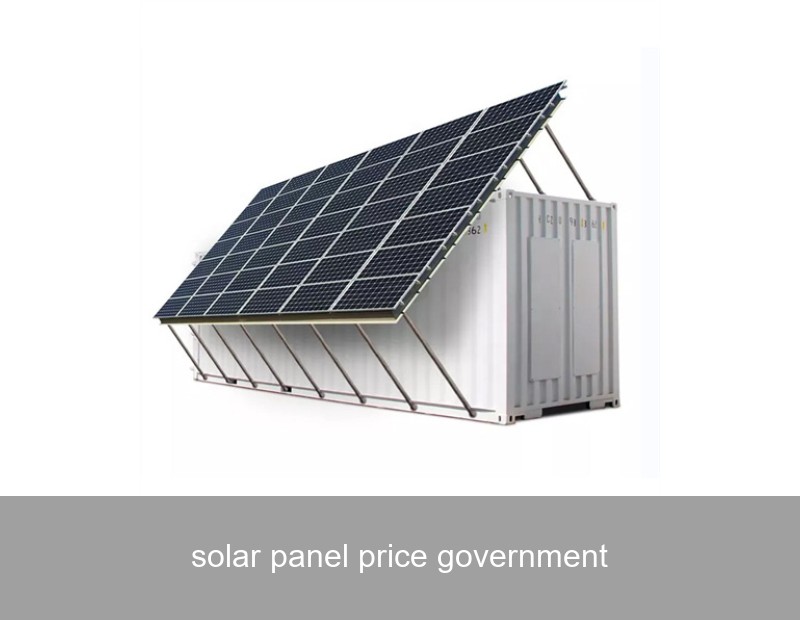
You've likely seen the headlines: solar energy is booming. But if you've also looked into installing a system, you know the upfront cost can be a significant hurdle. This is where solar panel price government incentives become a game-changer. Across Europe and the United States, national and local policies are actively working to lower the barrier to entry, making solar power more affordable than ever. However, navigating this landscape of rebates, tax credits, and regulations can feel overwhelming. This article will demystify how government actions directly influence what you pay for solar, showcase real-world impacts, and highlight how choosing the right technology partner maximizes your return on this powerful investment.
Table of Contents
The Solar Price Puzzle: More Than Just Hardware
When we talk about "solar panel price," it's crucial to look beyond the per-watt cost of the modules themselves. The final price tag for a functional solar system is a composite of hardware (panels, inverters, mounting), "soft costs" (permitting, inspection, installer labor), and the financing terms. Government policy intervenes at almost every single one of these points. For instance, streamlined local permitting processes can slash hundreds of dollars from an installation. On the other hand, tariffs on imported panels can increase hardware costs. Understanding this ecosystem is the first step to leveraging the available solar panel price government support effectively.
The Government's Toolbox: Levers That Pull Solar Panel Prices Down
Governments primarily use three powerful tools to make solar attractive: direct financial incentives, regulatory support, and market mechanisms.
1. Direct Financial Incentives
- Tax Credits and Rebates: The most direct impact on solar panel price government policy. In the U.S., the federal Investment Tax Credit (ITC) allows you to deduct a significant percentage of your system cost from your taxes. Many states offer additional rebates. In the EU, while there's no single credit, countries like Germany, Italy, and Poland offer substantial grants or VAT reductions.
- Net Metering & Feed-in Tariffs (FiTs): These policies don't lower the upfront cost but dramatically improve the payback period. Net metering allows you to sell excess power back to the grid, while FiTs guarantee a fixed, premium price for all the solar energy you generate.
2. Regulatory and Market Support
- Streamlined Permitting: Governments can mandate faster, online, and standardized permitting processes, significantly reducing "soft costs."
- Renewable Portfolio Standards (RPS): These laws require utilities to source a percentage of their power from renewables, creating guaranteed demand and fostering a competitive market that drives innovation and lowers long-term costs.
| Policy Type | How It Lowers Effective Cost | Example Regions |
|---|---|---|
| Investment Tax Credit (ITC) | Direct reduction of tax liability | United States (Federal) |
| Feed-in Tariff (FiT) | Guaranteed long-term revenue for generated kWh | Germany (historical), parts of the UK |
| VAT Exemption | Reduces the purchase price at point of sale | United Kingdom (0% VAT on solar) |
| Local Grant Programs | Direct cash rebate per kW installed | Many EU states, U.S. states like California |
Case Study: Berlin's Solar Acceleration
Let's look at a concrete example of solar panel price government action in Europe. In 2022, Berlin launched the "Solarcity Berlin" master plan, aiming for 25% of its electricity from solar by 2035. The strategy combines multiple policy tools:
- Mandatory Solar: A new solar mandate requires the installation of PV systems on all new buildings and major roof renovations.
- Financial Support: The city offers grants covering up to 30% of the investment cost for residential systems, with bonuses for storage integration.
- Simplified Processes: A dedicated "Solar Agency" acts as a one-stop shop for planning and permits.
The results? According to Berlin's Senate Department for Economics, Energy and Public Enterprises, the number of solar installations in the city saw a year-over-year increase of over 50% in 2023. This case shows how a holistic policy approach, targeting both demand (mandates) and cost (grants), can rapidly accelerate adoption. For a homeowner in Berlin, the effective "solar panel price" after the grant becomes a much more compelling investment, especially when paired with storage to maximize self-consumption of that solar energy.

Image: Modern solar installations in urban settings are increasingly common thanks to supportive policies. Source: Unsplash
Thinking Beyond the Panel: The Critical Role of Storage
Here's an insight many discover after installation: the true value of your solar system isn't fully unlocked without storage. Why? Because solar generation peaks during the day, while energy consumption often peaks in the morning and evening. Without a battery, excess solar energy is exported to the grid at a lower price than you buy it back for later. This is where the next layer of solar panel price government incentives is emerging: storage-specific grants and rebates.
Governments now recognize that solar + storage systems relieve grid stress, enhance energy security, and enable higher renewable penetration. For example, several U.S. states offer additional rebates for pairing storage with solar. In the UK, VAT on battery storage installations was recently reduced to 0% when coupled with solar. This evolution in policy shifts the conversation from the cost of panels alone to the value of an integrated, resilient energy system for your property.
How Highjoule Integrates with the Incentive Landscape
As a global leader in advanced energy storage since 2005, Highjoule's mission aligns perfectly with the goals of modern solar panel price government policies: to make sustainable, intelligent power solutions accessible and efficient. We don't just sell batteries; we provide integrated systems that ensure you extract maximum value from every solar panel and every kilowatt-hour generated.
Our H-Series residential and commercial battery systems are designed with smart energy management at their core. They seamlessly integrate with new or existing solar arrays, automatically optimizing when to store energy, when to use it, and when to sell it back based on your utility rates (including dynamic time-of-use rates). This intelligent operation directly amplifies the financial benefit of any net metering or feed-in tariff scheme.
For businesses and microgrids, our GridSynergy platform offers even more sophisticated control, allowing participation in grid services or maximizing self-consumption across large facilities. When you partner with Highjoule, you're not just buying hardware; you're gaining a technology partner that helps you navigate the complex incentive landscape to ensure your investment is future-proof and delivers the promised return, regardless of how policies may evolve.

Image: A modern home battery storage unit, similar to Highjoule's H-Series, enabling energy independence. Source: Unsplash
The Future of Solar Affordability
While incentives are crucial today, the long-term trend is clear: solar and storage costs will continue to fall due to technology improvements and economies of scale. However, government policy will remain a key driver in shaping the market and addressing equity. We can expect a shift from broad subsidies to more targeted incentives that encourage:
- Storage Integration: As seen, this is already happening.
- Grid Services: Compensating homeowners and businesses for using their battery systems to support grid stability.
- Low-Income Access: Specific programs to ensure the energy transition benefits all communities.
For authoritative data on solar cost trends and policy impacts, organizations like the International Energy Agency (IEA) and the U.S. National Renewable Energy Laboratory (NREL) provide excellent, up-to-date resources.
So, as you consider solar for your home or business, the most important question isn't just "what do the panels cost?" It's, "How can I design a system that leverages today's incentives to build resilient, long-term energy independence?" What's the first step you'll take to map out the available solar panel price government support in your region?
 Inquiry
 Online Chat