


Unlocking Rajasthan's Solar Potential: A Deep Dive into Solar Panel Schemes and Sustainable Energy Storage
Rajasthan, India's sun-drenched northwestern state, is undergoing a remarkable energy transformation. Blessed with some of the highest solar irradiance levels in the country, it has become a focal point for ambitious solar panel schemes in Rajasthan. These government-led and private initiatives are not just about installing panels; they represent a strategic shift towards energy independence and economic resilience. For a global audience in Europe and the US, understanding this model offers fascinating insights into how regions with abundant renewable resources can leverage smart technology to overcome intermittency and maximize returns. The real story, however, lies beyond generation—in how the captured energy is stored, managed, and turned into a reliable 24/7 power source. This is where advanced energy storage systems (ESS) become the critical linchpin for success.
Table of Contents
- The Rajasthan Solar Landscape: More Than Just Sunshine
- The Storage Imperative: From Intermittent to Intelligent
- How Highjoule's Technology Integrates with Solar Schemes
- Case Study: A Rajasthan Industrial Plant's Journey to Resilience
- Lessons for Global Markets: Europe and the US
- The Future Horizon: Smart Microgrids and Beyond
The Rajasthan Solar Landscape: More Than Just Sunshine
The numbers are staggering. Rajasthan has a solar power potential of over 142 GW, according to the National Institute of Solar Energy. To harness this, the state government's solar panel scheme in Rajasthan policies, like the Rajasthan Solar Energy Policy, offer subsidies, land incentives, and favorable tariffs. The result? Massive solar parks, like the Bhadla Solar Park—one of the largest in the world—and a growing adoption of rooftop solar by industries and households.
But here's the phenomenon every solar-rich region faces: the sun doesn't shine 24 hours a day. Generation peaks during midday, often creating a surplus, while demand typically spikes in the mornings and evenings. This creates a dual challenge: curtailment (wasting excess energy) and reliance on the conventional grid after dark.

This is the universal solar paradox. You generate immense clean power, but without a method to time-shift that energy, its value and reliability are limited. The data begins to tell this story. A study by the National Renewable Energy Laboratory (NREL) highlights that integrating storage can increase the value of solar PV by 20-50% depending on the market, by allowing it to serve peak demand periods.
The Storage Imperative: From Intermittent to Intelligent
Think of energy storage as a high-performance battery for your entire solar installation. It doesn't just store; it intelligently manages energy flow. For participants in any solar panel scheme in Rajasthan, whether a factory owner or a farm cooperative, adding storage transforms their solar asset:
- Energy Time-Shifting: Store cheap solar energy produced at noon and use it during expensive peak tariff hours in the evening.
- Grid Independence & Resilience: Maintain critical operations during grid outages, a vital feature for industrial and agricultural users.
- Grid Support: Advanced systems can help stabilize the local grid by providing frequency regulation and smoothing out solar power fluctuations.
This is no longer a futuristic concept. The global trend, from California to Germany, shows that solar-plus-storage is becoming the default standard for new installations. The technology that makes this seamless is the Battery Energy Storage System (BESS).
How Highjoule's Technology Integrates with Solar Schemes
At Highjoule, with nearly two decades of expertise since 2005, we've seen this evolution firsthand. Our role is to provide the intelligent layer that makes solar investments truly future-proof. For a region like Rajasthan, or for similar large-scale solar applications in Europe and the US, our systems offer tailored solutions.
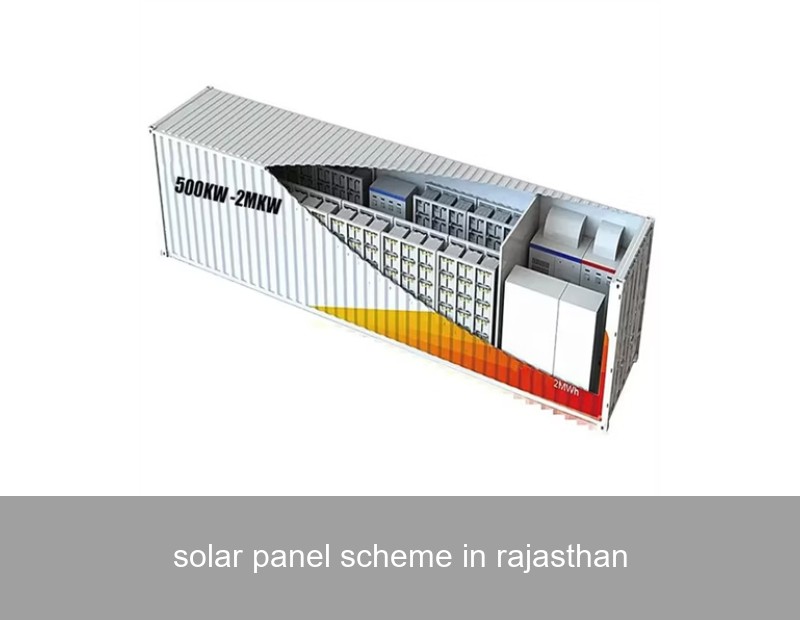
Our Highjoule H-IQ Commercial ESS is specifically engineered for the demands of solar integration. It's not just a container of batteries; it's an integrated power management platform. Featuring our proprietary battery management system (BMS) and AI-driven energy management software, it continuously learns energy usage patterns to optimize when to charge from solar, when to discharge, and when to interact with the grid.
For industrial users participating in solar panel schemes in Rajasthan, this means maximum return on investment (ROI). The system can be programmed to automatically avoid peak demand charges, which can constitute a significant portion of an electricity bill. Furthermore, our modular design allows for scalable deployment, from bolstering a rural microgrid to supporting a full-scale manufacturing plant.
Case Study: A Rajasthan Industrial Plant's Journey to Resilience
Let's look at a real-world application. Consider a textile manufacturing unit in Jodhpur, Rajasthan. The facility installed a 500 kW rooftop solar PV system under the state's net metering policy. While this reduced daytime grid consumption, they still faced high costs during evening operations and were vulnerable to frequent grid instability, which disrupted sensitive machinery.
The Challenge: To reduce overall energy costs, achieve greater energy self-sufficiency, and ensure uninterrupted production during grid outages.
The Solution with Highjoule: The plant integrated a 250 kW / 500 kWh Highjoule H-IQ Commercial ESS with their existing solar array. The system was configured for peak shaving and backup power.
| Metric | Before Highjoule ESS | After Highjoule ESS Integration |
|---|---|---|
| Grid Energy Consumption (Peak Hours) | 70% of peak load from grid | 20% of peak load from grid |
| Solar Self-Consumption Rate | ~65% | Over 95% |
| Annual Demand Charge Savings | Baseline | Approx. 28% reduction |
| Backup Power for Critical Loads | None (Diesel Generator only) | Seamless 4-hour backup, zero diesel use for short outages |
The Outcome: The payback period for the combined solar-plus-storage system was significantly shortened due to the dual savings from energy and demand charges. The plant manager noted not only improved financials but also a substantial reduction in their carbon footprint and enhanced operational reliability. This case mirrors challenges faced by industries worldwide, demonstrating a replicable model.

Lessons for Global Markets: Europe and the US
The Rajasthan example is a microcosm of a global shift. In Europe, the energy crisis underscored the need for energy sovereignty. Homeowners and businesses are rapidly moving towards solar-plus-storage to reduce dependence on volatile gas prices. Highjoule's Residential ESS line, with its sleek design and smart home integration, caters to this market by allowing users to maximize their self-consumption of rooftop solar, much like a homeowner in Jaipur would want to do.
In the US, particularly in states like California and Texas, incentives like the Investment Tax Credit (ITC) now explicitly include standalone storage. The focus is on grid resilience against wildfires and extreme weather. Highjoule's Microgrid Controllers and large-scale Containerized BESS solutions provide the backbone for community resilience hubs and commercial virtual power plants (VPPs), aggregating distributed energy to support the grid—a concept equally applicable to Rajasthan's growing solar clusters.
As noted by the International Energy Agency (IEA), energy storage is the key to accelerating the transition to renewables, and policy frameworks are increasingly catching up to this reality worldwide.
The Future Horizon: Smart Microgrids and Beyond
The logical evolution of a successful solar panel scheme in Rajasthan is the development of smart, decentralized microgrids. Imagine a cluster of villages or an industrial estate powered primarily by local solar resources, with Highjoule's storage systems providing the buffer and intelligence to manage the flow internally, only interacting with the main grid as a backup or for energy trading.
This vision of a democratized, resilient energy network is what drives innovation at Highjoule. Our systems are designed to be the building blocks of this future, whether in the Rajasthani desert, a European suburban community, or a Californian university campus.
An Open Question for Your Consideration
As you look at the energy landscape in your own region—be it facing rising costs, reliability concerns, or sustainability goals—what would be the primary driver for you to consider making the leap from solar generation alone to a fully integrated solar-plus-storage system? Is it financial ROI, energy security, or environmental impact that weighs most heavily in your decision?
 Inquiry
 Online Chat