


Understanding Solar Plant Price for Home: A Smart Investment Guide
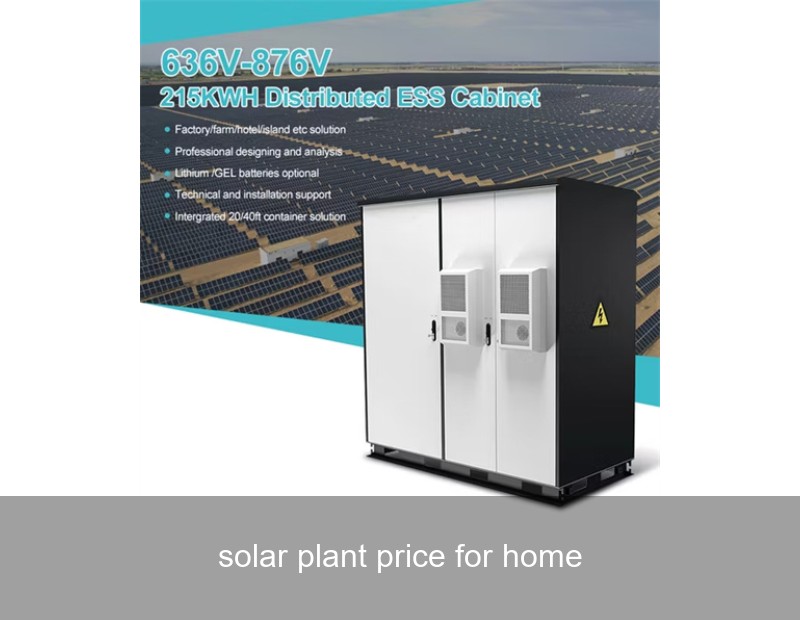
So, you're thinking about harnessing the sun's power for your home. The idea is exciting: lower electricity bills, energy independence, and a positive step for the planet. But the first question that comes to mind for most homeowners is, "What's the real solar plant price for home installation?" It's a crucial question, and the answer isn't a single number. The cost is an equation, influenced by your energy needs, location, equipment choices, and the long-term value it brings. Let's demystify the pricing and explore how a home solar system is less of an expense and more of a strategic investment in your property and future.
Breaking Down the Solar Plant Price for Home
In the U.S. and Europe, a typical residential solar power system (or "solar plant" for your home) is priced as a complete package. Think of it as buying a car—you pay for the engine, the chassis, the interior, and the labor to put it all together. As of 2024, the average gross cost for a 6-kilowatt (kW) system in the United States ranges between $16,000 and $21,000 before incentives. In Europe, prices vary significantly by country but often fall within a similar range per watt installed.
This package generally includes:
- Solar Panels (Photovoltaic Modules): The most visible component, converting sunlight into DC electricity.
- Inverters: The "brains" that convert DC electricity from the panels into usable AC electricity for your home.
- Mounting System & Racking: The hardware that securely attaches the panels to your roof or ground.
- Electrical Components & Wiring: All the necessary safety switches, conduits, and cables.
- Permitting, Design, and Installation Labor: Professional services to ensure the system is safe, compliant, and optimized.
However, this is just the starting point. The true value and performance—and therefore the real cost-effectiveness—are determined by what happens when the sun isn't shining.
Image: A modern home solar installation. The panels are just one part of the overall system value.
Key Factors Influencing Your Final Quote
Why can two neighbors get different quotes for seemingly similar systems? Several variables are at play:
| Factor | Impact on Price & Performance |
|---|---|
| System Size (kW) | Larger systems to offset high energy use cost more upfront but deliver greater long-term savings. |
| Panel Efficiency & Brand | High-efficiency panels (e.g., monocrystalline) cost more per panel but produce more power in limited space. |
| Inverter Type | Microinverters (per-panel) optimize shade handling but are pricier than string inverters. |
| Roof Complexity | Steep pitches, multiple angles, or fragile materials increase installation labor and time. |
| Local Market & Labor Rates | Installation costs vary by region due to competition, permitting fees, and labor costs. |
Beyond Panels: The Critical Role of Energy Storage
This is where the modern home solar conversation evolves. A system without storage is like having a rainwater tank with a hole in the bottom—you use it as it comes, losing the excess. Adding a battery energy storage system (BESS) transforms your solar plant into a true personal power station. It allows you to:
- Store Excess Energy: Use your solar power at night or during cloudy days.
- Gain Energy Independence: Reduce reliance on the grid, especially during peak rate periods.
- Ensure Backup Power: Keep essential appliances running during grid outages.
While adding storage increases the initial solar plant price for home projects, it dramatically increases the system's utility and financial return. This is the domain where companies like Highjoule excel. As a global leader in advanced energy storage since 2005, Highjoule specializes in integrating intelligent battery systems with residential solar installations. Their HomePower Stack series is designed for seamless compatibility, offering scalable storage that lets you start small and expand as your needs grow, ensuring your investment is future-proof.
A Real-World Case Study: The Thompson Family in Arizona, USA
Let's look at concrete data. The Thompson family in Phoenix, Arizona, installed a 8.2 kW solar system in 2022. Their goal was to eliminate their high summer cooling bills and gain backup power.
- System: 8.2 kW solar array + 13.5 kWh Highjoule HomePower Stack battery.
- Total Gross Cost: $31,500.
- After Federal ITC (30%): Net cost fell to $22,050.
- Annual Savings: Their first-year electricity bill savings were $2,400. They also avoided multiple "demand charge" peaks from their utility.
- The Clincher: During a 5-hour grid outage in July 2023, their home maintained power for refrigeration, cooling (set at 78°F), and all lights, while neighbors without storage faced discomfort and spoiled food.
Their simple payback period is now projected at under 9 years, and with a system lifespan of 25+ years, that's over 16 years of essentially free, resilient power. The battery wasn't just an add-on; it was the key to maximizing the value of every solar panel.

Image: A modern home battery storage unit, like Highjoule's HomePower Stack, installed neatly in a garage.
Financing Options and Long-Term Value
The sticker price doesn't have to be a barrier. Multiple pathways exist:
- Cash Purchase: Highest long-term savings, owning the system outright.
- Solar Loan: Monthly payments often lower than your old electricity bill, with ownership at the end.
- Leases/PPAs (Power Purchase Agreements): Little to no upfront cost, but you pay for the power produced, typically with less financial benefit than ownership.
Furthermore, incentives dramatically reduce net cost. In the U.S., the Federal Investment Tax Credit (ITC) currently offers a 30% tax credit. Many states and utilities offer additional rebates, especially for systems paired with storage. In Europe, schemes like national grants and favorable feed-in tariffs (though declining) still apply in many regions.
It’s vital to think in terms of Levelized Cost of Energy (LCOE)—the average cost per kWh over the system's life. For a well-designed home solar + storage system, the LCOE is often already lower than retail electricity rates in many parts of the U.S. and Europe, and this gap is widening as utility rates rise.
Choosing the Right Technology Partner
Your solar plant price for home should reflect quality, safety, and intelligence. This is where partnering with an experienced provider like Highjoule makes a profound difference. Beyond supplying top-tier battery storage, Highjoule's approach involves:
- Smart Energy Management: Their systems use AI-driven software to optimize when to store, use, or even sell back energy based on weather forecasts and your tariff, squeezing maximum value from every watt.
- Scalability: Start with what you need now. The modular design of Highjoule systems allows you to easily add more battery capacity later as your family's EV adoption or energy needs grow.
- Full-System Integration: They work with certified installers to ensure the solar inverters, batteries, and home energy management system communicate flawlessly for reliable, safe operation.
Ultimately, the question isn't just "What does it cost?" but "What is it worth?" A home solar and storage system is an investment in predictable energy costs, increased property resilience, and personal contribution to a sustainable grid. The technology is proven, the economics are sound, and the value extends far beyond the monthly bill.
Ready to calculate what your personalized solar and storage solution could look like? What's the one energy worry—be it blackouts, rising rates, or carbon footprint—that you'd most like to solve with your own home power plant?
 Inquiry
 Online Chat