


Solar Power Kit How Much? Your Complete Guide to Costs and Value in 2024
So, you're thinking about harnessing the sun's energy and asking the big question: "A solar power kit, how much will it actually cost me?" You're not alone. With rising electricity prices and a growing desire for energy independence, this is one of the smartest home improvement questions you can ask today. But the answer isn't a single number. It's a journey from initial investment to long-term savings, and it depends heavily on the quality, completeness, and intelligence of the system you choose. Let's demystify the costs and explore what truly makes a solar investment worthwhile.
Table of Contents
The Real Cost Puzzle: More Than Just Panels
The first price you see online for a "solar kit" can be misleading. Often, it covers only the basic components: panels and a basic inverter. The real-world cost of a functioning, resilient, and efficient home energy system includes several critical layers. Think of it like buying a car—the base model gets you moving, but the features that ensure safety, comfort, and performance on your specific roads are what create true value. For solar, this means considering energy storage, intelligent management, installation, and long-term service.
The Phenomenon: Sticker Shock vs. System Shock
Many homeowners experience initial "sticker shock" at the quote for a full system, only to face "system shock" later if they opted for a cheaper, less capable setup that doesn't meet their needs during a blackout or on cloudy winter days. The key is to shift the question from "How much does it cost?" to "What value does it deliver over 20+ years?"
Breaking Down the Price of a Solar Power Kit
To understand "how much," we need a clear breakdown. For a typical residential installation in Europe or the U.S., costs are influenced by system size, component quality, and regional labor rates.
| System Component | Cost Range (USD/EUR) | Percentage of Total | Why It Matters |
|---|---|---|---|
| Solar Panels (Photovoltaic Modules) | $4,500 - $6,000 | 25-30% | High-efficiency panels generate more power in limited space. |
| Inverter(s) & Power Electronics | $1,500 - $2,500 | 10-15% | Converts DC to usable AC power; the "brain" of the solar side. |
| Battery Energy Storage System (BESS) | $6,000 - $12,000+ | 35-50% | The game-changer. Stores excess energy for use at night, during outages, or peak tariff times. |
| Balance of System (Mounting, Wiring) | $1,000 - $2,000 | 5-10% | Physical hardware for safe, secure installation. |
| Installation & Permitting | $3,000 - $5,000 | 15-25% | Professional expertise ensures safety, compliance, and performance. |
| Total Installed Cost | $16,000 - $27,500+ | 100% | Varies by location, component brands, and system complexity. |
Source: Compiled from U.S. Department of Energy and European market data, 2024.
As you can see, the battery storage system is a significant portion of the investment. This is where the real transformation happens—from simply offsetting daytime grid use to achieving true energy autonomy and resilience.

Image Source: Unsplash (Professional photography of residential solar and storage)
The Hidden Value Factor: It's All About the Battery
Let's talk about the heart of a modern solar power kit: the battery. A solar-only system exports your excess energy to the grid, often for a low feed-in tariff. With a battery, you store that precious energy for yourself. This simple change unlocks multiple value streams:
- Maximized Self-Consumption: Use 70-80% of your solar energy directly, drastically cutting grid purchases.
- Backup Power: Keep your lights on and fridge running during grid outages—a critical feature becoming more valuable as noted in reports on grid resilience (IEA, 2023).
- Peak Shaving: Avoid drawing power from the grid during expensive peak-rate hours.
The technology inside the battery matters immensely. Lithium Iron Phosphate (LFP) chemistry, for instance, is now the gold standard for safety, longevity, and performance across more charge cycles.
A Real-World Case Study: A German Household's Journey
Let's make this concrete with data from a real installation. The Schmidt family in Bavaria, Germany, installed a 8.2 kWp solar array with a 10 kWh battery storage system in early 2022.
- Goal: Achieve energy independence and prepare for planned local grid outages.
- Previous Annual Consumption: 5,800 kWh
- System Cost (after tax incentives): €21,500
- 12-Month Result:
- Grid Import Reduced by 92%: From 5,800 kWh to under 500 kWh.
- Self-Consumption Rate: 78% of all solar energy produced was used directly in the home or stored.
- Outage Protection: System provided seamless backup during two grid maintenance blackouts, totaling 8 hours.
- Payback Estimate: With high German electricity prices (~€0.40/kWh), the system is projected to pay for itself in less than 9 years, delivering over 15 years of virtually free electricity thereafter.
This case shows that the upfront cost, while substantial, is a capital investment that actively generates savings and security for decades.
Highjoule: Your Partner in Maximizing Solar Value
This is where Highjoule's expertise transforms the equation. Since 2005, we've moved beyond selling simple components to providing integrated, intelligent energy solutions. We understand that "solar power kit how much" is really a question about value, and we engineer that value into every system.
For homeowners, our Residential Energy Ecosystem is a seamless package. It combines high-efficiency bifacial or monocrystalline panels with our flagship HiveCore™ Home Battery System. The HiveCore uses stable LFP chemistry and features an integrated AI-powered energy manager that learns your household patterns. It automatically decides when to store solar energy, power your home, or sell back to the grid at the optimal time, maximizing your financial return.

Image Source: Unsplash (Representative image of a modern home battery system)
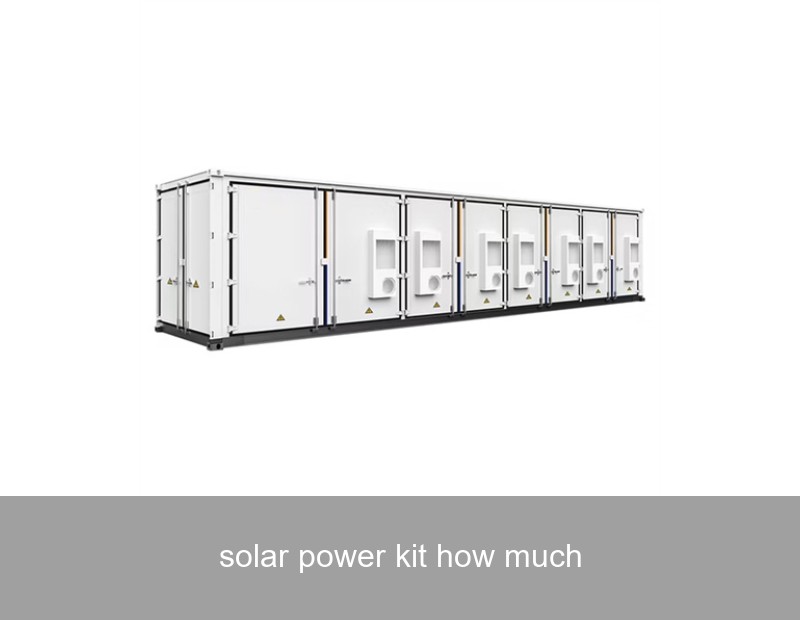
For businesses and microgrids, our Industrial & Commercial (I&C) and Microgrid Solutions offer scalable, containerized battery storage that stabilizes grids, reduces demand charges, and integrates renewable sources flawlessly. Our systems are designed for the rigorous demands of daily cycling and provide critical backup power for operational continuity.
The Highjoule Difference: Intelligence and Integration
Our systems are future-proof. With software-upgradable features and compatibility with emerging smart home standards, a Highjoule installation today adapts to the energy market of tomorrow. We handle the entire process—design, permitting support, installation by certified partners, and ongoing monitoring via our Highjoule Pulse™ platform.
Making the Right Investment for Your Home
So, when you ask "solar power kit how much?", we encourage you to have a conversation with a certified energy advisor. The right questions to ask are:
- What is my total household energy consumption (kWh) over the past year?
- What are my primary goals: reducing bills, backup power, environmental impact, or all three?
- Does the proposed system include intelligent storage and management, or just panels?
- What is the warranty on the battery's performance and longevity (e.g., 10 years at 70% capacity)?
With incentives like the U.S. federal Investment Tax Credit (ITC) and various European subsidies, the net cost of a high-value system like Highjoule's is more attractive than ever.
Ready to move beyond the initial price tag and calculate the lifetime value for your specific home? What's the first thing you'd want to power during a blackout?
 Inquiry
 Online Chat