


Solar Power Per Unit Cost: Your Guide to Understanding and Optimizing Your Investment
Let's talk about a number that's on the mind of every business leader, homeowner, and energy manager considering solar: the solar power per unit cost. Often referred to as the Levelized Cost of Energy (LCOE), this isn't just the price tag on the panels. It's the total lifetime cost of your solar energy system divided by the total energy it will produce. Think of it as the "price per kilowatt-hour" for the sun's power over 25+ years. For years, the narrative has been simple: solar costs are falling. But with fluctuating material prices, grid complexities, and the critical need for reliability, the modern conversation is shifting from just installing solar to optimizing it. This is where understanding the true solar power per unit cost becomes your most powerful tool for a sustainable and economical energy future.
Table of Contents
Breaking Down the Solar Power Per Unit Cost
So, what exactly goes into this crucial metric? The solar power per unit cost (LCOE) is calculated by considering all costs over the system's life—installation, financing, maintenance—and balancing them against the total electricity generated. Here's a simplified breakdown:
| Cost Component | Description | Impact on Per-Unit Cost |
|---|---|---|
| Capital Costs (CAPEX) | Solar panels, inverters, mounting, installation labor. | High initial impact, but spread over decades. |
| Operational Costs (OPEX) | Cleaning, monitoring, insurance, routine maintenance. | Ongoing, typically low for solar alone. |
| Performance & Location | Sunlight hours, panel efficiency, system degradation. | Directly determines total energy output denominator. |
| Financing | Interest rates, loan terms, incentives (ITC, rebates). | Can significantly raise or lower the lifetime cost. |
According to Lazard's 2023 Levelized Cost of Energy Analysis, the unsubsidized LCOE for utility-scale solar has plummeted by over 90% since 2009. This is phenomenal news. However, for commercial and industrial (C&I) users, the story is more nuanced. Your solar power per unit cost is fantastic when the sun shines, but what about the evening peak demand charges? Or those cloudy days when you're forced to buy expensive grid power? This mismatch between solar production and energy consumption patterns creates a hidden cost that isn't always captured in simple LCOE models.

While utility-scale solar costs have fallen, C&I users need to consider their specific load profiles to calculate true cost savings.
The Game-Changer: How Storage Drives Down Your Effective Cost
This brings us to the pivotal innovation in energy economics: battery energy storage systems (BESS). Adding storage is the key to unlocking the lowest possible effective solar power per unit cost. Why? Because it transforms solar from a intermittent source into a dispatchable one.
- Arbitrage: Store cheap solar energy at noon and use it during expensive peak-rate hours in the evening.
- Demand Charge Reduction: Slash high monthly charges based on your highest 15-minute power draw by discharging the battery during short demand spikes.
- Increased Self-Consumption: Use more of the solar energy you produce on-site, instead of selling it back to the grid at lower rates.
- Backup Power: Mitigate the cost of outages, ensuring business continuity without the fuel and maintenance costs of traditional generators.
When you integrate storage, you're not just adding a cost component; you're adding a value-optimization engine. The battery increases the utilization and economic value of every kilowatt-hour your solar panels produce, thereby lowering the overall solar power per unit cost from the perspective of your total energy bill.
Real-World Impact: A German Manufacturing Case Study
Let's look at a concrete example from Bavaria, Germany. A mid-sized automotive parts manufacturer installed a 500 kW rooftop solar array in 2020. While it reduced their base energy purchase, they still faced significant peak demand charges and couldn't shift their energy-intensive presses to only sunny hours.
In 2022, they partnered with Highjoule to integrate a 372 kWh Highjoule CubeStack battery storage system. Here are the results after one year of operation:
- Solar Self-Consumption Rate: Increased from 35% to over 80%.
- Peak Demand Charges: Reduced by an average of 40% month-over-month.
- Effective Cost of Solar+Storage Energy: The combined system achieved an effective LCOE of €0.08/kWh, compared to their average grid purchase price of €0.32/kWh (including all charges and taxes).
- ROI Period: Projected to be under 7 years, thanks in part to Germany's supportive regulatory environment for storage.
This case shows that the true metric of success isn't just the standalone solar power per unit cost, but the optimized energy cost per unit delivered by a smart, integrated system.
The Highjoule Solution: Intelligent Systems for Optimal Cost
At Highjoule, we've been at the forefront of this evolution since 2005. We understand that minimizing your solar power per unit cost is an engineering and intelligence challenge. Our approach goes beyond providing components; we deliver integrated, smart systems designed for maximum economic return.
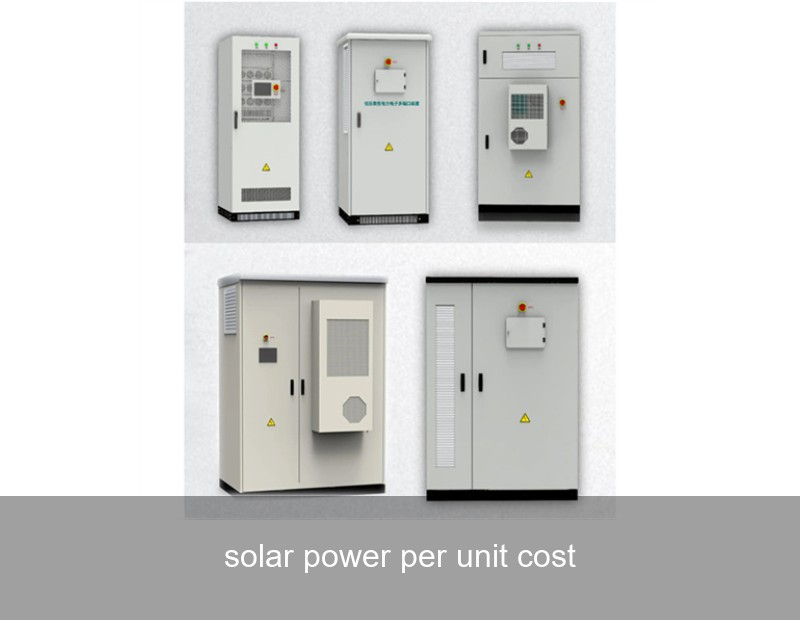
Our flagship product, the Highjoule EnergiPak, is a modular, containerized BESS built with lithium iron phosphate (LFP) battery chemistry, renowned for its safety, longevity (over 10,000 cycles), and stable performance. Paired with our Highjoule Apex Energy Management System (EMS), it becomes the brain of your energy ecosystem.

Intelligent energy management systems are crucial for dynamically optimizing energy flow and cost.
The Apex EMS uses AI-driven forecasting to predict solar generation, facility load, and grid pricing. It automatically decides, in real-time, the most cost-effective action: charge from solar, discharge to shave peak, or participate in grid services where available. This continuous optimization ensures that your combined solar and storage assets are always working to drive down your effective cost per kilowatt-hour.
For commercial, industrial, and microgrid applications, this intelligence is what separates a simple solar investment from a strategic energy asset. We provide full lifecycle support—from design and financing assistance to commissioning and remote monitoring—ensuring your system delivers on its promised economics for decades.
Key Features that Lower Total Cost of Ownership:
- Modular Design: Scale your storage capacity as your needs grow, protecting your initial investment.
- Advanced Thermal Management: Extends battery life and maintains efficiency in diverse climates, crucial for both European winters and American summers.
- Grid-Forming Inverter Technology: (For microgrids) Allows the system to "island" and provide stable power independently, adding immense value for resilience.
Future Trends Affecting Your Solar Economics
The journey to lower solar power per unit cost continues. Several trends will shape your decisions:
- Volatile Grid Prices: As seen in recent U.S. Energy Information Administration (EIA) reports, electricity price volatility is increasing. Solar-plus-storage provides a predictable, long-term hedge.
- Grid Service Markets: In many U.S. regions and parts of Europe, batteries can earn revenue by providing frequency regulation or capacity services, creating a new income stream that further offsets costs.
- Technology Advancements: Continued improvements in solar cell efficiency (like perovskite tandem cells) and even higher-density batteries will slowly push LCOE lower, but the integration intelligence will remain the key differentiator.
The most forward-thinking organizations are now modeling their energy projects not on payback period alone, but on lifetime value, risk mitigation, and sustainability goals. The question is no longer "Can we afford solar?" but "What is the optimal mix of solar, storage, and intelligence to secure our energy future at the lowest possible cost?"
 Inquiry
 Online Chat